Fascinated by Gallo-Roman history? Click Here to download > > > Here are 6 ways Rome affected France





Follow me on
- Home ›
- Destinations ›
- Northern France ›
- Belleau Wood
Belleau Wood: Where the US Marines Made History
Published 21 October 2026 by Leyla Alyanak — Parisian by birth, Lyonnaise by adoption, historian by passion
Belleau Wood, near Château-Thierry in the Aisne department of northern France, was where US Marines helped halt a German advance toward Paris in 1918. One of America's first major battles of World War I, it helped establish the Marines' reputation. Today, visitors can walk through the battlefield and its American cemetery, reminders of the human cost of the war.
There is something unsettling about walking through Belleau Wood.
It's peaceful now, with trees growing where artillery once tore through the forest. If you didn't know what happened here in June 1918, you might think you were simply taking a stroll through a clump of serene woods in the French countryside.
But look more closely.
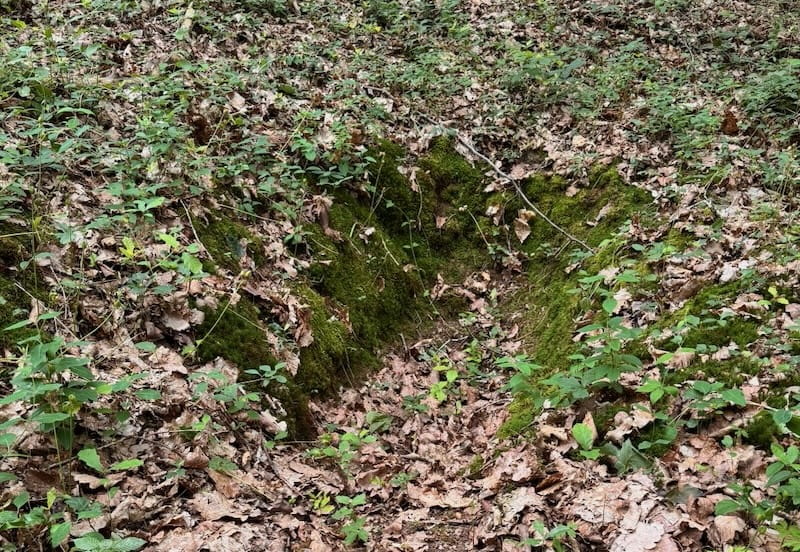 You can still see foxholes scattered throughout Belleau Wood ©OffbeatFrance
The ground isn't smooth – it is pitted with depressions left by exploding shells. Remnants of trenches criss-cross the grass, tracing the positions soldiers fought over more than a century ago.
I visited Belleau Wood and the adjoining Aisne-Marne American Cemetery with a guide. It's one of those places where having someone explain what you're looking at makes a huge difference, however much or little you know about World War I.
World War I was cataclysmic – it brought down empires and redrew the map of Europe, helping create the political tensions that would lead to another world war just 20 years later. For the United States, it marked a significant step toward becoming a world power.
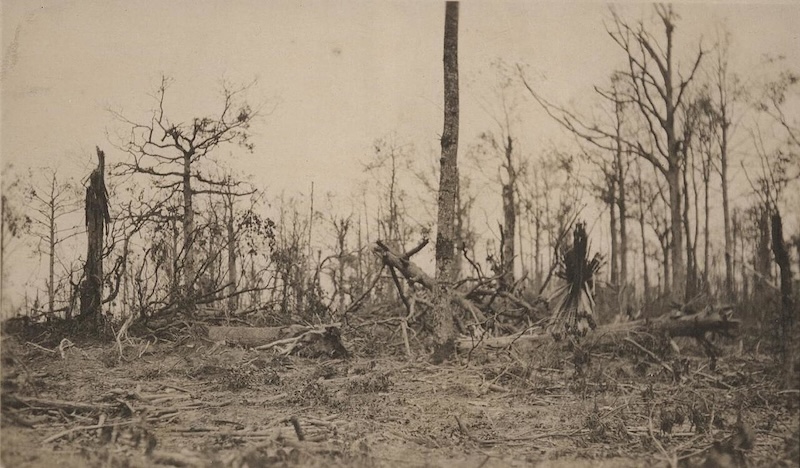 Shell-torn trees in Belleau Wood following the nearly month-long battle. Photo Adolph B. Miller (COLL/1068) - USMC Archives
In France, the consequences of that war have not disappeared even after more than a century. Towns and villages were destroyed and entire stretches of countryside became battlefields, with scars still visible today. Hundreds of thousands of soldiers were buried far from home; visit northern France today and you'll find their cemeteries and memorials almost everywhere.
Belleau Wood was a small but important part of that war.
It was also one of the first places where American troops played a major role against the German army. With German forces advancing toward Paris, the Americans were beginning to make a difference — both to France's defense and to their own military reputation.
NOTE: Pages on this site may contain affiliate links, which support this site. See full Privacy Policy here.
The meaning of Belleau Wood
First, a little background.
By the spring of 1918, World War I had been dragging on for nearly four years. What began with the assassination of an Austrian archduke in 1914 had escalated into a war involving countries around the world, with Germany and its co-belligerents fighting France, Britain and their allies. Millions had died, and much of northern France had become a battlefield. France and Britain were exhausted, and Germany was desperate to win before enough American troops arrived in Europe to give the Allies the decisive advantage.
The United States had entered the war in April 1917, but transporting and training an army for combat in Europe took time.
In late May 1918, German forces launched a major offensive in northern France. It began at the Chemin des Dames, a ridge farther north where a disastrous French offensive had taken place the previous year. Within days, German troops had pushed south to the Marne around the town of Château-Thierry, threatening Paris.
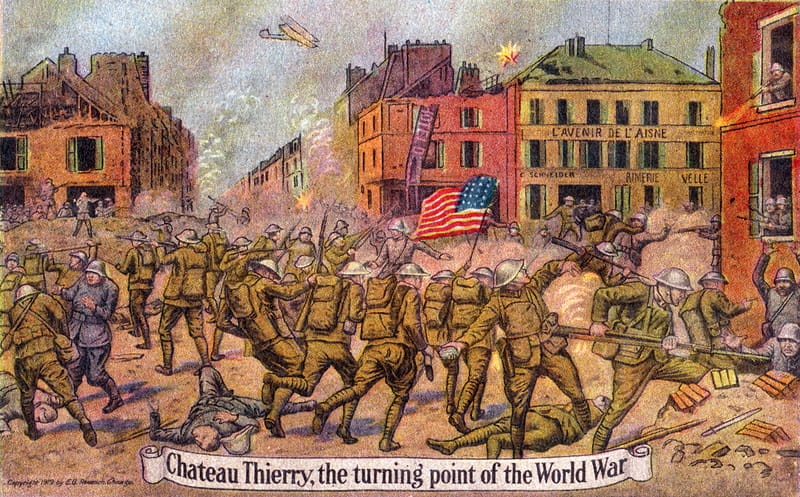 Postcard depicting the World War I Battle of Château-Thierry
Just northwest of town was Belleau Wood, occupied by seasoned German troops, which the American Marines were supposed to drive out. For many Americans, this was their first experience of major combat against an experienced German army, but their arrival provided much-needed support to the weary French and Britons.
The woodland was a difficult place to fight: the trees limited visibility, and soldiers had to work their way through fallen branches and smoke. The ground was uneven, churned upd by shellfire during the fighting.
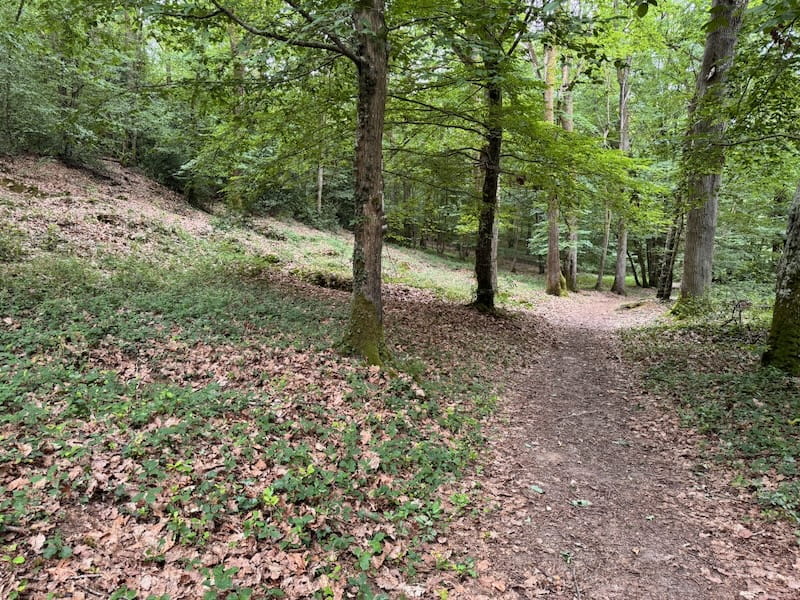 A peaceful Belleau Wood today, but you can still see craters in the distance ©️OffbeatFrance
All this made advances on German machine-gun positions extremely dangerous as soldiers moved forward without knowing exactly where the enemy was. In some places, opposing positions were so close that soldiers could hear one another speaking at night.
What happened here in June 1918?
On 6 June 1918, American Marines began attacking the German soldiers occupying Belleau Wood. It took three weeks of fierce fighting, and some areas had to be captured more than once before the Americans finally drove the Germans out of Belleau Wood.
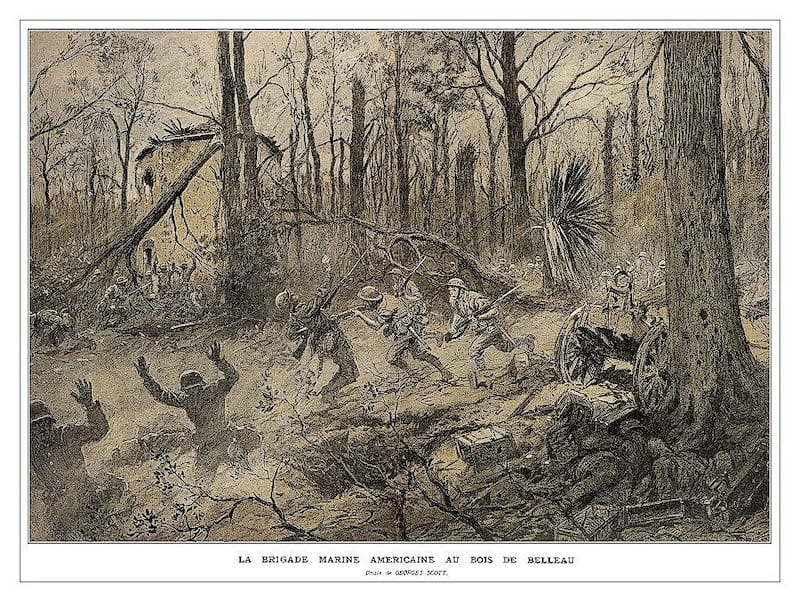 US Marines at Belleau Wood (1918)
The cost was appalling. On the first day of the assault, the Marines suffered more deaths than on any previous single day in their history. Their determination during the weeks that followed helped establish the reputation for which the Corps is still known.
The US Army's 2nd Division, which included the Marine brigade, suffered more than 8000 casualties — men killed, wounded or missing — during the wider fighting in the area in June 1918.
Four days after the battle ended, the French Army officially renamed the forest Bois de la Brigade de Marine — Wood of the Marine Brigade — in recognition of the Marines' contribution.
The Marine memorial
There's a memorial in the woodland that commemorates the Marines who fought here.
You'll find it beside the flagpole in the clearing where the road passes through the wood. It is a bronze bas-relief mounted on a dark stone memorial showing a Marine advancing with his rifle and bayonet.
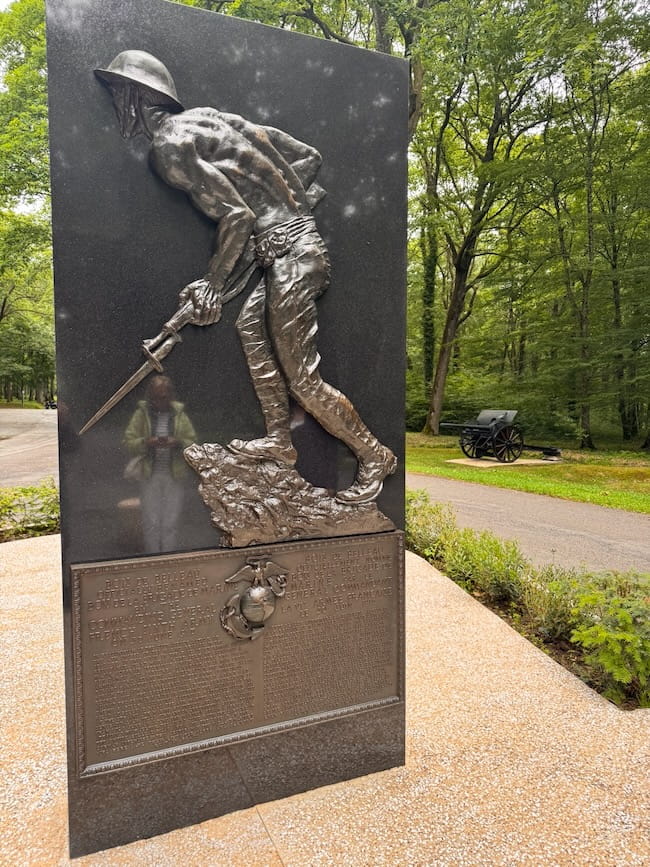 Belleau Wood Marine Memorial ©️OffbeatFrance
Nearby are artillery pieces, reminders of the weapons used in the battle. But what stayed with me most was the landscape itself: the exposed fields, the trees that hid the enemy, the foxholes, the thought of soldiers so close they could hear one another's voices at night.
WERE THE MARINES REALLY CALLED DEVIL DOGS?
One of the best-known stories associated with Belleau Wood is that German soldiers were so impressed by the ferocity of the American Marines that they called them Teufelshunde, or Devil Dogs.
But did German soldiers actually use the nickname? Its supposed German origin is difficult to establish, even though Devil Dogs became an enduring part of Marine Corps identity.
Another celebrated line supposedly came from Marine Captain Lloyd Williams when a French officer suggested withdrawing in the face of the German advance:
“Retreat? Hell, we just got here!”
The words have become inseparable from Belleau Wood.
Whether every detail of these stories is accurate or not, they do say a lot about the reputation the Marines established here.
The Aisne-Marne American Cemetery
At the foot of Belleau Wood is the Aisne-Marne American Cemetery, the perfect next stop after walking through the battlefield (although you can't walk through – you'll have to drive around).
The cemetery covers more than 42 acres, with rows of white headstones sweeping around a hillside. There are 2289 American war dead buried here, most of whom died during the fighting in the summer of 1918, although some died of disease, including the influenza pandemic.
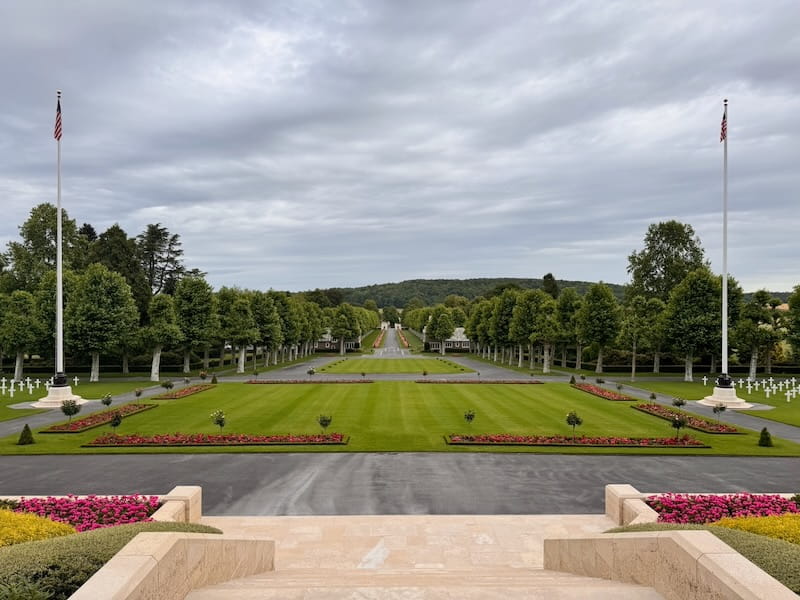 Aisne Marne American Cemetery ©️OffbeatFrance
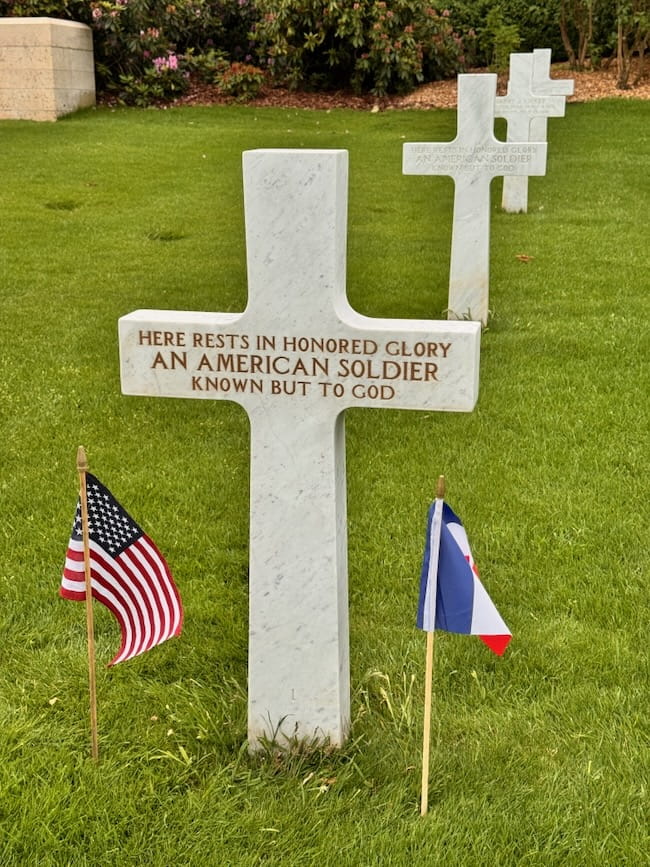
More than 200 of the graves belong to unidentified soldiers whose names may never be known. But one thing we do know is that each soldier, named or not, had a life somewhere else, thousands of miles from this French hillside.
Above the graves you'll find the cemetery's memorial chapel.
Inside are the names of 1060 American service members who were missing in action and whose remains had not been identified when the memorial was built (some have since been found). A small rosette next to a name means that the person's remains were subsequently recovered and identified.
The chapel also reminds us unexpectedly of another war: during fighting in 1940, the building was damaged and while most of it was repaired, one shell hole was deliberately left visible, a World War II scar in a World War I memorial.
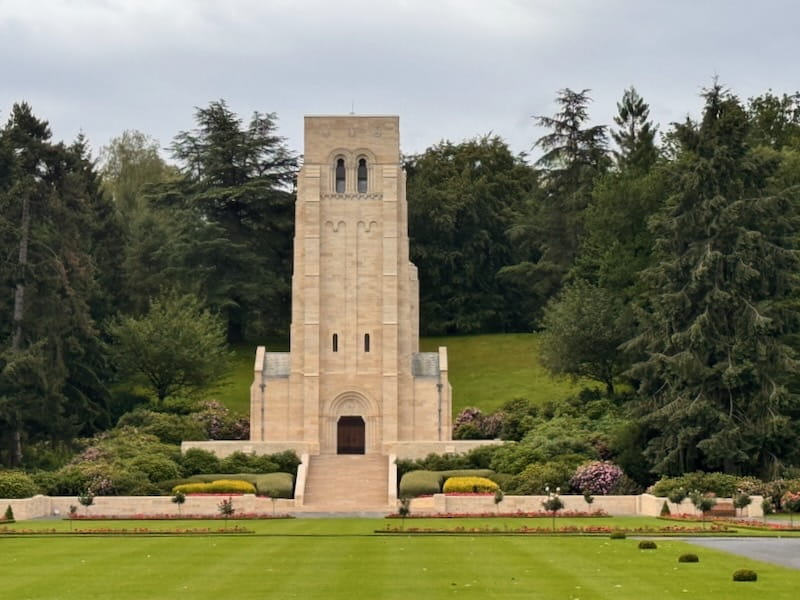 The Memorial Chapel at the cemetery ©OffbeatFrance
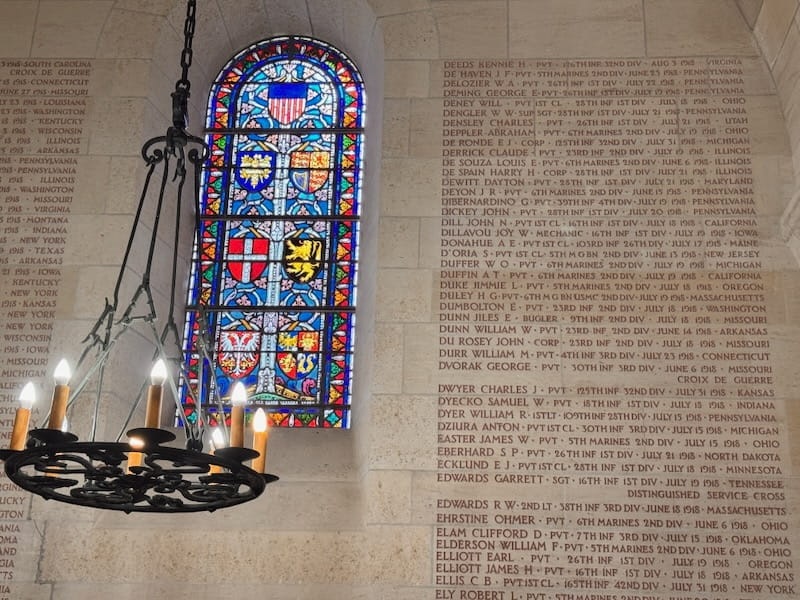
The cemetery is maintained by the American Battle Monuments Commission, the US government agency responsible for American military cemeteries and memorials overseas. It has a visitor building staffed with people who can help visitors locate individual graves and explain the history of the site.
If you're looking for a particular service member, you can also use the ABMC burial search before you travel.
And people still come, roughly 30-40 a year, to visit relatives buried here, generations after the war.
A battlefield where the war isn't entirely over
There are many stories connected with Belleau Wood.
One of the stories my guide told during my visit concerned a very young American named John DeHaven, who enlisted at just 14, lying about his age and telling his mother he was leaving home to work.
He went to war instead.
The story says he died at Belleau Wood the day after his 16th birthday.
Another involves human remains discovered in 2005 near the edge of the wood after a farmer plowed a field. These possibly belonged to at least three soldiers, two of them German and one perhaps a Marine. It is a reminder that the battlefield still contains traces of men from both sides who disappeared during the fighting.
Objects are still found as well, including bullets embedded in trees. If you find anything, leave it where it is and report potentially dangerous discoveries to the visitor center.
Belleau Wood and the town of Château-Thierry
The fighting extended well beyond Belleau Wood, and the nearby town of Château-Thierry suffered extensive damage.
Today, if you look up from Château-Thierry, you'll see the American Monument which stands on Hill 204 overlooking the town and the Marne valley. It commemorates the cooperation of American and French forces in the region.
The monument itself is quite spectacular, and its visitor center retraces the movements of the American forces in the southern Aisne between June and August 1918, explaining the importance of Belleau Wood in the campaign as a whole.
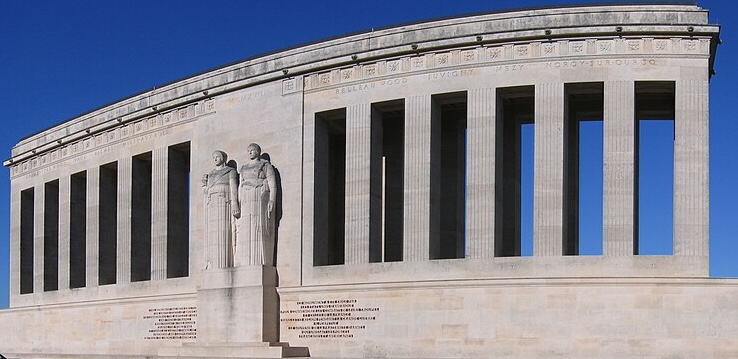 The Château-Thierry American Monument, overlooking the Marne Valley, commemorates the American and French soldiers who fought together to halt the German advance in 1918. Zeugma fr (Antoine FLEURY-GOBERT), CC BY-SA 3.0, via Wikimedia Commons
The monument was designed by Paul Cret, a French-born architect based in Philadelphia, and was dedicated in 1937. On the west face stand two enormous figures carved by the Franco-American sculptor Alfred Bottiau. They represent the United States and France, and they hold hands to symbolize the alliance between the two countries. Their smooth, simplified forms are in the Art Moderne style, a later and more streamlined phase of Art Deco, so they look quite different from most war memorials in France. On the east face, toward Château-Thierry, stands a large eagle in honor of the United States.
The monument also provides an interesting contrast: the town of Château-Thierry is the birthplace of Jean de La Fontaine, the 17th-century poet and writer whose fables are still memorized by French schoolchildren.
You can experience two very different chapters of French history almost on the same doorstep by visiting La Fontaine's museum and then drive 15 minutes to sites that played a major role in American military history.
PRACTICAL INFORMATION
- Getting there: The cemetery is approximately 10 kilometers (6.5 miles) northwest of Château-Thierry. Belleau Wood rises immediately behind it. It's easiest to reach by car from Château-Thierry (an hour by direct train from Paris Gare de l'Est). From there you'll need a taxi to Belleau, a 15-minute journey.
- How long to stay? You'll need 2-3 hours to see Belleau Wood and the cemetery.
- How to visit? You can visit all the sites independently. This official Belleau Wood trail map might be helpful. Having a guide with a car is easiest.
IF YOU'D LIKE A GUIDED VISIT...
- You can visit Belleau Wood on a day trip from Paris
- Explore Belleau Wood and the involvement of the US Marines
- Take a private tour to Belleau Wood
Before you go...
Belleau Wood is only part of the World War I story in northern France. If you'd like to visit more battlefields and memorials, my Somme battlefields road trip takes you through another region devastated by the fighting.
There, you can walk through preserved trenches, visit enormous memorials to the missing, and see how the war transformed the landscape of northern France.
Did you enjoy this article? I'd love if you shared it!

🇫🇷

Bonjour! I'm Leyla.
Born in Paris and now based in eastern France between Lyon and Annecy, I've spent years exploring the places and stories that explain why France is the way it is.
Offbeat France is for curious francophiles, whether you're planning a trip or simply fascinated by France. Here you'll discover the history behind the villages, castles, traditions, landscapes and everyday details that most visitors notice but few can explain.
Alongside practical travel advice, I share the context that helps you make sense out of France. The more you understand, the more rewarding every visit becomes.
If you finish an article thinking, "I never knew that... now I want to know more," then I've done my job.
Learn more about me!
Read my Substack historical essays
🇫🇷

🇫🇷
Booking.comWhat's New!


-
Belleau Wood: Where the US Marines Made History
Oct 21, 26 03:12 AM
A peaceful French forest hides the scars of a fierce World War I battle. Walk through Belleau Wood, where US Marines made history, and visit the American cemetery. -
Wellington Tunnels and the Boves: Exploring Underground Arras
Oct 13, 26 11:12 AM
What if an entire army could hide beneath a city? Explore the Wellington Tunnels and medieval Boves of Arras, where centuries of history lie underground. -
Figurines Compiegne Museum: More Than Toy Soldiers
Oct 12, 26 05:10 AM
Visit the Museum of Figurines, Compiegne, where thousands of toy soldiers share the stage with ancient objects comic-book heroes. -
The Strange Story of Compiegne’s Armistice Wagon
Oct 07, 26 04:08 AM
Discover the strange story of the Compiegne Armistice Wagon, where Germany signed an armistice in 1918 and France signed one in 1940. -
Arras, France: Where Things Are Not What They Seem
Sep 30, 26 04:34 AM
Discover things to do in Arras France, from grand Flemish-style squares to a hidden underground city, a curious citadel and a rebuilt historic center.