Fascinated by Gallo-Roman history? Click Here to download > > > Here are 6 ways Rome affected France





Follow me on
- Home ›
- Destinations ›
- Northern France ›
- Underground Arras
Wellington Tunnels and the Boves: Exploring Underground Arras
Published 13 October 2026 by Leyla Alyanak — Parisian by birth, Lyonnaise by adoption, historian by passion
The northern French city of Arras has streets, buildings, shops and monuments like any other city. But it also has an underground world you can visit, from medieval chalk quarries known as the Boves to the Wellington Tunnels, used by Allied soldiers during World War I.
Arras has a secret that is easy to miss.
Above ground, it is a handsome northern French city known for its Flemish-style squares and monumental belfry. But beneath its streets is another Arras: a network of underground tunnels and caves whose use has changed over the centuries.
Two very different parts of Arras's underground history are open to visitors. Beneath the historic center, the Boves reveal how medieval quarrymen extracted the chalk used to build the city. Farther southeast, the Wellington Quarry shows how New Zealand tunnellers adapted other abandoned chalk quarries to shelter thousands of Allied soldiers during World War I.
The two sites aren't part of the same visitor network, but they share a common origin: the chalk beneath Arras.
KEEN ON UNDERGROUND ATTRACTIONS?
DEEP UNDER ARRAS
It might seem to the casual visitor that there's a Swiss cheese below Arras – three levels of it, in fact:
- the first is 4 meters (13 ft) below ground and was used for storage; these days, that level has often been transformed into a business, such as a restaurant or a bar
- the second level is 8 meters below ground – definitely storage facilities
- and then you have the Boves, at 12 meters (40 ft), the former chalk quarries
Wellington Tunnels, from quarry to military city
Arras was near the Western Front and was the site of much fighting during World War I. By 1916, as British soldiers planned their major offensive around Arras, they needed to bring thousands of men close to the German lines without the Germans finding out.
The answer would be found beneath their feet: the chalk quarries in the southeastern part of Arras had been excavated for centuries but were now abandoned. The British realized that these tunnels could be connected and turned into a huge underground military complex.
They brought in skilled New Zealand tunnellers for the task, about 500 of whom – including 43 Māori pioneers – worked on the project. Many had been miners or railway workers and were particularly suited to the job.
Arras was already under bombardment when they arrived and began turning the old Arras tunnels into a concealed military base which would come to be known as the Wellington Quarries.
Not only was the operation huge, but it was handled with lightning speed.
Over roughly six months, the tunnellers excavated and connected about 20 kilometers (12 miles) of galleries, all by hand. The work was done with picks and other handheld tools, working around the clock in eight-hour shifts, in teams of three.
At its peak, the New Zealanders were excavating roughly 80 meters (260 ft) of tunnel a day.
The existing quarries were given names to help the men navigate the underground maze: Wellington, Auckland, Nelson and Blenheim were all names from New Zealand, a reminder of the tunnellers' homes.
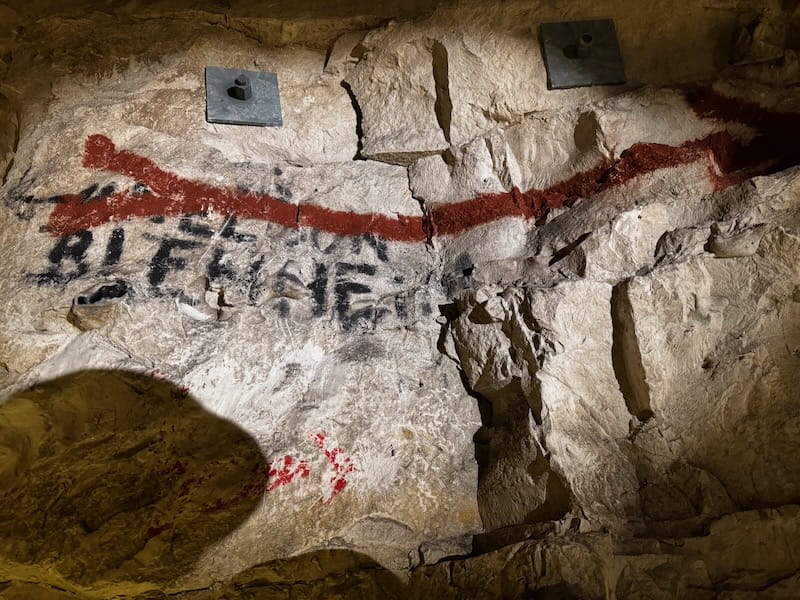 The New Zealanders called their underground quarters familiar names to remind them of home – like Blenheim, a town on New Zealand's South Island ©OffbeatFrance
A city within a city
This wasn't your basic hiding place for soldiers, it was an underground complex designed for an entire army to live – a functioning military headquarters with electricity, sanitation and communications. There were sleeping areas, showers, offices, storage areas and places to eat. There was also a hospital with 700 beds, and a well that provided water. Railway tracks helped move supplies through the underground tunnels.
The numbers were staggering: this would be home to about 24,000 soldiers, who would spend roughly a week underground before the attack, sleeping and eating, with the streets of Arras some 20 meters (65 ft) above their heads.
But unlike the medieval quarrymen who first dug down below Arras, the men who built this underground world were working against deadline of life or death.
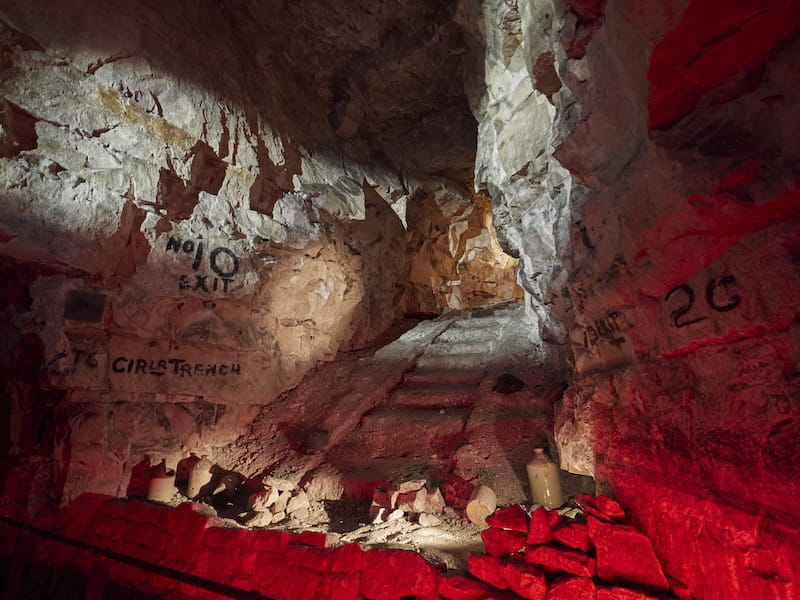 Memorial of the Battle of Arras in the Welllington Quarry ©Hauts-de-France tourisme Frédérik Astier
The danger underground
While the Wellington caves were deep, the British could not assume they were safe.
The Germans knew there was digging around Arras, and the British had to make sure their own tunnellers could detect an approaching enemy.
They used listening devices called geophones, which could pick up sounds of digging through the chalk, helping them work out whether Germans were excavating nearby.
The point wasn't to fight an underground war but to shelter and move troops secretly: once the Battle of Arras began, thousands of soldiers would emerge from the tunnels and head towards the battlefield without having had to assemble in full view of the Germans.
Twenty-four thousand men waiting underground
For about a week before the attack, 24,000 soldiers lived underground. The galleries were crowded, and every available space had to be used. As the men slept and ate in the chalk tunnels, their supplies and messages moved through the damp and crowded network.
The guide's explanations told us how the men strived to maintain some semblance of ordinary life: even underground, they still expected their tea and snacks.
The men also left physical evidence of their presence.
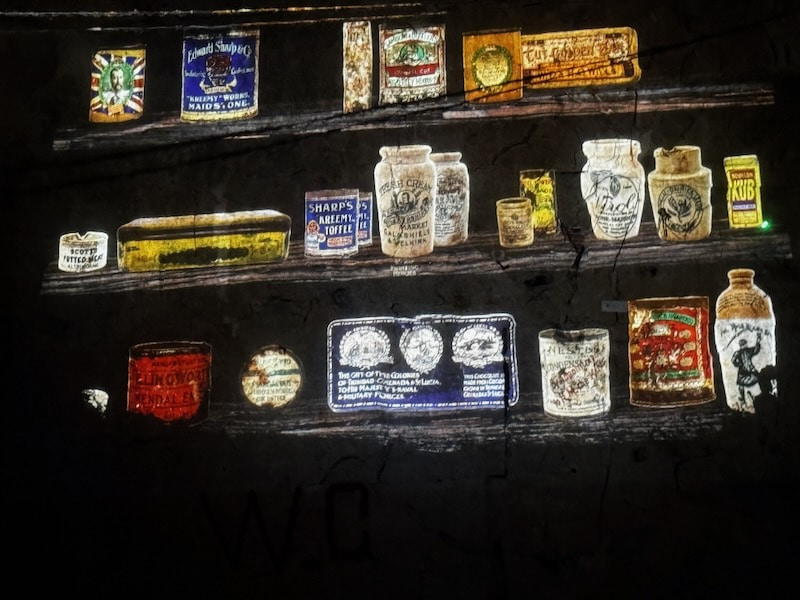 Reminders of the types of foods the men below were eating ©OffbeatFrance
As you walk around, you'll see names and drawings on the chalk walls. Some are simple graffiti; others connect the tunnels to particular men and units. The New Zealand presence is especially visible, making the underground spaces feel less like an anonymous military installation and more like a place occupied by particular people for a very short, very intense period.
Among the names recorded in the tunnels are Toi Karini, who was Māori, and two Cook Islanders from the same battalion, Angene Angene and Solomon Isaacs.
The final climb to the surface
At 5:30 on the morning of 9 April 1917, the waiting ended.
The soldiers emerged from the Arras underground tunnels and advanced towards the German positions. The network had done its job: it had hidden the movement and concentration of a huge Allied force until the last possible moment.
While the Battle of Arras began with a major Allied advance, the offensive would eventually stall at enormous human cost.
THE BATTLE OF ARRAS
The Battle of Arras began on 9 April 1917, when British and Canadian forces, with Australian and South African units also taking part, launched a major offensive against German positions around the city. The attack was preceded by weeks of artillery preparation and by the secret construction of the underground network beneath Arras, which allowed thousands of troops to move into position without being seen.
The opening attack made significant gains, but the offensive soon stalled. Fighting continued until 16 May, with roughly 285,000 casualties on the Allied and German sides combined. The battle achieved some important tactical successes but failed to produce the decisive breakthrough the Allies had hoped for.
For the men who had spent the previous week underground, the transition must have been extraordinary. They had gone to sleep and eaten beneath the city, surrounded by chalk walls and artificial light. Then they emerged into a war zone.
That transition is still part of the Wellington experience today. Visitors go down into the quarry and follow the underground galleries before eventually retracing the soldiers' route toward the surface and the violence waiting above it.
It all started with chalk
The Wellington Quarry wasn't the only place where Arras's inhabitants had dug beneath the streets. For centuries, quarrymen had been extracting chalk in different parts of the city, leaving behind underground spaces that would eventually find new uses.
The Boves beneath the historic center are another example, although their history took a different turn.
The soft chalk found underground was easy to excavate, and people had been quarrying it since at least the 9th century for stone to build religious buildings and the city's first defensive walls. As Arras expanded, more quarries were opened, creating a growing network of underground galleries and chambers.
Then the city changed, and so did the purpose of the space below it.
In the historic center, quarrying gradually gave way to other uses. By the 12th century, as Arras became an important commercial center, other sources of building stone were found and many of the old quarries were abandoned. The spaces didn't just disappear – merchants began using them as storage cellars, taking advantage of the cool, stable conditions underground. The temperature in the chalk quarries, called Boves, remains around 11°C (52℉) year-round.
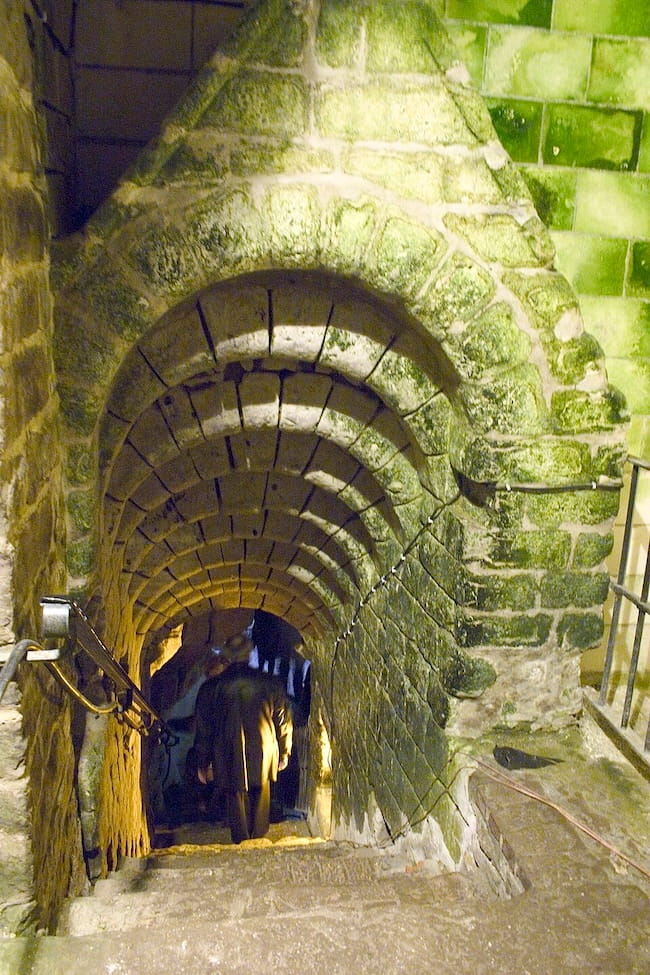 Heading down into the Boves in Arras Pir6mon, CC BY-SA 3.0, via Wikimedia Commons
WHY ARE THEY CALLED BOVES?
Bove is an old regional word for an underground cavity, cave or passage. It is thought to be connected with the old French bover, meaning to dig or excavate. The word was used in northern France and particularly in Artois for the underground spaces created by quarrying.
The Boves may have started as quarries, but once chalk was no longer essential, these underground spaces managed to find another purpose.
Going down for a visit, you'll still find evidence of how the area's use evolved over time – extraction shafts, space for later storage of barrels, and much later, remains of electrical installations from World War II.
The visit itself is intriguing, with passage after passage of stone leading further in, or back to where we started from. I didn't feel it was possible to get lost but there were plenty of nooks and crannies to explore.
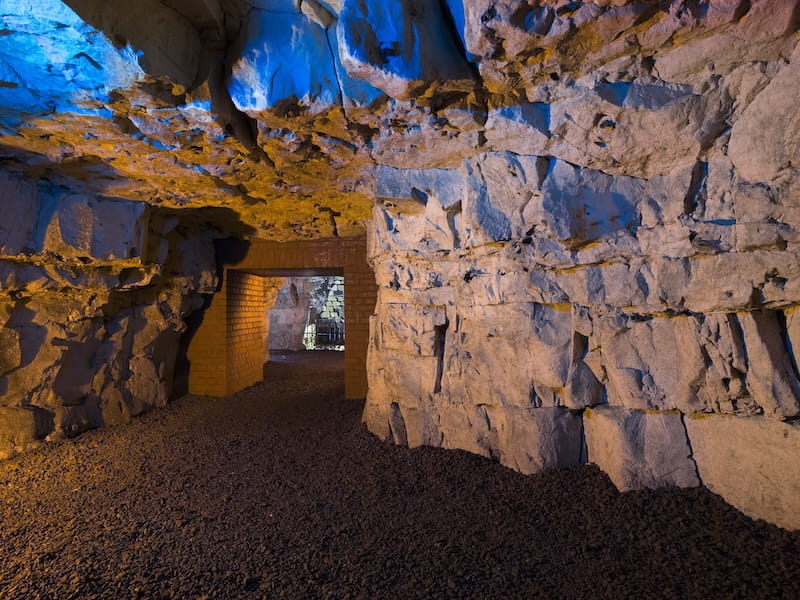 ©Hauts-de-France tourisme / Frederik Astier
Two quarries, two very different histories
The Boves and Wellington Quarry are separate underground sites, created by quarrying in different parts of Arras.
Their histories diverged once the stone was no longer needed. Beneath the historic center, the old quarries became storage cellars for merchants. Farther southeast, other abandoned quarries were connected and adapted by New Zealand tunnellers into a military complex for thousands of soldiers.
Visiting both gives you two very different views of the same city's past: one shaped by medieval commerce, the other by the demands of modern warfare.
PRACTICAL INFORMATION
- The Boves: Visits start from the basement of the Tourist Office in the Town Hall, Place des Héros and last 45 minutes. The site is closed for much of January so check with the Tourist Office. There are stairs and uneven surfaces. Buy your tickets here.
- Wellington Quarry: Less central than the Boves, about 25min walk from the historic center. There are buses as well – ask at the tourist office because there were transportation improvements afoot when I was visiting. Buy your tickets here.
- NOTE: Reserve if you can because the number of people on each tour is limited.
- Language: Both sites must be visited on a guided tour, so ask about language. Some tours are fully bilingual or in English or French.
- Attire: You'll be provided with hard hats for both visits. Wear warm clothing because it is always cool and humid. Shoes with a bit of grip can help if the ground gets slippery with the humidity.
Before you go...
Visiting the Boves and the Wellington tunnels are among the essential sights of Arras but if you have time, add the Citadel of Arras to your itinerary. It gives you the above-ground side of Arras's military history and, like the underground sites, shows how Arras has repeatedly put old places to new uses.
Did you enjoy this article? I'd love if you shared it!

🇫🇷

Bonjour! I'm Leyla.
Born in Paris and now based in eastern France between Lyon and Annecy, I've spent years exploring the places and stories that explain why France is the way it is.
Offbeat France is for curious francophiles, whether you're planning a trip or simply fascinated by France. Here you'll discover the history behind the villages, castles, traditions, landscapes and everyday details that most visitors notice but few can explain.
Alongside practical travel advice, I share the context that helps you make sense out of France. The more you understand, the more rewarding every visit becomes.
If you finish an article thinking, "I never knew that... now I want to know more," then I've done my job.
Learn more about me!
Read my Substack historical essays
🇫🇷

🇫🇷
Booking.comWhat's New!


-
Wellington Tunnels and the Boves: Exploring Underground Arras
Oct 13, 26 11:12 AM
What if an entire army could hide beneath a city? Explore the Wellington Tunnels and medieval Boves of Arras, where centuries of history lie underground. -
Figurines Compiegne Museum: More Than Toy Soldiers
Oct 12, 26 05:10 AM
Visit the Museum of Figurines, Compiegne, where thousands of toy soldiers share the stage with ancient objects comic-book heroes. -
The Strange Story of Compiegne’s Armistice Wagon
Oct 07, 26 04:08 AM
Discover the strange story of the Compiegne Armistice Wagon, where Germany signed an armistice in 1918 and France signed one in 1940. -
Arras, France: Where Things Are Not What They Seem
Sep 30, 26 04:34 AM
Discover things to do in Arras France, from grand Flemish-style squares to a hidden underground city, a curious citadel and a rebuilt historic center. -
Chateau De Pierrefonds: The Strange Curse Of A Fairy-Tale Castle
Sep 26, 26 02:16 PM
Discover Château de Pierrefonds, a fairy-tale castle in northern France with a turbulent history, spectacular restoration and plenty of strange surprises.