Fascinated by Gallo-Roman history? Click Here to download > > > Here are 6 ways Rome affected France





Follow me on
- Home ›
- Destinations ›
- Northern France ›
- Armistice Wagon at Compiègne
The Strange Story of Compiègne’s Armistice Wagon
Published 7 October 2026 by Leyla Alyanak — Parisian by birth, Lyonnaise by adoption, historian by passion
The Armistice Wagon at Compiègne has a history far stranger than its quiet setting in the Forest of Compiègne suggests. Two armistices were signed here, and the entire clearing, not just the museum, is part of the story.
There is something strange about arriving at the Clairière de l’Armistice, a clearing set in the middle of the historic forest of Compiègne, surrounded by trees and serenity and a few monuments from the last century.
It is gone now but in 1918, a railway carriage also stood here. Inside it, Germany signed an armistice with the Allies ending World War I.
And 22 years later, Germany came back to the same carriage to sign another armistice — this time with a defeated France.
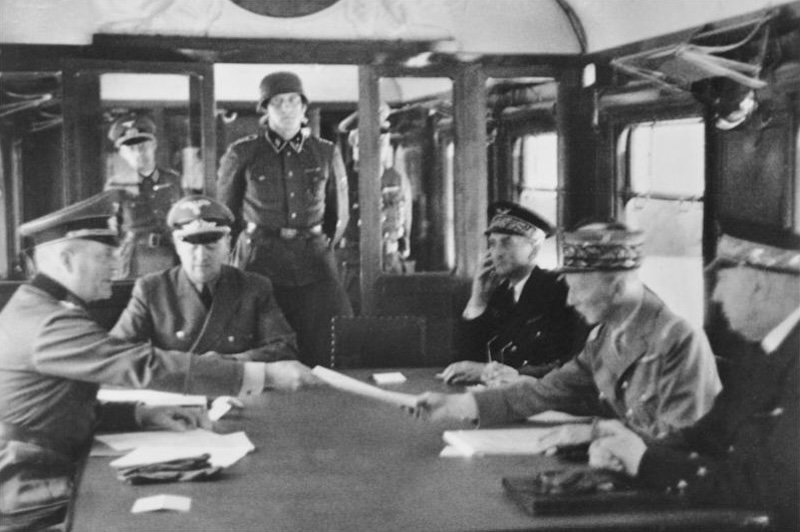 German and French officers signing the 1940 armistice in the Compiègne railway car Bundesarchiv, Bild 146-1982-089-18 / CC-BY-SA 3.0, via Wikimedia Commons
DISCOVERING NORTHERN FRANCE

The railway car ended up here because Marshal Ferdinand Foch, the Allied commander-in-chief on the Western Front, wanted somewhere quiet and isolated for the negotiations to end World War I. He also needed two railway lines: one for his own train and another for the German delegation.
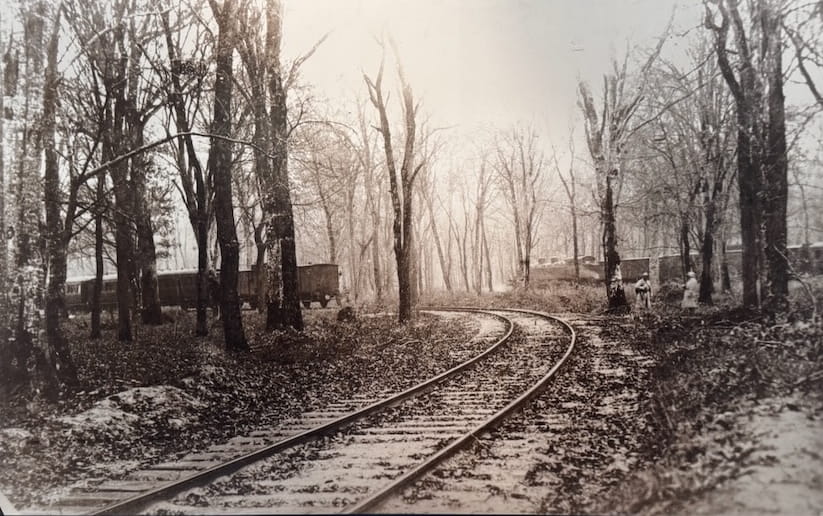
The train tracks were already there because they had been used during the war to move heavy artillery towards the front, so the choice was practical rather than picturesque.
There was no grand building or ceremonial hall and no monument or clearing back then. Just a forest, the tracks, and a railway carriage which had unceremoniously begun life as a dining car.
The Armistice of 1918
November 8 was not a peace conference between equals. Germany wanted an end to the fighting, while the Allies were in a position of strength to dictate the military terms that would force Germany to withdraw and surrender its weapons.
These terms were itemized over 13 pages, each of which had to be read and translated by those around the table. The atmosphere would have been heavy, and the talks would be met with long-lasting bitterness on the part of the Germans.
After three solid days, in the early hours of 11 November, the armistice was signed: it was 5:15 in the morning.
The ceasefire would take effect at 11 a.m.
During that six-hour gap, the news would have to reach troops along hundreds of kilometers of front. Communications were still painfully slow by modern standards, with the clairon — the military bugle — one of the instruments used to transmit orders.
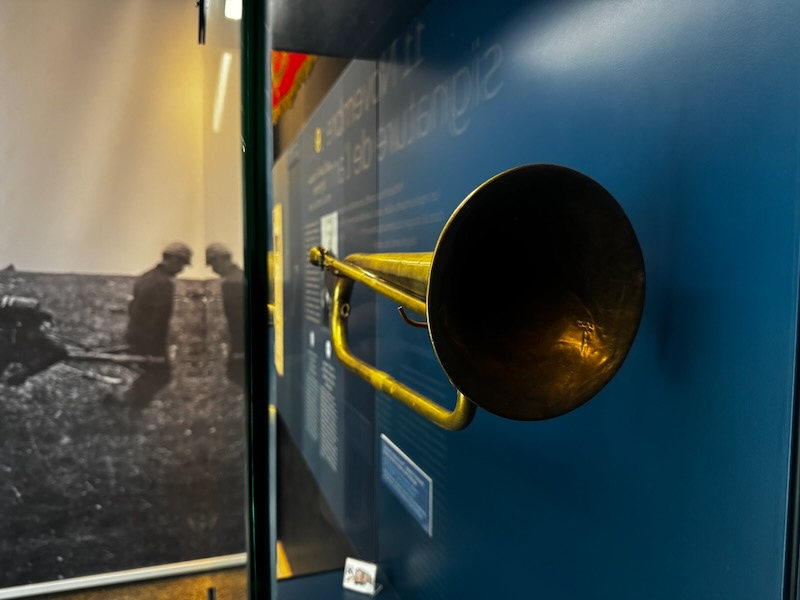 A far cry from today's communications, this bugle, or "clairon", was used to communicate major news during World War I. Held at the Armistice Museum in Compiègne ©OffbeatFrance
Armistice or not, the war still killed people. Augustin Trébuchon, a 40-year-old French soldier serving as a military messenger, was carrying a final message to his captain when he was killed at 10:50 that morning, ten minutes before the armistice took effect.
THE ARMISTICE IN PICTURES
Marshal Foch had banned journalists from the clearing and allowed only one official photographer. But railway official Pierre Toubeau apparently decided the order did not apply to him. He took his own photographs and, after Foch's death, deposited six of them at the Compiègne town hall. You can see them all in the museum.
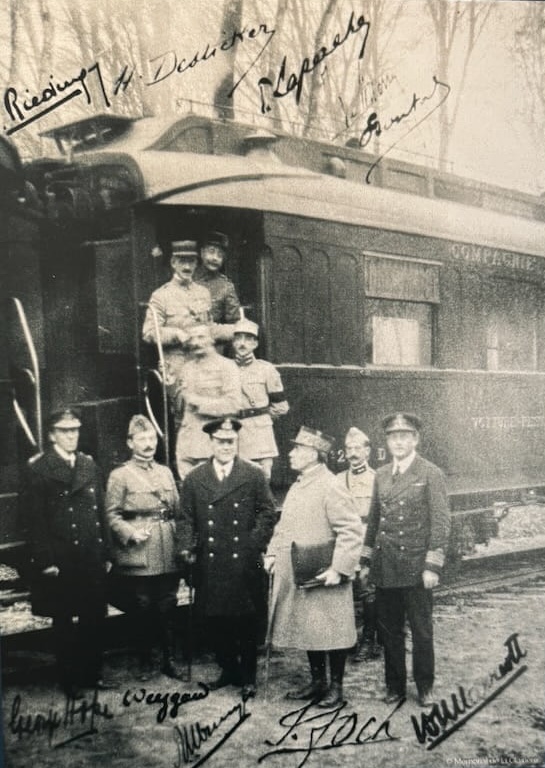 One official photograph contains a small surprise: the cook can be seen among the dignitaries (second from the right). Perhaps he wanted to be included because he knew he was witnessing history.
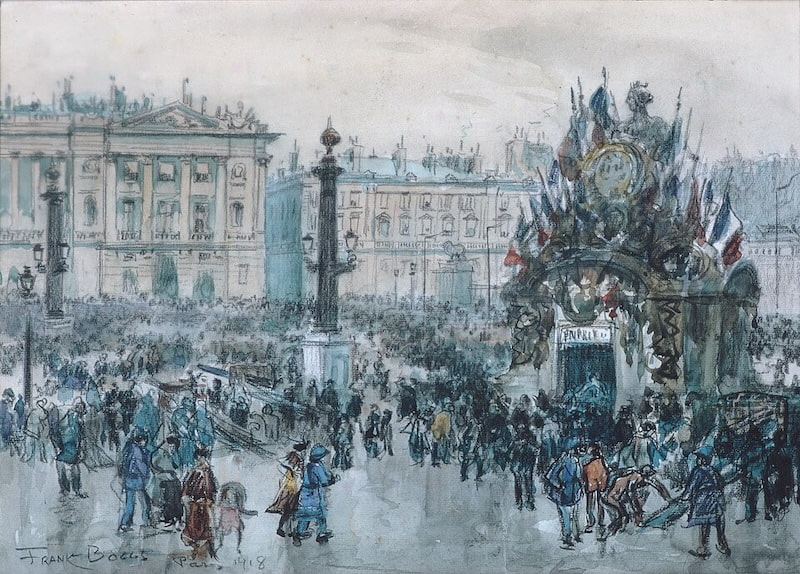 Armistice Day 1918 in Paris as painted by Frank Myers Boggs, CC0, via Wikimedia Commons
The wagon becomes a memorial
After the 1918 armistice, the railway carriage was taken to Paris and displayed at the Invalides, the military museum and complex in central Paris. But the wagon was made of teak and although it was covered with a tarp, years of exposure to the weather began to take their toll. Water seeped in, and journalists began raising concerns about its condition.
The solution was to repair it and bring it back to Compiègne.
The mayor of Compiègne found an American benefactor, Arthur Henry Fleming of Pasadena, California, who financed a shelter for the historic carriage. It returned to the clearing in 1927.
The forest had already been cleared in 1922 to create the great circular space you see today, inaugurated that year with the central stone slab and the monument to the soldiers of Alsace-Lorraine.
This would no longer be a railway siding in a forest but a major memorial.
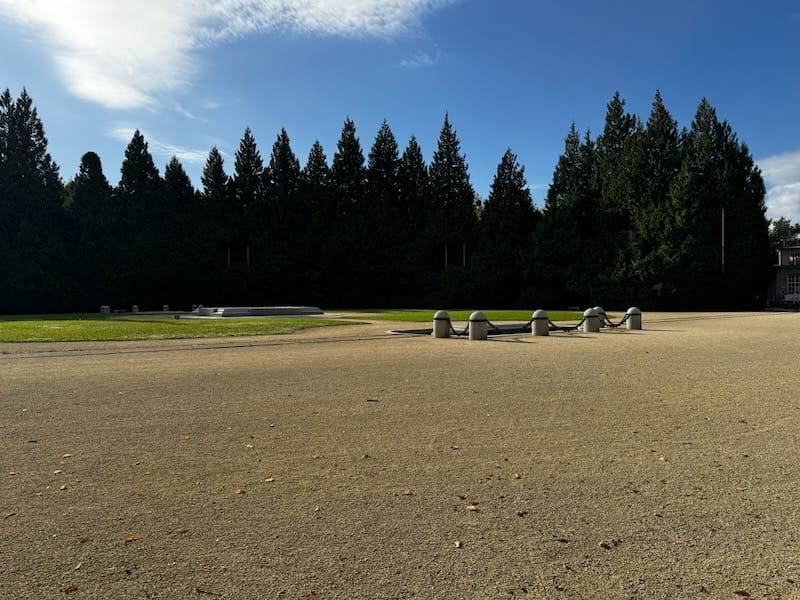
Hitler returns to Compiègne
Then came 1940.
Germany invaded France on 10 May, and within weeks the French government was retreating south. Prime Minister Paul Reynaud resigned on 16 June, and Marshal Philippe Pétain became head of government. Pétain’s government requested an armistice, and a French delegation was sent to Compiègne.
Hitler had chosen the location: he ordered the historic railway carriage out of its shelter and had it positioned on the site where the 1918 negotiations had taken place.
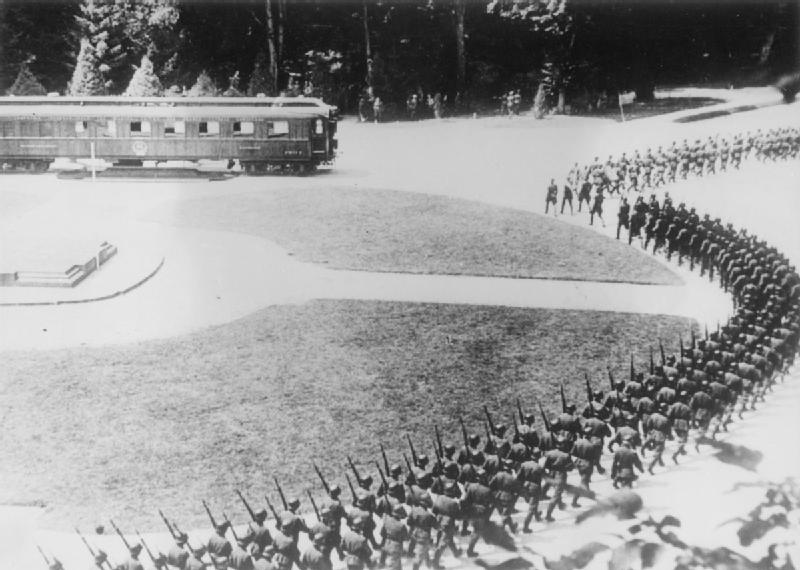 The historic railway carriage at Compiegne where Petain's government signed Armistice Terms in June 1940. A German guard of honor is seen marching round the carriage
When Hitler arrived with his entourage, he entered the carriage and deliberately sat where Foch had sat for the first armistice. In 1918, Germany had come to this forest to accept the terms of the victorious Allies. In 1940, France had come to the same forest to accept Germany's terms.
These were read to the French delegation, and the armistice was signed on 22 June. France was required to demobilize and disarm most of its armed forces, while a limited army was permitted to maintain order. Germany occupied the northern part and the Atlantic coast of France, while the French government retained sovereignty in the unoccupied south. France also had to pay the costs of the German occupation.
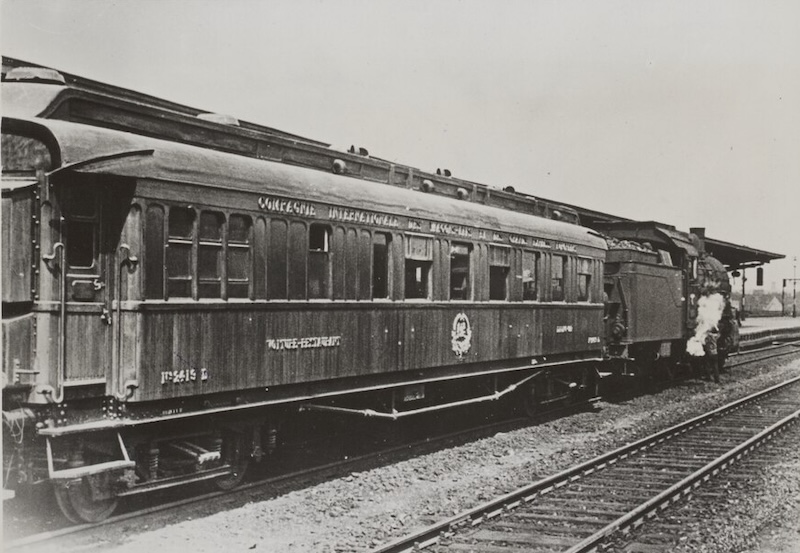 The railway carriage from Compiègne is transferred to Berlin on Adolf Hitler’s orders. A stopover at Hamm railway station Atlantic Photo, CC0, via Wikimedia Commons
After using the original wagon for the second armistice, Hitler then ordered the entire memorial dismantled.
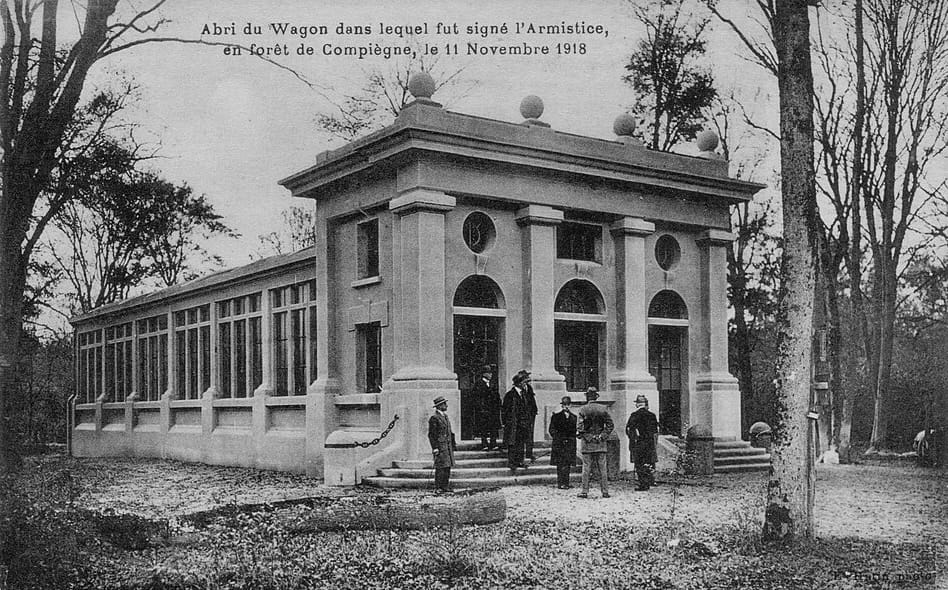 The original shelter, which held the original railway car. It would be dismantled by Germany after the 1940 armistice
The monuments were numbered and transported to Berlin, the shelter was dynamited and the clearing plowed. The wagon itself was transported by road to Crépy-en-Valois, where it was put back on the railway and sent to Germany. Only the statue of Foch survived, although why it was left standing has never been truly explained.
By the end of the war, the original memorial was gone, as was the original wagon, which would be eventually destroyed in a fire in Germany.
The carriage you see today
After the Allied victory in World War II, France set about rebuilding what had been destroyed.
A replacement wagon from the same series was found. Using the plans of the original, it was adapted to reproduce the signatories' room and protected by a new shelter. The reconstructed Musée de l'Armistice 14-18 was inaugurated on 11 November 1950.
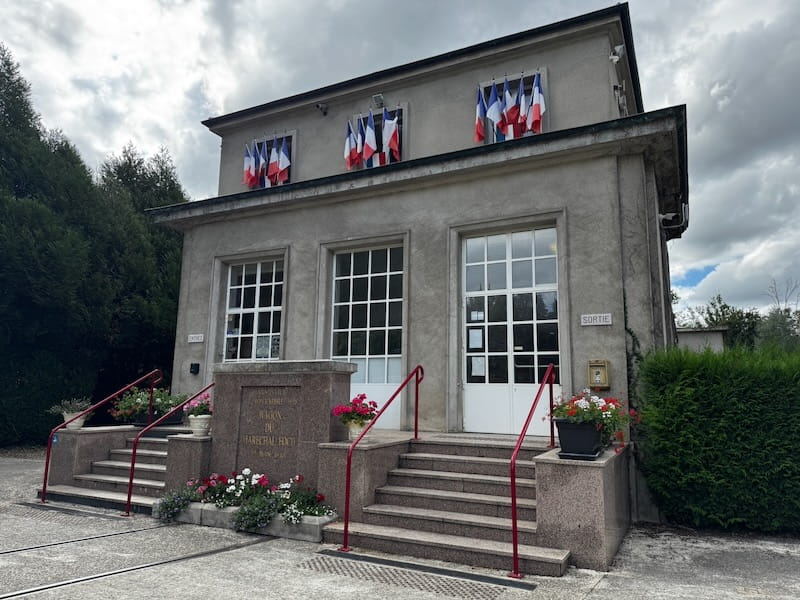 The new museum that replaced the one destroyed after the second armistice ©OffbeatFrance
Today, the carriage is part of a much larger memorial. The museum in which it is housed contains around 20 rooms with documents, newspapers, photographs, maps and uniforms, organized around the history of the two armistices.
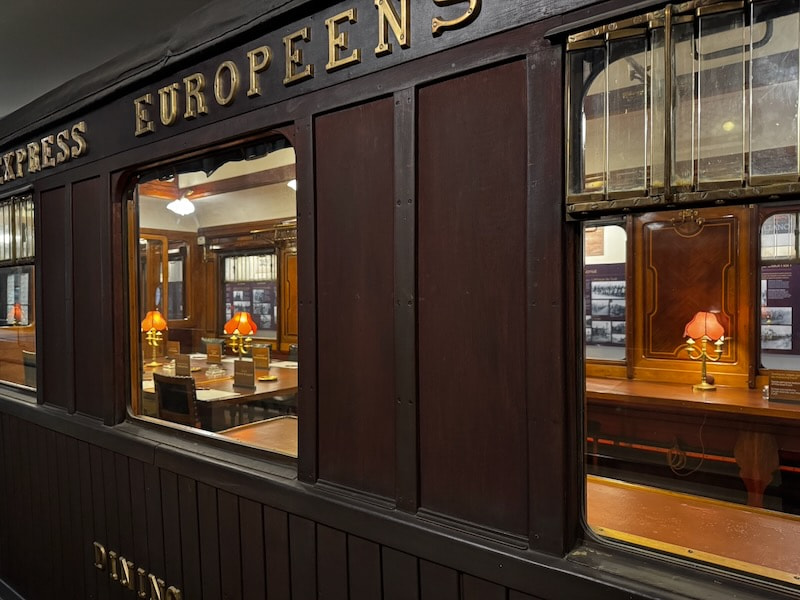 The railway carriage inside the Musée de l’Armistice 14-18 is not the original. The historic carriage, No. 2419D, in which the 1918 and 1940 armistices were signed, was taken to Germany and destroyed in 1945. The carriage on display today is No. 2439D, from the same series, installed here in 1950 and fitted out to match the original ©OffbeatFrance
Outside, two stone markers show the positions of the two wartime trains. At the center is a large stone slab with a deliberately triumphant inscription: “Here, on 11 November 1918, the criminal pride of the German Empire, defeated by the free peoples it sought to enslave, succumbed.”
A monument to the soldiers of Alsace-Lorraine was also added at the end of the main avenue, and on the side we can see the statue of Marshal Foch, showing him as he appeared after signing the 1918 armistice, the convention in its satchel.
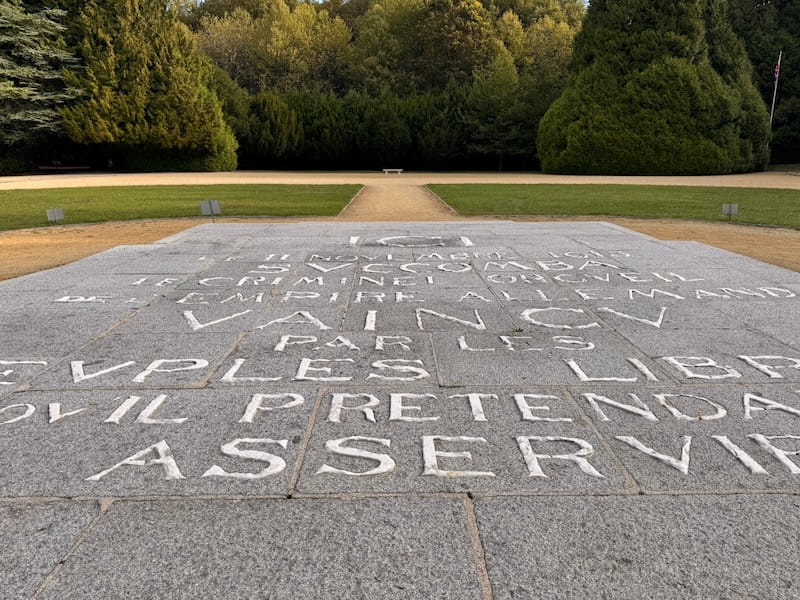 The central stone in the clearing bears the inscription commemorating Germany’s defeat in 1918 ©OffbeatFrance
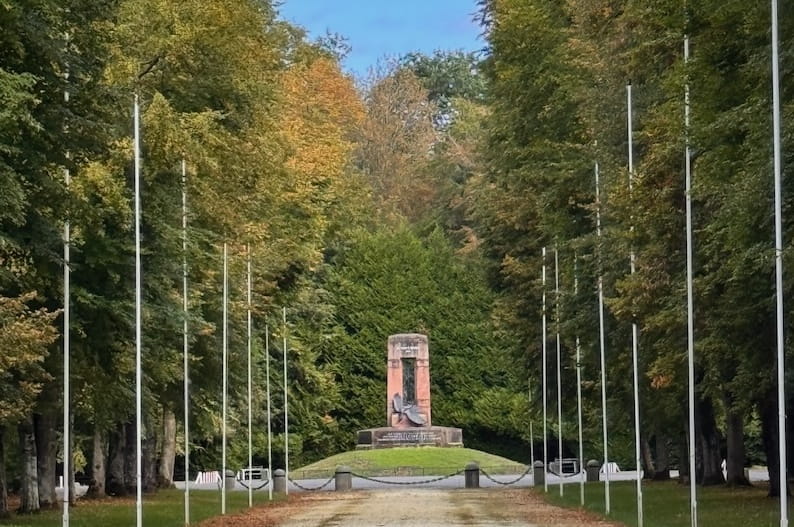 At the end of a long well-kept alley in the forest of Compiègne is the monument to the World War I soldiers of Alsace-Lorraine ©OffbeatFrance
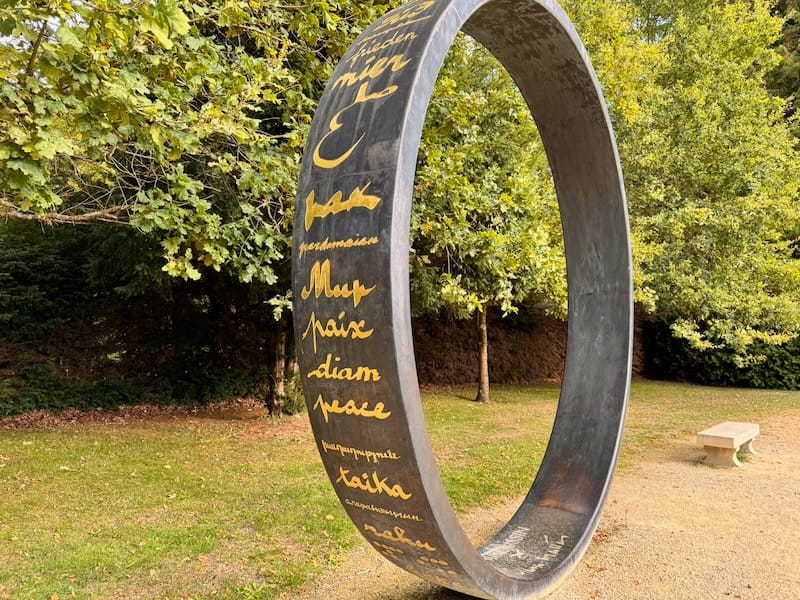 Nearby is the Alliance de la Paix, a large bronze ring by artist Clara Halter, with the word “Peace” written in 52 languages ©OffbeatFrance
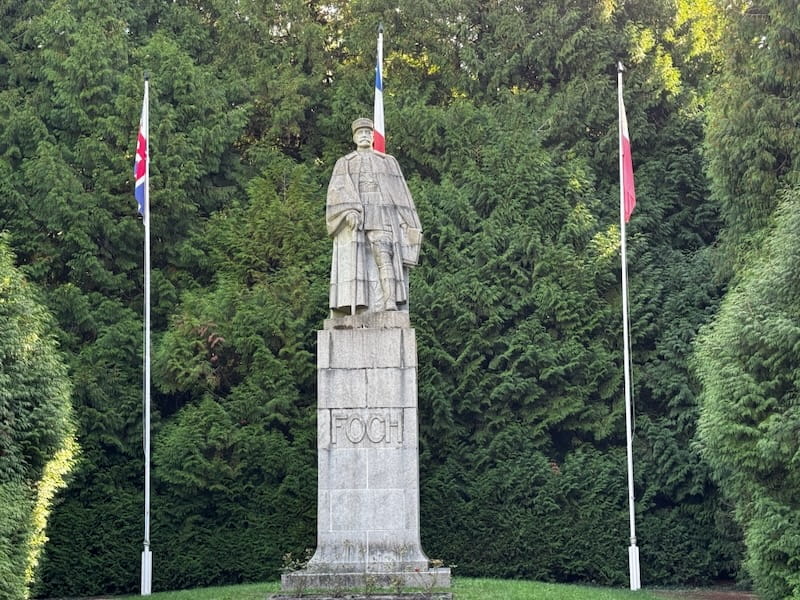 The only monument that survived the second armistice was that of Marshal Foch ©OffbeatFrance
The strange story of the original wagon
Years after the events, once the Berlin Wall had fallen, a young history-geography teacher began investigating what had happened to the wagon and asked his pupils to collect local memories. Their research eventually uncovered witnesses who had seen the wagon after it was destroyed so he invited a French delegation to meet some of them.
General Gamache, who led the delegation, asked a certain Claire Pagura to come with them.
“You speak German,” he told her. “You're coming with us. You'll translate.”
In October 1992, the French delegation traveled to Thuringia, in central Germany, where it met two elderly men who had been teenagers when they noticed a huge plume rising above the forest near them. Investigating, they found a railway carriage on fire.
Once the fire died down, they got closer but there was little left. The wooden carriage had burned, leaving its framework and other pieces of metal scattered around the site. Among the debris were an emblem and several large brass letters that had once been fixed to the wagon's teak sides to spell out Compagnie Internationale des Wagons-Lits et des Grands Express Européens.
The young men kept some of the pieces and as the years passed, through marriages and family life, they never imagined that one day someone would come looking for them.
By the time the French delegation arrived in 1992, the two men were in their eighties. One was very frail, and his grandson brought out the pieces the family had preserved.
For Claire Pagura, the story did not end with the objects' recovery. She made the family a promise: when she told visitors about the surviving pieces, she would also remember those who had helped preserve them.
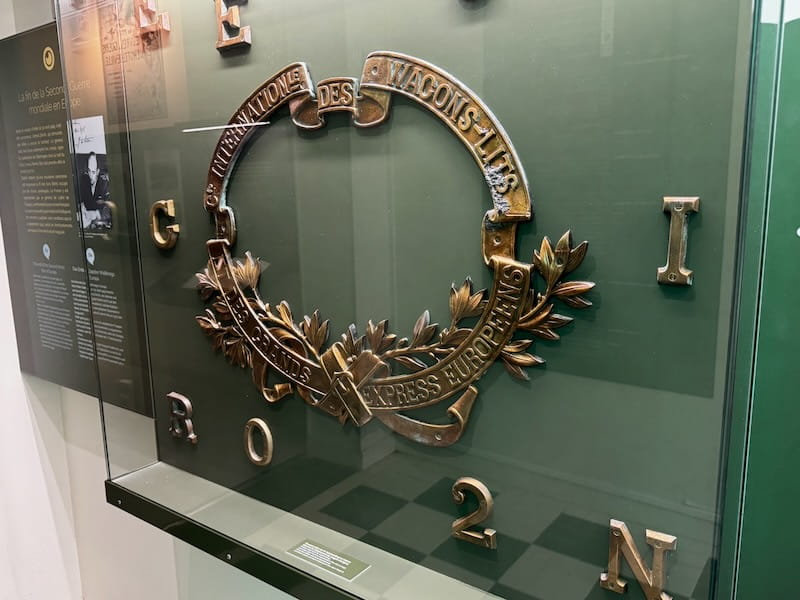 These few metal pieces were found in Thuringia, in Germany, after the original armistice railway wagon was destroyed. Against all odds they survived decades and are now in the Armistice Museum 14-18 ©OffbeatFrance
Nearly 35 years later, in a strange twist of fate, I met Claire as she guided me around the Armistice Memorial, sharing both her encyclopedic knowledge and her own extraordinary first-hand story. She pointed out the name of Monsieur Kummerling below the museum casing, keeping her promise.
PRACTICAL INFORMATION
- Getting there: The clearing is a 10-minute drive from Compiègne or a 10km (6mi) bike ride along the flat forest. There is also a bus, Line 106, but you'll still have a walk of at least half an hour when you arrive, and the schedule is sporadic. Best to ask at the tourist office in Compiègne.
- How long to stay? Two hours should see you through the museum and the clearing itself. If you have your own transportation, you can continue on to Pierrefonds Castle.
- Where to stay: In Compiègne. Alfred Hotels is among the best, and right downtown, but Compiègne has plenty of guesthouses and short-term rentals.
- More information: Museum website. It is closed Tuesdays. All information panels are translated into English and German.
- Best for: travelers interested in the history of the two World Wars and the armistices signed at Compiègne.
Before you go...
Traveling through northern France, the toll World War I took on the country is still visible, even though France has worked hard to erase it.
Ultimately, the Clairière de l’Armistice is a place where the history of the Western Front can be traced through the sober clearing that remembers what happened here, and the museum that fills in the story.
If you'd like to pursue your explorations of World War I in northern France, the battlefields of the Somme lie to the north, where the scale and cost of the war can still be seen in the trenches and craters that scar the landscape, so characteristic of what the French call La Grande Guerre, the Great War.
Did you enjoy this article? I'd love if you shared it!

🇫🇷

Bonjour! I'm Leyla.
Born in Paris and now based in eastern France between Lyon and Annecy, I've spent years exploring the places and stories that explain why France is the way it is.
Offbeat France is for curious francophiles, whether you're planning a trip or simply fascinated by France. Here you'll discover the history behind the villages, castles, traditions, landscapes and everyday details that most visitors notice but few can explain.
Alongside practical travel advice, I share the context that helps you make sense out of France. The more you understand, the more rewarding every visit becomes.
If you finish an article thinking, "I never knew that... now I want to know more," then I've done my job.
Learn more about me!
Read my Substack historical essays
🇫🇷

🇫🇷
Booking.comWhat's New!


-
The Strange Story of Compiegne’s Armistice Wagon
Oct 07, 26 04:08 AM
Discover the strange story of the Compiegne Armistice Wagon, where Germany signed an armistice in 1918 and France signed one in 1940. -
Arras, France: Where Things Are Not What They Seem
Sep 30, 26 04:34 AM
Discover things to do in Arras France, from grand Flemish-style squares to a hidden underground city, a curious citadel and a rebuilt historic center. -
Chateau De Pierrefonds: The Strange Curse Of A Fairy-Tale Castle
Sep 26, 26 02:16 PM
Discover Château de Pierrefonds, a fairy-tale castle in northern France with a turbulent history, spectacular restoration and plenty of strange surprises. -
The Louvre-Lens Museum: How A Former Mining Town Got The Louvre
Sep 21, 26 07:51 AM
Discover why the Louvre-Lens Museum brought the Louvre to a former mining town, plus 11 remarkable works worth the trip from Paris. -
Poitiers in France: Why This Historic City Deserves More Visitors
Aug 02, 26 03:05 PM
Discover the best things to do in Poitiers, France, from Roman ruins and medieval streets to Eleanor of Aquitaine's legacy and remarkable architecture.