Fascinated by Gallo-Roman history? Click Here to download > > > Here are 6 ways Rome affected France





Follow me on
- Home ›
- Destinations ›
- Northern France ›
- Arras
Arras, France: Where Things Are Not What They Seem
Published 29 September 2026 by Leyla Alyanak — Parisian by birth, Lyonnaise by adoption, historian by passion
Arras looks like a beautifully preserved historic city, but much of what you see was rebuilt after World War I. This guide explores the squares, town hall, abbey, citadel, historic neighborhoods and other details that reveal the surprises hidden in this northern French city.
Walk into the grand square surrounding the town hall of Arras in northern France and you might be in for a few surprises.
First, this grand square is actually the smaller of Arras's two great squares, although it looks so vast that I assumed otherwise.
And those lovely old façades lining the square? They're medieval.
Sort of.
By the end of World War I, roughly three-quarters of Arras had been destroyed, with some assessments putting the figure at around 80%.
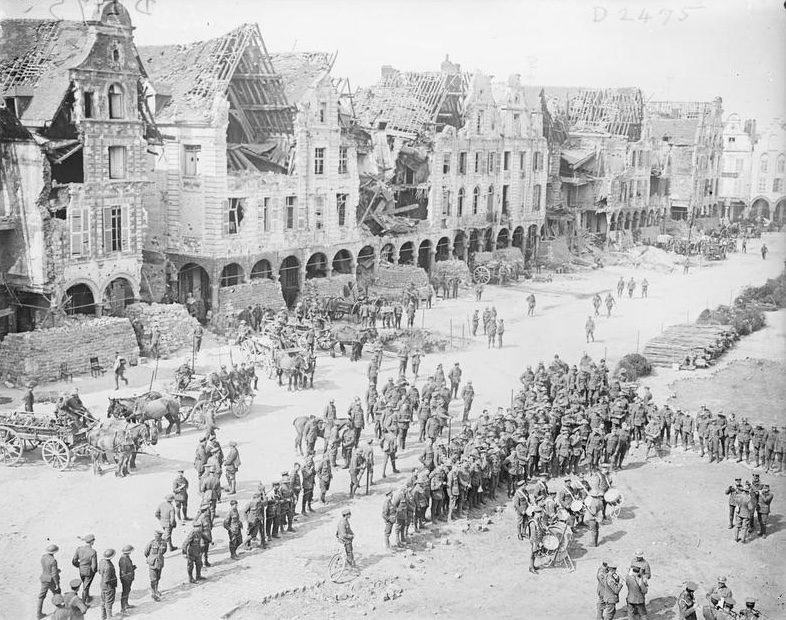 The destruction of Arras during World War I, by John Warwick Brooke, Public domain, via Wikimedia Commons
When it came time to rebuild, local inhabitants didn't want to replace their lost city with a modern one. They loved Arras and wanted it back.
The result is unusual. The center looks centuries old, but much of what you are seeing was actually reconstructed in the 1920s.
QUICK FACTS ABOUT ARRAS
- Population: 40,000
- Region: Hauts-de-France
- Département: Pas-de-Calais (62)
- Known for: Flemish-Baroque squares, World War I reconstruction, the belfry, Vauban's Citadel and underground quarries
- Historic industries: Tapestry weaving and the grain trade
- Major landmark: The Belfry and Hôtel de Ville
- Major attraction: The Boves and Wellington Quarry
- Royal connection: François I was Count of Angoulême before becoming King of France
- UNESCO status: World Heritage: the Belfry (2005) and the Citadel, part of Vauban's fortifications (2008)
That slightly idiosyncratic vibe is what makes Arras interesting - the façades look so medievally similar, yet the buildings behind them don't necessarily match; architectural details are jumbled; and in the midst of all this folly, the 1920s quietly made their entrance.
Then there is everything beneath your feet, a hidden city. Or two.
Just when you think you've deciphered Arras, it seems to melt away.
IF YOU'RE SHORT ON TIME, FOCUS ON...
- The historic center: Place des Héros and Grand'Place, looking closely at the façades and house signs.
- The civic center: Belfry and Hôtel de Ville, including the interiors if they're open.
- Military Arras: the Citadel.
- Underground Arras: Boves and Wellington Quarry.
You can get tickets from the Tourist Office just inside the Hôtel de Ville.
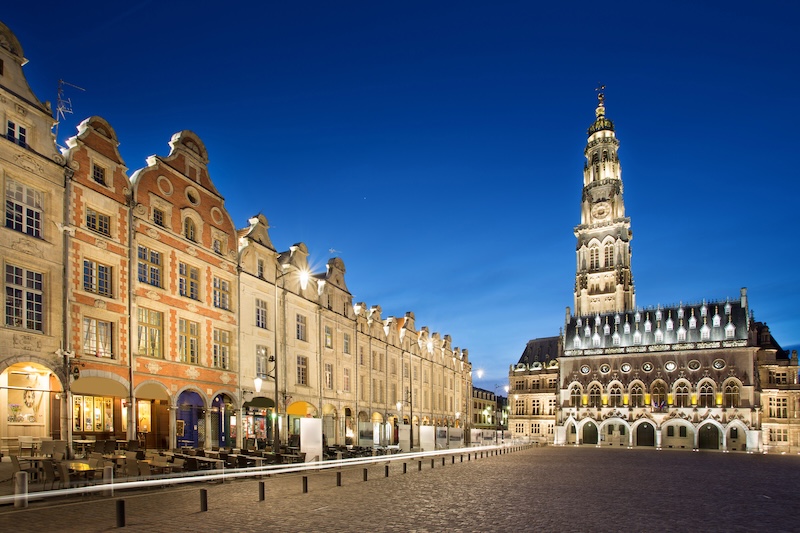 Place des Héros at night
MORE HISTORIC CITIES IN NORTHERN FRANCE


The two great squares
The historic heart of Arras is built around two enormous squares: the the Grand'Place, and the smaller Place des Héros, which together are surrounded by 155 houses.
They date back to the 12th century, taking shape as Arras's markets expanded. The city was prosperous, and at one point held as many as three markets a week.
The two squares had different functions.
The Place des Héros, originally the Petite Place, was the everyday market, where residents bought food and other necessities.
The Grand'Place was the larger commercial market, particularly associated with grain and professional traders.
Place des Héros
The Place des Héros is the obvious place to begin (the "small" square I mistook for the larger one).
Most houses have brick-and-stone façades, arcades, tall windows and elaborate gables influenced by Flemish architecture. They're harmonious and form a magnificently coherent whole.
But here's the important part: before World War I, only three major monuments in Arras were protected as historic monuments: the Belfry, Saint-Vaast Abbey and the cathedral.
The houses around the squares were not.
After the war, however, Arras wanted its historic appearance back. Pierre Paquet, the architect responsible for the city's historic monuments, found a way to make that possible.
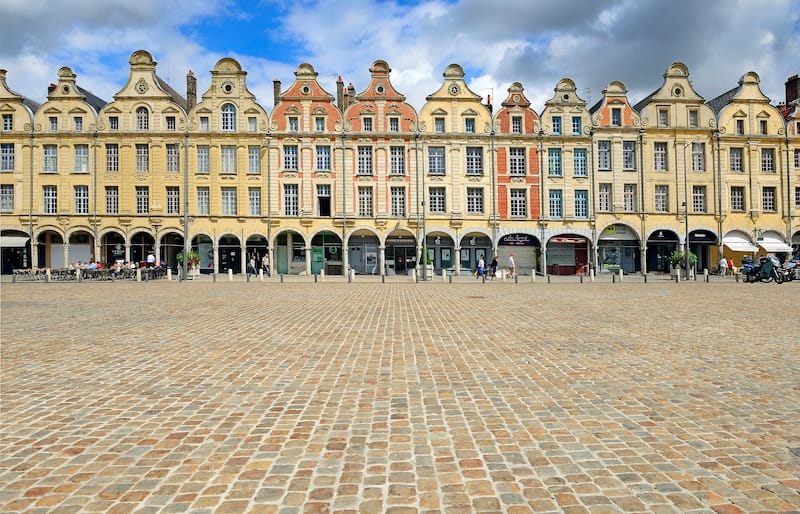 The rebuilt façades of the Place des Héros
In 1919, while the buildings were still ruins, he had the façades classified as historic monuments - the interiors, on the other hand, could be modernized.
That meant the exteriors had to be rebuilt the way they looked like before the war, in what is called à l'identique, while the owners had much more freedom inside.
This is why the Place des Héros looks so remarkably uniform while the buildings behind those façades can be more modern.
The architects also had help. A photographer had documented the façades before the war, so there was a valuable record of buildings that no longer existed.
The photographic campaign was particularly valuable because the architects were trying to reconstruct individual façades, not just create a generic version of an old Arras. They also had plans, archives and engravings to work from, but not everything had been documented so a certain amount of "informed judgment" was called for.
Grand'Place
If you follow the Rue de la Taillerie you'll reach the Grand'Place, the larger of the two squares — about 17,000 square meters, compared with roughly 6,000 for the Place des Héros.
This was the professional and grain market. By the 18th century, it was one of the largest grain markets in northern France.
The square also served as a major public space and is lined with arcades, as is its smaller sibling. These arcades were practical as well as decorative, sheltering merchants and pedestrians and creating a covered space around the market.
Sovereigns were welcomed on the square during their joyeuses entrées (elaborate ceremonies in which a new ruler formally entered the city), and military parades took place here. It is still used today for major events in the city.
At one point, a railway even reached the square so that grain could be loaded and unloaded directly.
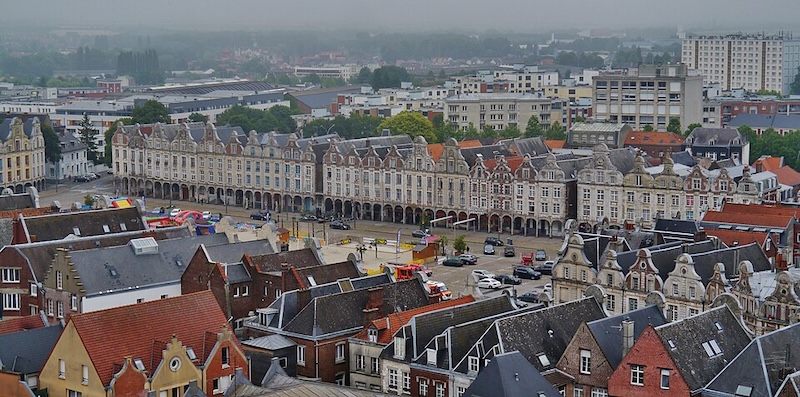 Grand'Place as seen from the belfry
Today, the enormous paved center can make the square seem almost too large for its surroundings, yet crowded with parked cars. That is changing: the city is redeveloping the central area, with plans for more pedestrian space and greenery.
When I visited, the work was still underway, and the square felt rather empty compared with the Place des Héros (not to mention an oversized marquee that seemed distinctly out of place here). The renovations should bring back terraces and make the square feel more like a place to linger, a bit like the smaller square next door.
When you walk around the Grand'Place, use the same trick as in the Place des Héros: don't just admire the façades as a group but look at individual buildings, their gables and their decorative details. They are remarkably different, yet there is a unity there.
One house deserves particular attention.
Maison des Trois Luppars
The Maison des Trois Luppars is the oldest house on the Grand'Place, and the only one with a stepped gable instead of a Flemish Baroque one. It is now a hotel.
Its present brick structure dates to 1467, although there was an earlier building here.
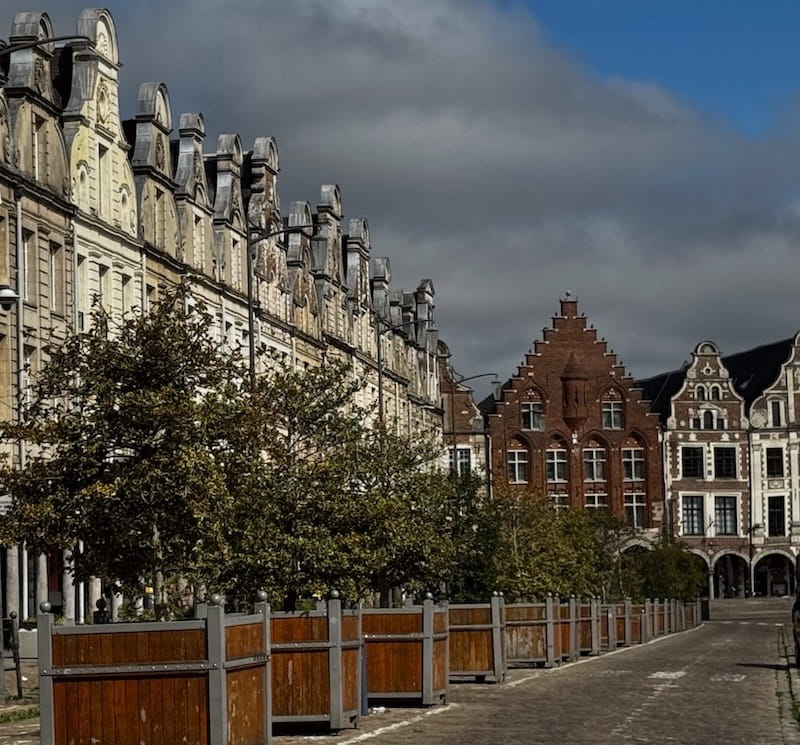 The Maison des Trois Luppars on the Grand'Place ©️OffbeatFrance
The house is unusually elaborate because its architecture was also a status symbol. It has a brick façade, with pointed sandstone arches and windows are arranged in travées brugeoises, also found in the Flemish cities.
The house also has a remarkable political history.
In 1435, the square hosted a papal nuncio during negotiations that led to the Treaty of Arras, an important step in ending Burgundy's alliance with England during the Hundred Years' War.
The treaty itself was signed at Saint-Vaast Abbey.
So one of the buildings you might dismiss as a pretty old house was once the setting for important European diplomacy.
BEFORE ARRAS WAS FRENCH
Arras was not always part of France.
For centuries it belonged to the County of Artois and was part of the Burgundian and later Habsburg Netherlands; the city became definitively French in 1659, when the Treaty of the Pyrenees transferred Artois to France.
The materials
The façades can help tell you in which period the original houses were built.
The more elaborate brick-and-stone houses generally date from the late 16th and 17th centuries, when Arras was part of the Spanish Netherlands and Flemish Baroque architecture influenced the city.
The more restrained, often entirely stone façades generally belong to the 18th century, after Arras became French.
House signs
Before street numbering came into use in the 18th century, houses in Arras were identified by names and symbols.
If you look, you'll see that some of those old identifiers are still on the façades.
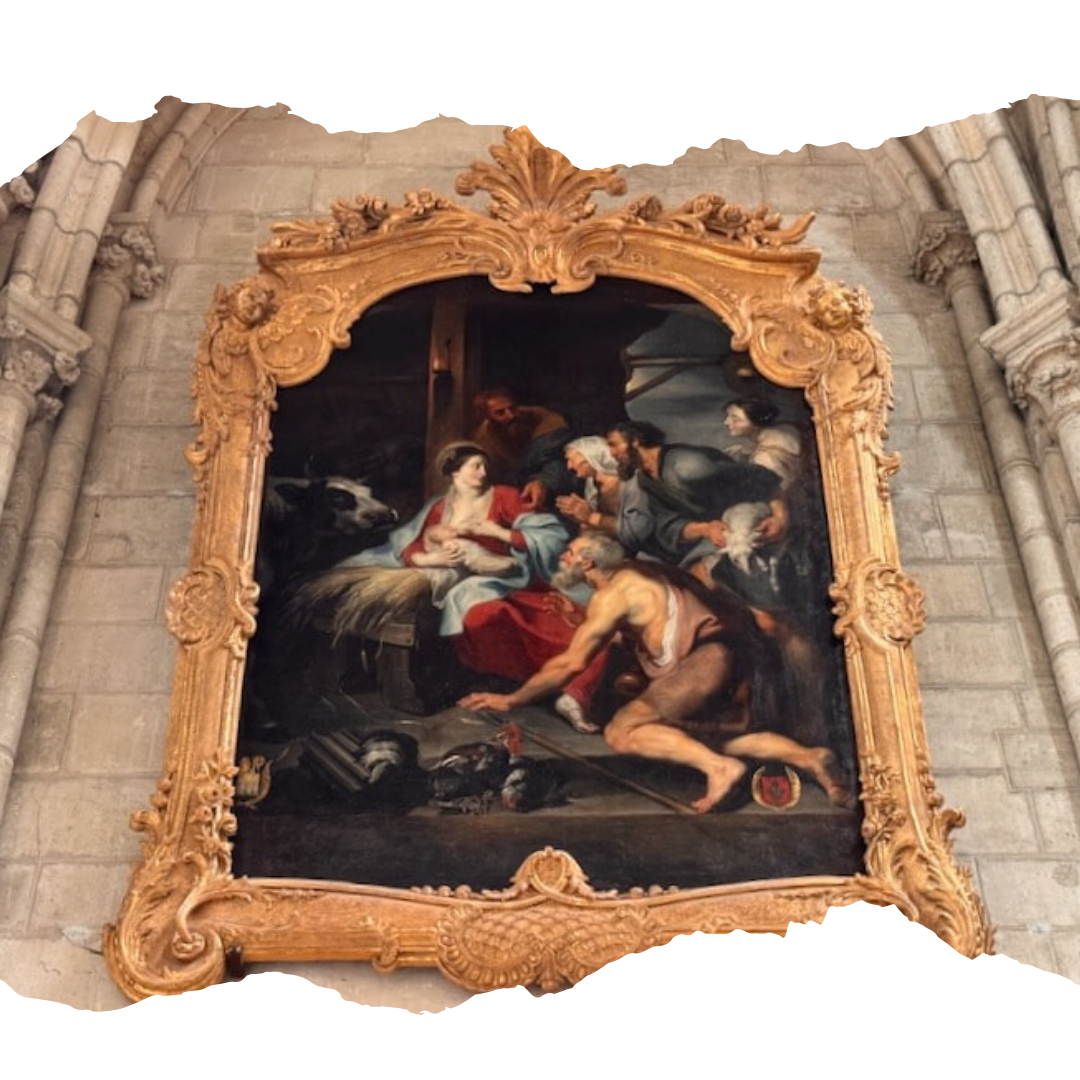
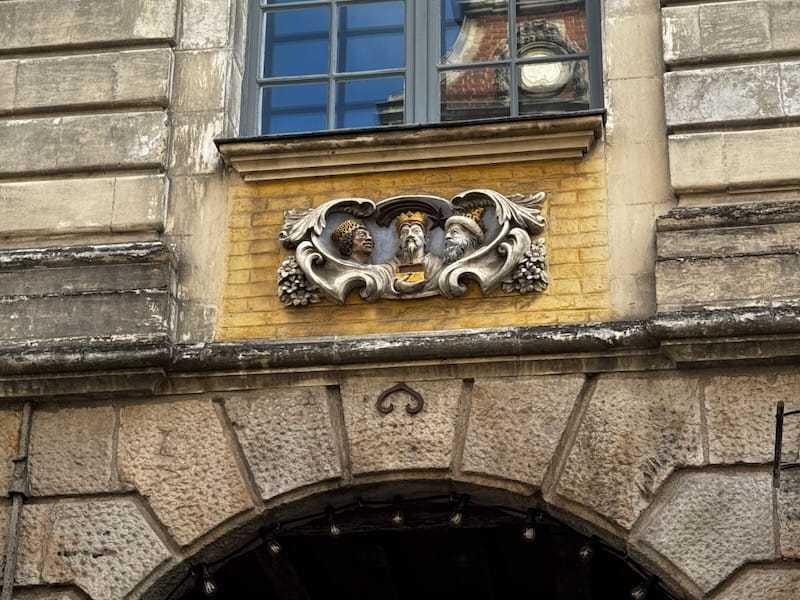 On the Rue de la Taillerie, which links the two great squares, look for Les Trois Rois (the Three Kings) at No. 8. The sculpted cartouche shows the three Magi ©️OffbeatFrance
Search for a unicorn, a mermaid, shells, religious figures and symbols associated with trades. A farrier, for example, could identify his business with a horseshoe that required no explanation. On the Grand'Place, these are often agricultural - sheaves of wheat, crossed palms, cereals, all recalling the square's original function as a grain market.
There was even a rule about how signs could be displayed: they couldn't just hang from a projecting bracket over the street, presumably because of the danger of them swinging in the wind over the busy squares. You could spend hours looking for these signs and identifying them.
The belfry and Hôtel de Ville
The belfry and Hôtel de Ville, or town hall, form the architectural and civic center of Arras, and are best visited together.
The belfry
The Arras Belfry is one of 23 in northern France listed on the UNESCO World Heritage site Belfries of Belgium and France. UNESCO describes these towers as symbols of the emergence of municipal power and the civic freedoms won by medieval towns.
That's exactly the case in Arras.
In 1194, Philippe Auguste granted Arras a charte de franchise, giving the city greater municipal autonomy. Its officials, the échevins, now had the power to administer the city's justice, economy and government, in other words, self-government.
The city also acquired the right to its own civic bell — it could mark civil time independently, so around 1463 the city began building its belfry, which would only be completed nearly a century later, in 1554.
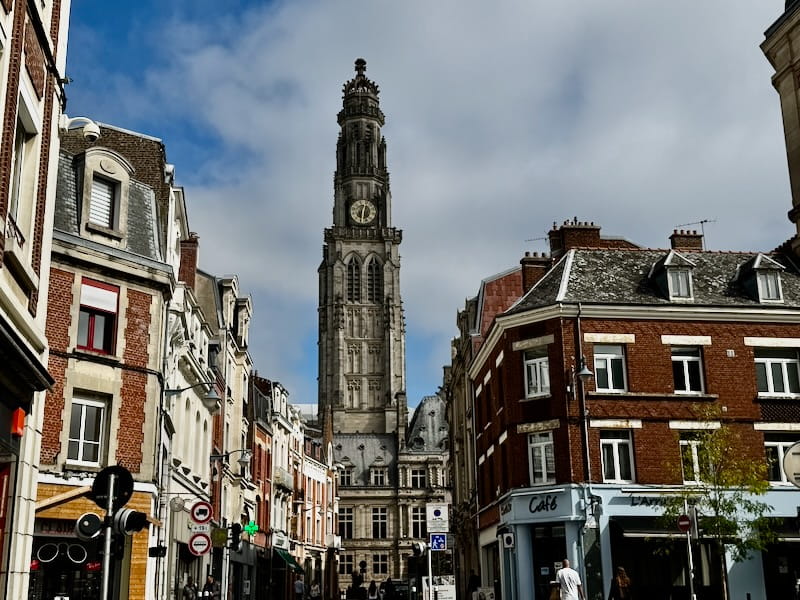 A side view of the belfry from the streets of Arras ©️OffbeatFrance
The tower starts with a square base and becomes octagonal higher up. Look for the four clock faces and the wooden slats through which the sound of the bells can escape.
The bells each had practical uses. The three large bells beneath the clock could announce an approaching enemy or a fire, as well as signal specific civic events. The Cloche du Lait was associated with marking time related to the working day; Joyeuse announced the arrival of sovereigns for their joyeuses entrées; and the Retraite marked curfew.
Above them is a 37-bell carillon which plays a traditional song from northern France.
At the top, you'll see the crown associated with Charles V and, most of the time, the golden lion of Arras. When the belfry was completed in the mid-16th century, Charles V was still sovereign, so a real royal crown was placed above the tower.
The lion normally sits above the crown and acts as a weather vane but is currently away for restoration and gilding; its tail was damaged and is being repaired and is expected back around April 2027.
The climb is easier than you might expect. An elevator takes you most of the way up, followed by a circular metal staircase to the viewing level. I have vertigo, so I wasn't entirely looking forward to that part, but the view made it worthwhile and the ascent was easy.
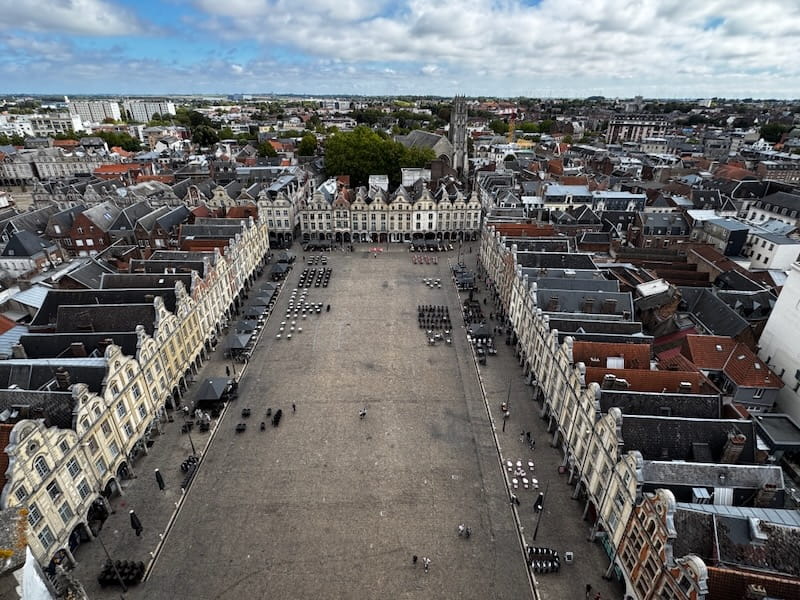 The Place des Héros as seen from the belfry, but I didn't quite catch the Grand'Place, which is just off to the left ©️OffbeatFrance
Hôtel de Ville
The Hôtel de Ville brings several periods of Arras's architecture together. The original building dates from 1501 and is Flamboyant Gothic, while the Renaissance wing, added around 1572, is more classical, with columns and carved decoration.
A 19th-century wing was later added in an eclectic style, but it was destroyed in World War I. During the reconstruction, Pierre Paquet chose to return to the 16th-century design, so the rebuilt Hôtel de Ville does not reproduce everything that stood here before 1914.
When I visited, the right-hand wing was under scaffolding, but you can still see the contrast between the Gothic and Renaissance sections.
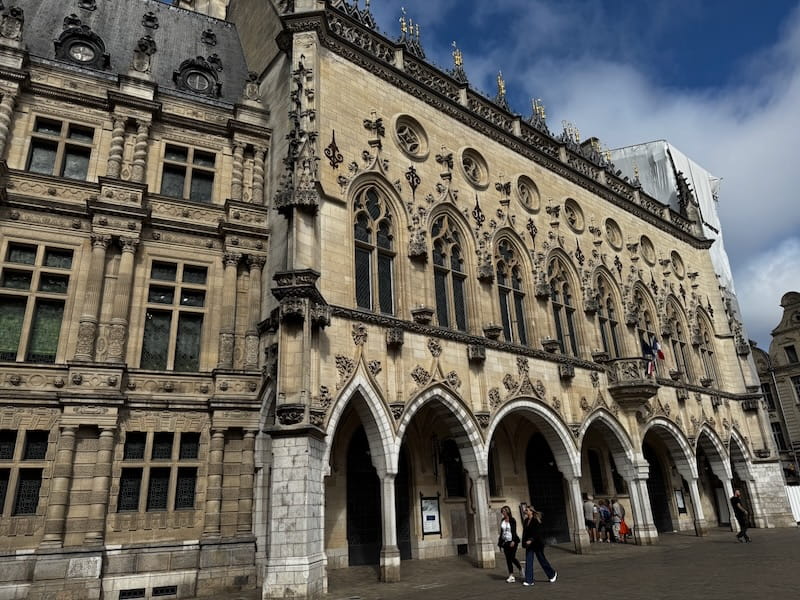 On the left is the Renaissance wing, and the large central section is the original Flamboyant Gothic building. On the right, nearly hidden and covered in scaffolding, is the other, newer Renaissance wing ©️OffbeatFrance
Go inside
The interior is where you can see the differences between the historic-looking exterior and the 20th-century reconstruction.
The Salle des Gardes contains Gothic elements, while the ceremonial rooms combine older styles with Art Deco, the style that was popular at the time of reconstruction.
There are three particularly important ceremonial rooms, as well as toiles marouflées — large paintings mounted directly onto the walls. These can all be visited (as long as they're not being used) on tours organized by the tourist office, which is inside the building as you enter on your left.
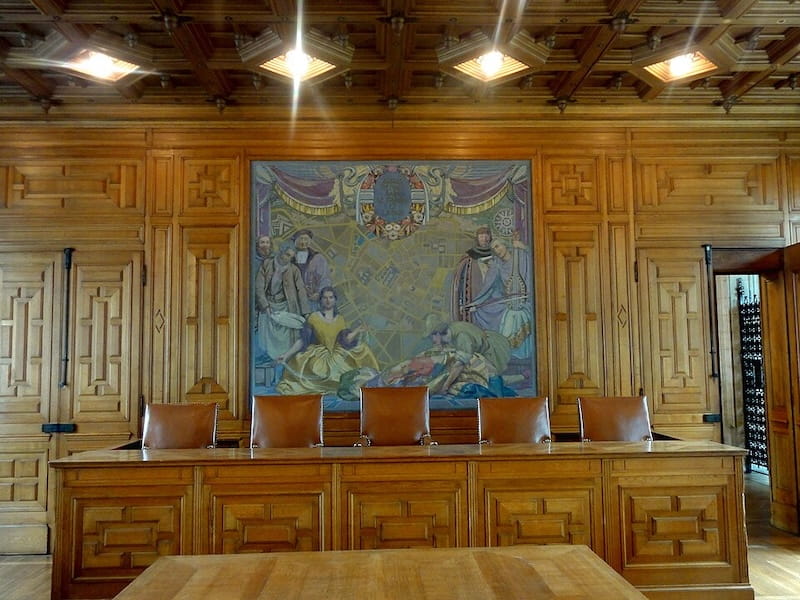 The very Art Deco municipal council room of the Arras town hall by Pierre Poschadel, CC BY-SA 4.0, via Wikimedia Commons
It's worth the visit because this Art Deco redesign is one part of Arras you cannot see from the outside.
Art Deco
The reconstruction took place largely during the 1920s, so the period inevitably left its mark, and not just in the town hall. Look for geometric decoration, ironwork, doors, balconies, mosaics and shopfronts.
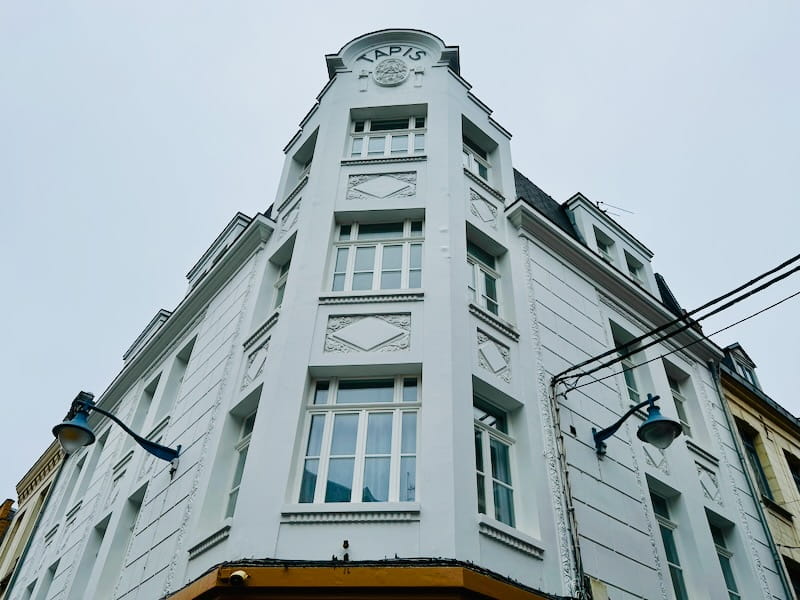
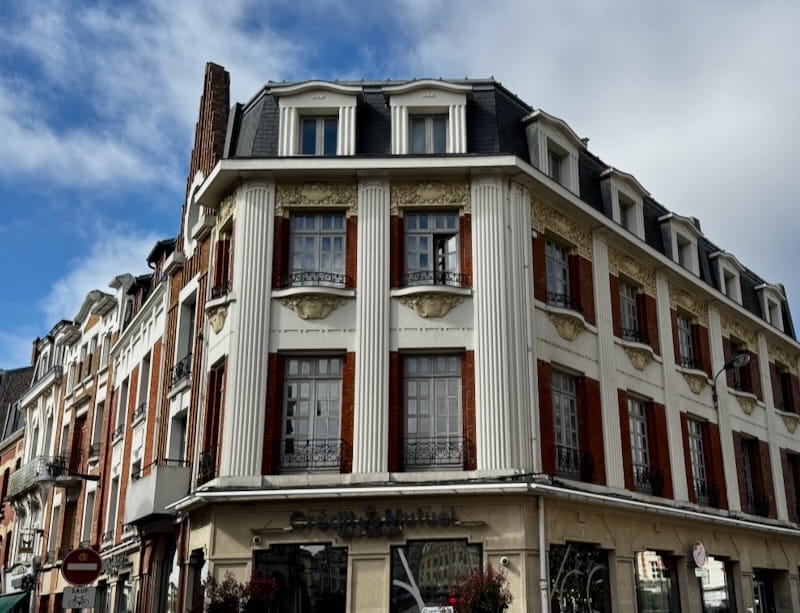 Examples of the Art Deco buildings you'll find scattered around Arras ©️OffbeatFrance
Arras has considerably more Art Deco than visitors realize, but that it isn't promoted consistently outside the annual Printemps de l'Art Déco, unlike the promotion given to Art Deco heritage in other cities of the Hauts-de-France region, like Saint-Quentin.
Saint-Vaast Abbey and the Musée des Beaux-Arts
The enormous former Saint-Vaast Abbey is another important stop, particularly if you want to see how much of Arras's monumental architecture extends beyond the two great squares.
Although it was founded in the 7th century, the Benedictine abbey you see today dates largely from the 18th century, when the abbey was rebuilt in a grand classical style. It was badly damaged during World War I and reconstructed afterward, with Pierre Paquet overseeing the work.
Nor is this just another old French abbey. At around 20,000 square meters (nearly five acres), it is described by the French Ministry of Culture as the largest ensemble of 18th-century religious architecture in France.
Today the complex houses the Musée des Beaux-Arts, whose collections range from medieval sculpture to Flemish and Dutch painting, as well as the former monks' refectory, cloister and other historic spaces.
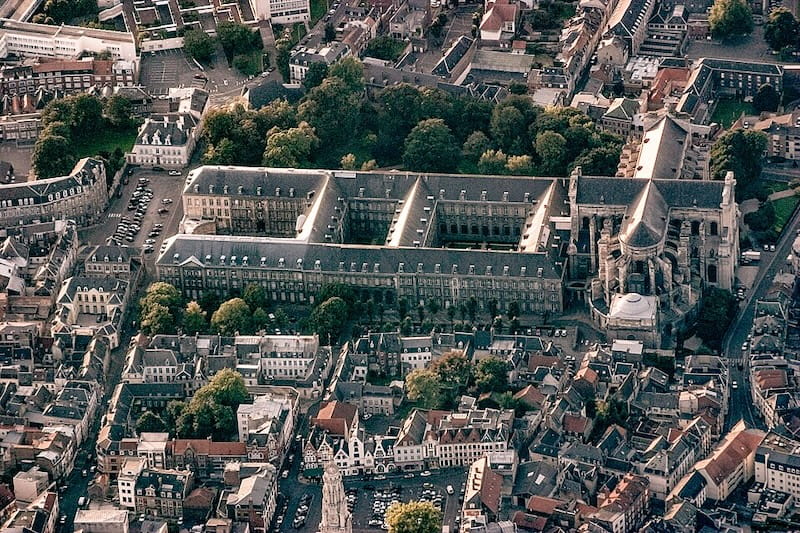 St Vaast Abbey as seen from above. Photo posted by Pir6mon, CC BY-SA 1.0, via Wikimedia Commons
The Citadel: Arras's military side
The Arras Citadel is a completely different experience from the squares and the historic and civic center.
A pleasant 15-minute walk from the grand squares will lead you from the world of merchants and markets to the Arras of Louis XIV.
Arras's Citadel was built by Vauban, the king's military engineer, in the 17th century as part of the defensive pré carré, the fortified belt protecting France's northern frontier.
Make sure you visit the Mur des Fusillés, the wall against which 218 Resistance members were shot (the Place des Héros is named in their honor). Also worth visiting are the Place d'Armes, the Arsenal and the chapel.
Today the Citadel is a UNESCO World Heritage Site and an unusual place to explore because the military occupation ended only in 2010: much of the original complex survives, but barracks and other military buildings have been converted to civilian uses. You can even live there.
Go underground: the Boves and Wellington Quarry
Arras has another city beneath its streets. The Boves are a network of underground quarries and passages created by centuries of quarrying beneath the city center.
Many houses traditionally had several levels of cellars. The first two were roughly four and eight meters below street level and were used to store goods for the businesses above. Below them, the Boves could extend to around 12 meters (40 feet) beneath the streets.
As you walk around Arras, look for small openings at sidewalk level or around older buildings. These hatches lead down into the cellars and, in some places, eventually to the Boves. Some of the underground spaces have since been converted into restaurants and bars, so you can have one business at street level and another operating directly underneath it.
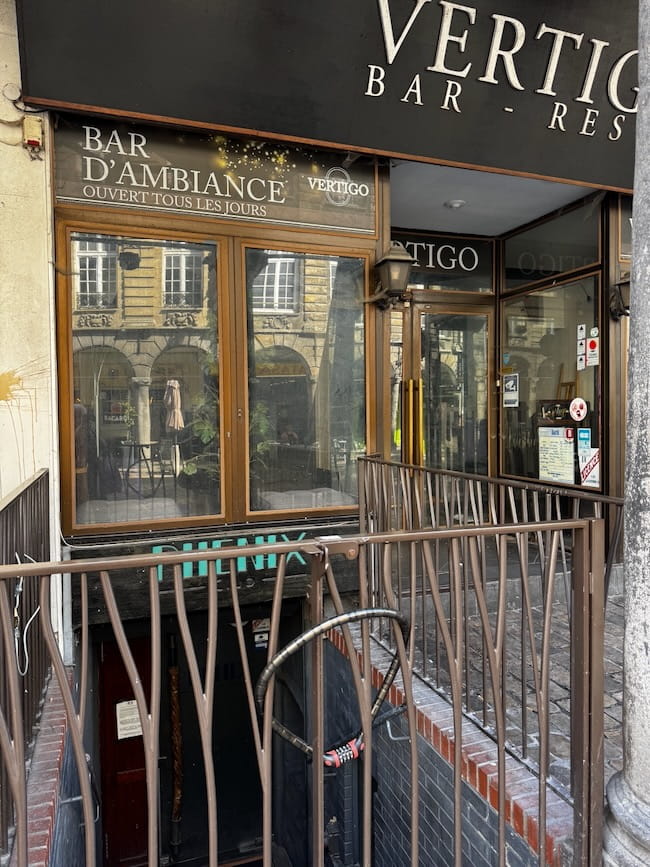 This is an example of how basements are reused for businesses these days - a restaurant bar upstairs, and another one at the level below ©OffbeatFrance
Then there is Wellington Quarry, which is the wartime counterpart to the older Boves: an underground space created when the existing quarries were adapted for military purposes during World War I.
New Zealand tunnellers connected the quarries to create an underground barracks for up to 24,000 soldiers, who waited there before emerging close to the German lines on the morning of 9 April 1917.
Together, the Boves and Wellington reveal what is often called Underground Arras, the hidden city beneath Arras, where centuries of quarrying left a network of spaces that was repeatedly given new purposes.
BEYOND ARRAS
Arras makes a useful base for exploring the wider Artois region. Vimy Ridge and Notre-Dame-de-Lorette are natural additions for anyone following the World War I story; Lens and the Louvre-Lens provide a different day out. If you have a car, you can combine several of the area's battlefield sites in a single outing.TIP
A few more things to look for
Walking around town, you might miss a few details as you move around, details like...
The rat
It's the city's unlikely symbol.
The rat has been associated with Arras for centuries, partly because the city's name once sounded like à rats — “with rats” — in French. Rats were already appearing on the city's seals in the 14th century.
The story became more elaborate during the siege of 1640, when French forces captured Arras from the Spanish. According to local tradition, the departing Spanish left a taunt: “When the French take Arras, the mice will eat the rats.” The French supposedly responded by erasing a single letter from the verb, changing the meaning to “When the French give up Arras, the mice will eat the rats.” Arras stayed French, and the rat remained.
You'll find rats throughout the city's imagery — including on the Hôtel de Ville and even on the cathedral — and in local chocolate shops, where chocolatiers have turned the city's unlikely mascot into a rather more appetizing souvenir.
Victor Hugo quarter
One more place worth adding to your walking map is the Victor Hugo quarter, beside the former Schramm military district. This 18th-century neighborhood survived World War I and is useful for comparison: here you can actually see what an Arras street looked like before the 20th-century rebuilding. There is an octagonal square with an obelisk at its center and several restrained, classical buildings.
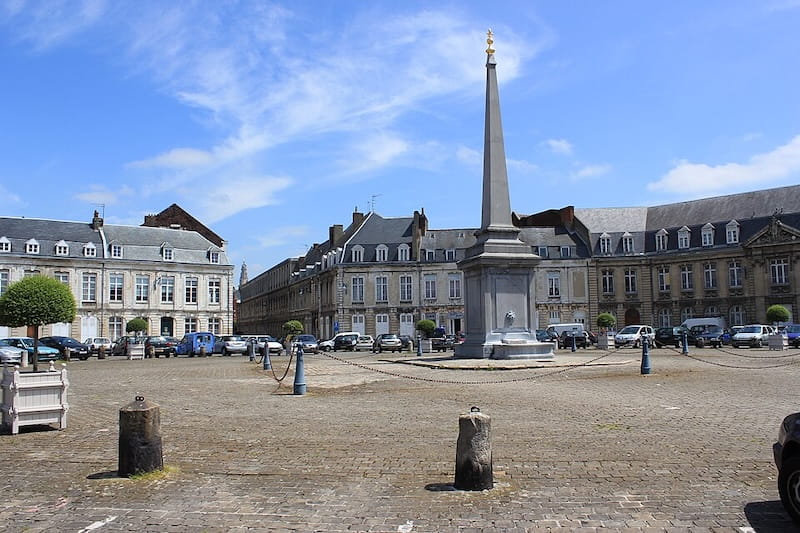 Victor Hugo Square, one of Arras’s surviving 18th-century neighborhoods. Photo by Devisme.alain, CC BY-SA 3.0, via Wikimedia Commons
The quarter is also where you will find the Maison Robespierre, the 18th-century house where Maximilien Robespierre lived with his sister Charlotte and brother Augustin from 1787 until he left for Versailles in 1789.
Robespierre was born in Arras and worked here as a lawyer before becoming one of the most prominent — and controversial — figures of the French Revolution. He became a deputy to the Estates-General and later a leading member of the Committee of Public Safety during the Terror, the period of revolutionary repression and mass executions in 1793–94.
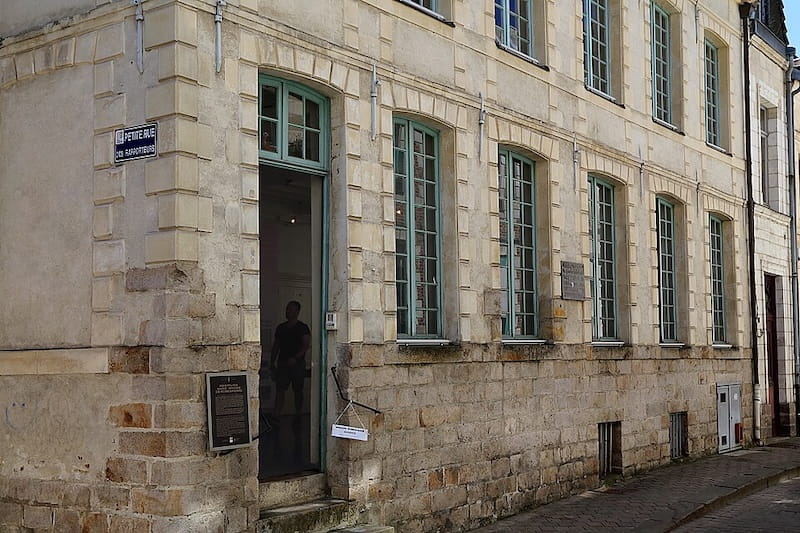 Maison Robespierre at 9 rue Maximilien-Robespierre. It's closed to the public these days but check with the tourist office since there are sporadic thoughts about reopening it. Photo by Jamain, CC BY-SA 4.0, via Wikimedia Commons
The house has been restored, and its main room contains panels and documents about his youth in Arras and his career as a lawyer. It hasn't been open in a while so check with the tourist office before making a special trip.
Opposite the house is the late-18th-century Neoclassical theater, another reminder that this was an important and cultured city long before World War I.
PRACTICAL INFORMATION
- Getting there: Arras, the Pas-de-Calais department of the Hauts-de-France region, is less than an hour on the high-speed TGV line from Paris Gare du Nord. It's a ten-minute walk downtown but you can also hop on the free shuttle, La Citadine.
- How long to stay? You can see the main sights in the historical center in a day, but a second day would also give you a chance to visit some of the less usual venues, especially those underground or those outside town, like the Canadian memorial at Vimy.
- Where to stay: I stayed at the very welcoming Mercure across from the train station (I arrived at the end of a long day) but you'll also find plenty of accommodations in the historical center.
- Where I ate: All around the Place des Héros. There are plenty of restaurants with terraces right on the square and you'll get your fill of regional food. I had a delicious lunch at Le Silex - definitely a stop for meat-lovers (I had a yummy but highly perfumed andouillette d'Arras in mustard sauce).
- Best for: travelers interested in military history and architecture, urban renewal, UNESCO sites, WWII and the Résistance.
Before you go...
As you've probably seen by now, in Arras, things are not always what they seem. The city center looks as though it survived World War I unscathed, yet it was rebuilt, almost from scratch, carefully and with plenty of research.
The town hall is a pastiche of styles where Gothic, Renaissance and Art Deco coexist, and the Citadel, once military, is now geared to the citizenry of Arras. Below the city streets, Arras continues playing tricks on us, with underground tunnels extending the city far from the surface.
So when you visit, look twice – once for that first impression, and again for what hides behind it.
If that sort of historical sleight of hand appeals to you, you'll love the Château de Pierrefonds, another French landmark where things are not quite what they seem.
Did you enjoy this article? I'd love if you shared it!

🇫🇷

Bonjour! I'm Leyla.
Born in Paris and now based in eastern France between Lyon and Annecy, I've spent years exploring the places and stories that explain why France is the way it is.
Offbeat France is for curious francophiles, whether you're planning a trip or simply fascinated by France. Here you'll discover the history behind the villages, castles, traditions, landscapes and everyday details that most visitors notice but few can explain.
Alongside practical travel advice, I share the context that helps you make sense out of France. The more you understand, the more rewarding every visit becomes.
If you finish an article thinking, "I never knew that... now I want to know more," then I've done my job.
Learn more about me!
Read my Substack historical essays
🇫🇷

🇫🇷
Booking.comWhat's New!


-
Arras, France: Where Things Are Not What They Seem
Sep 30, 26 04:34 AM
Discover things to do in Arras France, from grand Flemish-style squares to a hidden underground city, a curious citadel and a rebuilt historic center. -
Chateau De Pierrefonds: The Strange Curse Of A Fairy-Tale Castle
Sep 26, 26 02:16 PM
Discover Château de Pierrefonds, a fairy-tale castle in northern France with a turbulent history, spectacular restoration and plenty of strange surprises. -
The Louvre-Lens Museum: How A Former Mining Town Got The Louvre
Sep 21, 26 07:51 AM
Discover why the Louvre-Lens Museum brought the Louvre to a former mining town, plus 11 remarkable works worth the trip from Paris. -
Poitiers in France: Why This Historic City Deserves More Visitors
Aug 02, 26 03:05 PM
Discover the best things to do in Poitiers, France, from Roman ruins and medieval streets to Eleanor of Aquitaine's legacy and remarkable architecture. -
Limoges, France: Much More Than Porcelain
Jul 25, 26 09:14 AM
Limoges France is more than porcelain. Discover medieval streets, enamel masterpieces and centuries of history.