Fascinated by Gallo-Roman history? Click Here to download > > > Here are 6 ways Rome affected France





Follow me on
- Home ›
- Destinations ›
- Northern France ›
- The Louvre-Lens
The Louvre-Lens Museum: How a Former Mining Town Got the Louvre
Published 21 September 2026 by Leyla Alyanak — Parisian by birth, Lyonnaise by adoption, historian by passion
From coal mining to the Louvre: how this former mining town became home to one of France’s most unusual museums, and what to see when you visit
Ever since a "branch" of the Louvre Museum opened in the former mining town of Lens in northern France, I've been wanting to visit what can only be termed an incongruous marriage of substance and place.
The exquisiteness of the Louvre? In a northern mining town?
And once you hear the story and understand the "why" behind the decision, it will all start to make sense.
IF YOU'RE IN A MUSEUM MOOD
The building - a work of art in itself
Beyond the building: the Galerie du Temps
11 works to look for at the Louvre-Len
- 1. A piece of the Roc-de-Sers
- 2. The statue/monolith of the Mas-Capelier
- 3. Statue of Nakhthorheb
- 4. Funeral ensemble of Djedkhonsuiuefankh
- 5. The Sphinxes from the Serapeum of Memphis
- 6. Heroic statue of (maybe) Julius Caesar
- 7. Musical contest between the god Apollo and the satyr Marsyas
- 8. The Saint-Louis chessboard
- 9. Arcimboldo's Four Seasons
- 10. Goya's portrait of Luis María de Cistué y Martínez
- 11. Cupid and Psyche by Canova
In recent years, France has tried to make culture more accessible beyond Paris, to give people who don't live in the capital a chance to enjoy major national collections.
The opening of the Louvre-Lens in 2012 is a result of this cultural policy − not only to share cultural treasures with northerners, but also to help revitalize a region whose economy had crashed after coal mining ended.
The legacy of Lens
The city of Lens, like many northern cities, was devastated by German forces during World War I. Little was left.
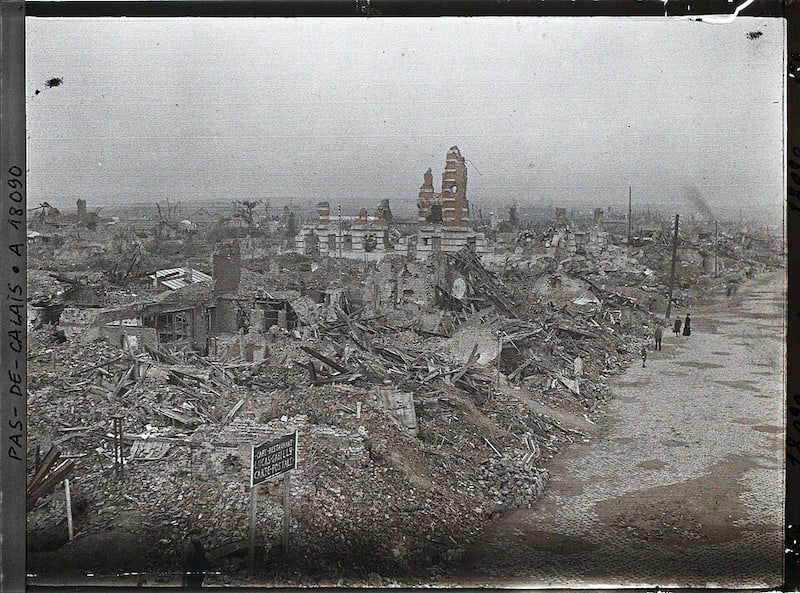 Lens after World War I, which left few of its pre-war buildings standing. Musée Albert-Kahn, CC BY-SA 4.0, via Wikimedia Commons
Lens was a major coal-mining center at the time, and retreating German forces also destroyed mine infrastructure.
The city was rebuilt afterwards, which explains much of the Art Deco character you see today.
Then came World War II. In 1944, Allied bombing destroyed about 1000 buildings in Lens and killed more than 500 people. The city had to rebuild again.
The last coal was extracted here in 1960, and the mine buildings were demolished in the 1980s. For several decades the site was essentially wasteland, surrounded by the industrial landscape left by the mines.
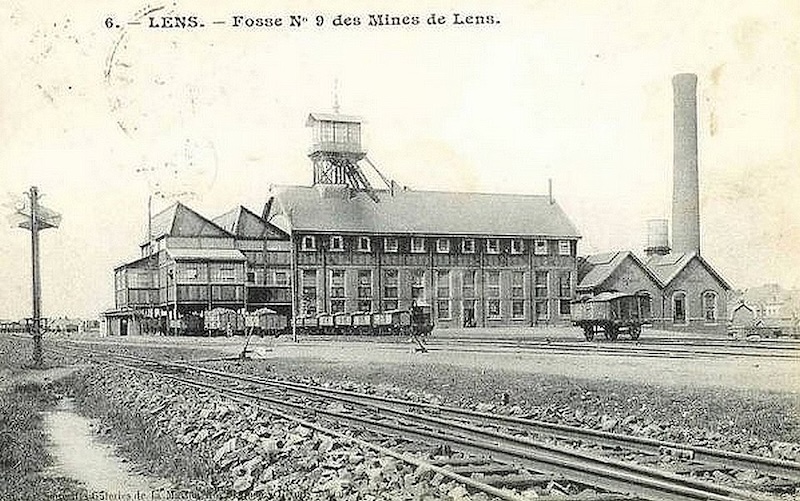
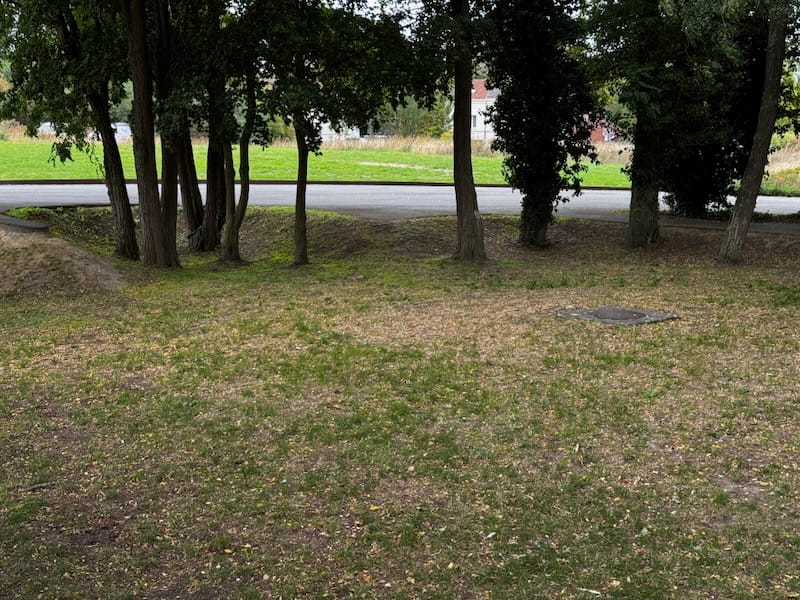 Top: Pit #9 of the Lens Mining Company, where the museum now stands. Above: What's left - a manhole
Then, in 2003, the French Ministry of Culture commissioned a study of museum attendance. It found that Parisian museums attracted a disproportionate share of visitors. (We are not surprised.)
The decision to decentralize some of the Louvre's collection followed. Once the decision was made, the question was where to put the new Louvre.
Several cities in northern France wanted it, including Boulogne-sur-Mer, Calais, Arras, Amiens, Valenciennes and Lens. Lens was the only one of the cities without a major museum, and it eventually won out – not just because it needed a museum but for several other reasons:
- the former mining site provided something rare in a city: plenty of land
- its location was close to the major roads between Paris and Lille
- there was plenty of local support, both political and local
Lens itself lies in the heart of the historical mining basin of the Pas-de-Calais, which itself is a UNESCO World Heritage Site.
Today the Louvre-Lens is home to one of France's most unusual museums: rather than a grand Renaissance palace filled with masterpieces, we have a low, modest glass-and-aluminum building set in a park right where the mine's Shaft #9 used to be.
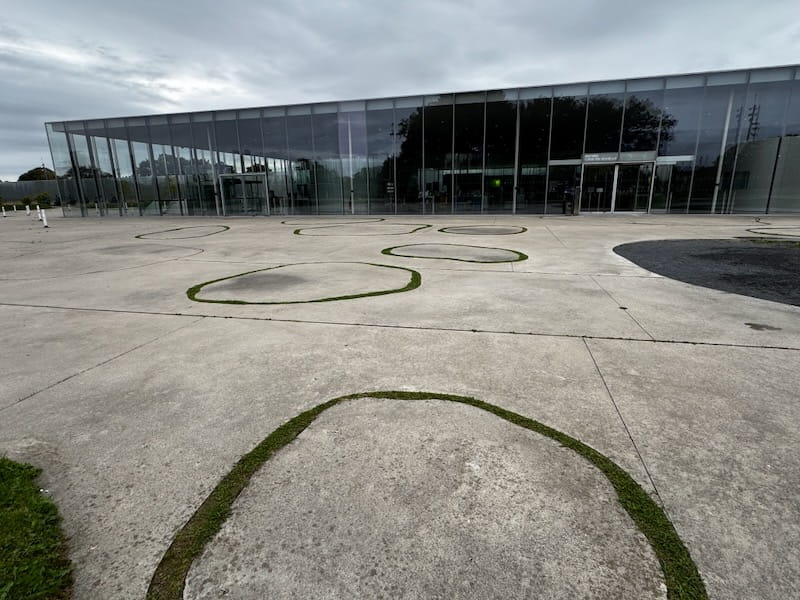 The gleaming exterior of the Louvre-Lens Museum ©️OffbeatFrance
And it is popular, often cited as one of the most visited museums outside Paris.
The building - a work of art in itself
Shortly I'll introduce you to a (very subjective) list of 11 essential works of art at the Louvre-Lens, but I would be perfectly justified in adding a 12th item to the list: the building itself.
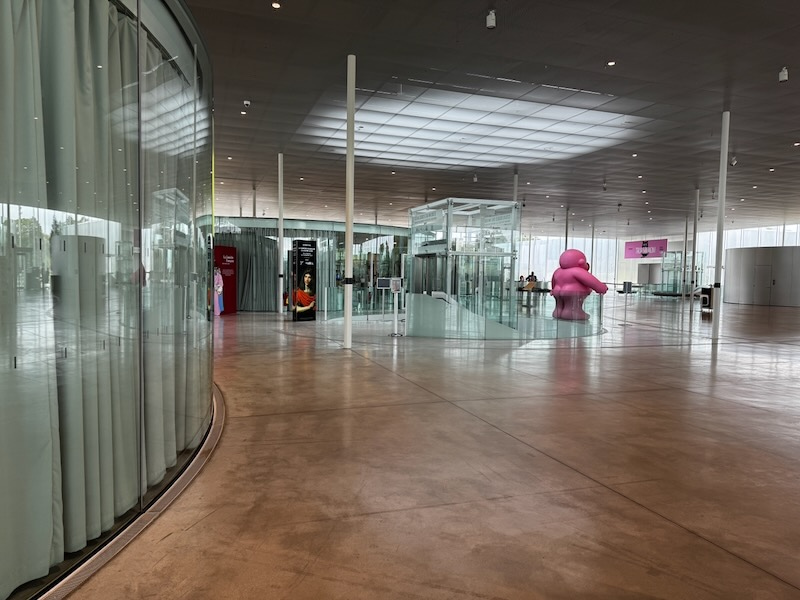 The Louvre-Lens lobby: the architecture is full of curves inside and looks geometric and linear outside - but those exterior walls are subtly curved as well. Stand inside at an extreme corner and look outside, and you'll see what I mean ©️OffbeatFrance
A major contest was launched, attracting 124 architectural teams, with the winning proposal submitted by the Japanese firm SANAA, founded by Kazuyo Sejima and Ryue Nishizawa.
Their brief was almost the opposite of a monumental Louvre: make it simple, open to nature and accessible, especially in a city not accustomed to hosting a major museum.
The gleaming silver structure, all straight lines and angles (or so they seem), is hard to see from the street; you'll have to walk up the gentle slope toward it.
Much of the building is glass, so that from outside you can see in and, from inside, you can see the park. That meant something in this former mining city, and authorities wanted local residents to feel that the building belonged to them.
The museum opened in December 2012, with special efforts to involve local people. Today, the Louvre-Lens has one of the highest proportions of visitors from its local and socially disadvantaged communities among French museums.
Beyond the building: the Galerie du Temps
The Louvre-Lens is not a smaller version of the Louvre in Paris.
The Louvre in Paris is organized largely by artistic themes, periods, and departments, so visitors move between separate galleries and collections. The Louvre-Lens takes a different approach: its Galerie du Temps is arranged chronologically, so you can move through 5000 years of art in a single open space.
That makes it possible to see connections between cultures and eras that are usually separated in Paris, and I have to say it works beautifully.
This leads to several discoveries and moments of enchantment, as sculptures and paintings are mixed together, with only time weaving between them.
When you enter the gallery, you'll notice a few things:
- the space is huge, about 3000 square meters (about 32,000 sq ft)
- the floor slopes very gently downward, giving an impression of space
- the light is natural, from slats in the high ceiling, bathing the artwork in a warm glow
- there isn't much on display, by museum standards, only some 250 works, which gives you time to observe and avoids overwhelm, making the collection easier to digest.
You'll also see a "suggested" route with footsteps taking you through the exhibits, but frankly? Let your instinct lead you: look around, see something you love, and make a beeline for it. You can always double back.
11 works to look for at the Louvre-Lens
This Gallery (sometimes called "River of Time") is the reason I'm here.
Walking along with my knowledgeable guide, Godeleine Vanhersel, we identified 11 works of art you should make a point of finding. And then go on to discover many more yourself.
While plenty of the works in Louvre-Lens are drawn from the Louvre in Paris, the collection is being increased regularly by loans from other museums.
Ready for the list? We've tried to represent as many eras and styles as possible...
1. A piece of the Roc-de-Sers
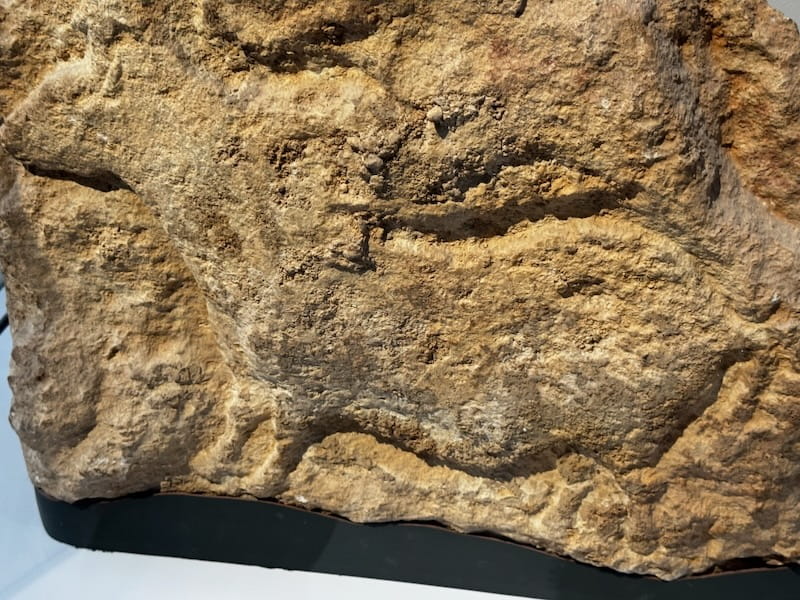 Carved horse, about 20,000 years old, from the Roque de Serre cave near Angoulême. The bas-relief shows the small horse in motion; prehistoric horses stood only about 1.3–1.4 meters at the shoulder ©️OffbeatFrance
We start at the beginning – about 20,000 years ago.
This small horse – they were smaller then – is part of a carved section of cave wall from the Roc de Serre near Angoulême. The animal is represented in bas-relief (sticking out slightly from a flat background), and you can make out its legs, belly and body as though it were moving across the stone (it's definitely clearer in person than from my photograph).
The cave was discovered in 1927, and part of the wall had already been broken. Fortunately, the break came just below the animal's legs, leaving the horse remarkably intact. Speaking of the legs, the sculptor (or sculptress, we don't know) distinguished one leg from the other, giving a distinct impression that the animal is walking.
This rare item also shows us how art history doesn't begin with the Greeks or the Egyptians ᠆ it begins much earlier.
2. The statue/monolith of the Mas-Capelier
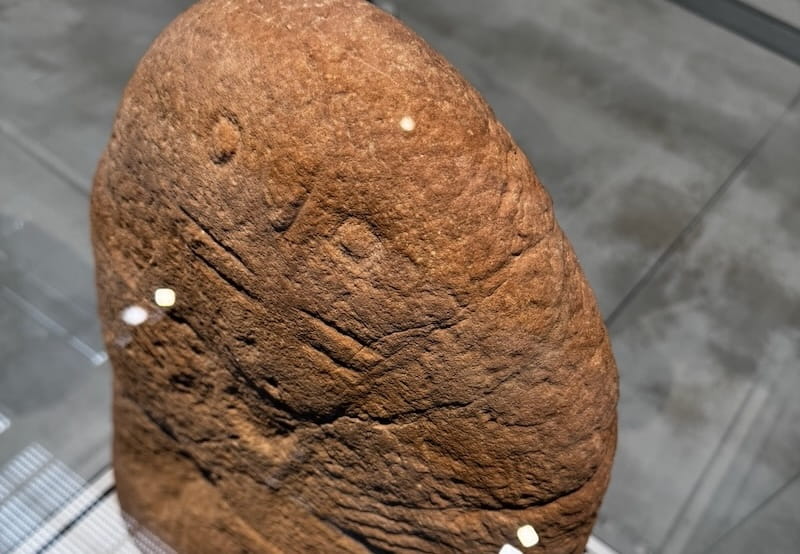 Statue-menhir of the Mas-Capelier, about 3000 BCE, one of some 220 carved standing stones found in southern France. The figure is identified as female from details including the pendant beneath her chin and the circular shape representing a breast ©️OffbeatFrance
Move forward several thousand years and look for this prehistoric standing figure, dating to around 3000 BCE, one of 220 or so examples of carved men and women discovered near the junction of the Aveyron, Tarn and Hérault departments.
At first glance she looks almost schematic: a face, hands, belt and extremely short legs. But move closer and a triangular pendant beneath her chin suggests jewelry, while a small circular shape on the chest represents a breast, details that helped archaeologists identify the figure as female.
One minute, it's just a simple block of stone. And then an artist touches it, and it begins to look human.
3. Statue of Nakhthorheb
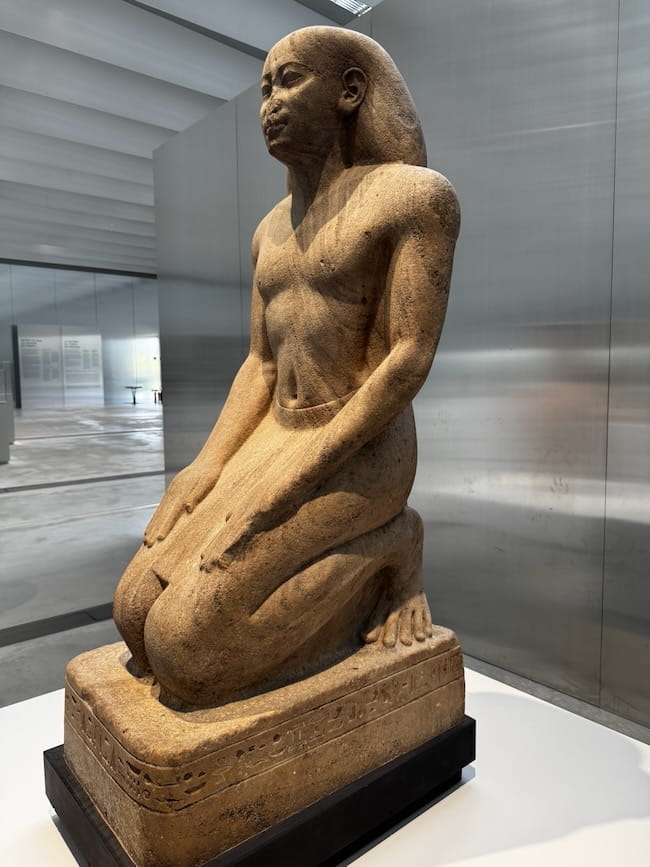 Statue of Nakhthorheb, an Egyptian priest and magician. The hieroglyphs reveal his high status at the royal court and explain why he was permitted to have a statue placed in a temple, an unusual privilege for an individual ©️OffbeatFrance
This 6th-century BCE Egyptian statue looks so simple: Nakhthorheb is kneeling in prayer, wearing little more than a loincloth, his arms close to his body. But you can't always judge a man by his clothes.
The statue is carved with hieroglyphics (along the back pillar as well) and they tell us plenty about him, including that he is placed under the protection of the ancient Egyptian deity Thoth.
Nakhthorheb was a priest and magician and held an important position at the royal court. He was influential enough to have a statue of himself placed in a temple — something highly unusual for an individual.
But that's not why it ended up at the Louvre in Paris, its original stop ⎻ it arrived in 1816, before hieroglyphs had been deciphered, so it was kept for its artistic quality rather than for its inscriptions.
The body is quite sophisticated, the six-pack muscles clearly delineated, provoking both light and shade.
And, like many Egyptian sculptures, the face is idealized rather than trying to capture an actual image of someone.
4. Funeral ensemble of Djedkhonsuiuefankh
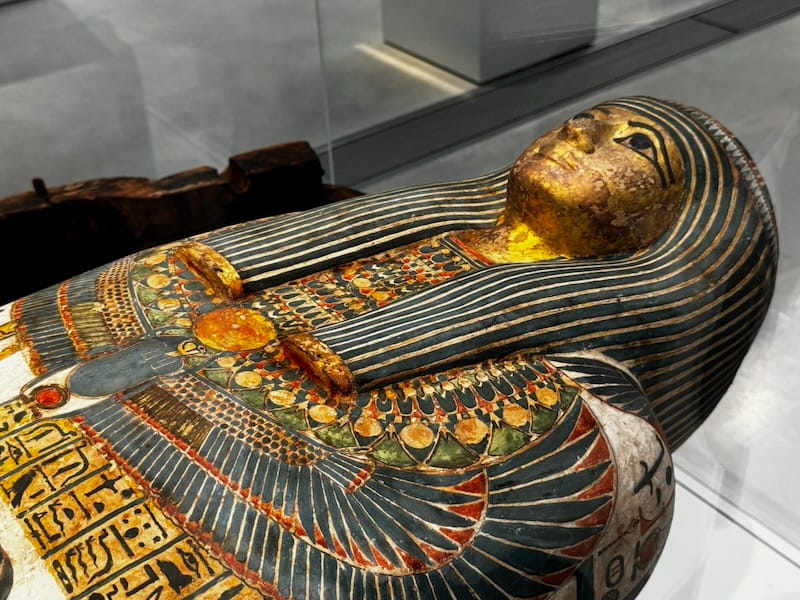
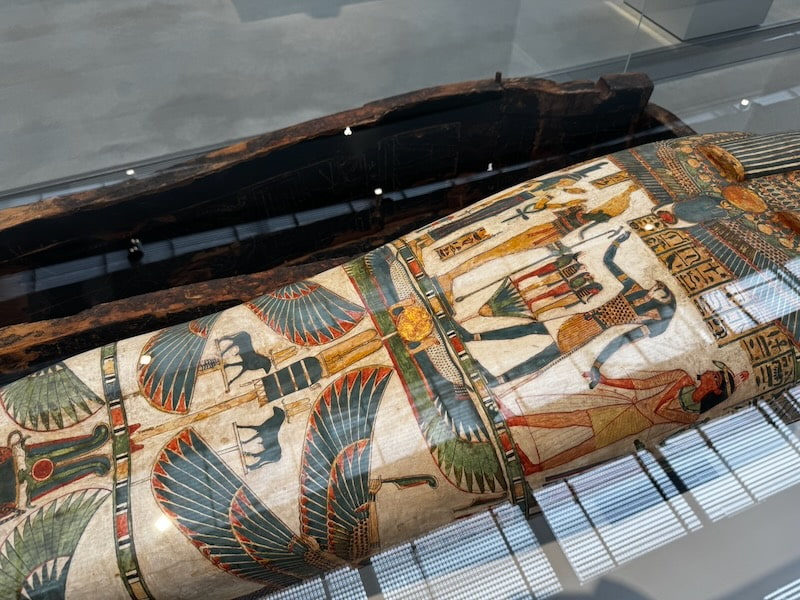 Funeral ensemble of Djedkhonsuiuefankh, including painted cartonnage made to cover the mummy. The imagery shows Osiris, Isis and Horus; the gold-covered face reflects the Egyptian belief that gold was associated with the flesh of the gods ©️OffbeatFrance
This was one of my favorite pieces, mostly because I'd never seen one before. This was the decorated covering made for a mummy, made with a technique called cartonnage — layers of fabric covered with plaster and painted, made to fit around the mummy.
It wasn't simply decoration, but part of a system of belief: ancient Egyptians believed that the afterlife required preserving the body, and the cartonnage was part of their approach to death and resurrection.
Osiris, god of the afterlife, appears alongside Isis and Horus. Horus takes the hand of the dead man, suggesting that he is being admitted into the kingdom of Osiris.
The gold covering on the face carries another message. In ancient Egyptian belief, gold was associated with the flesh of the gods, while blue suggested divine hair, providing an inkling about what the Egyptians hoped would happen after death.
5. The Sphinxes from the Serapeum of Memphis
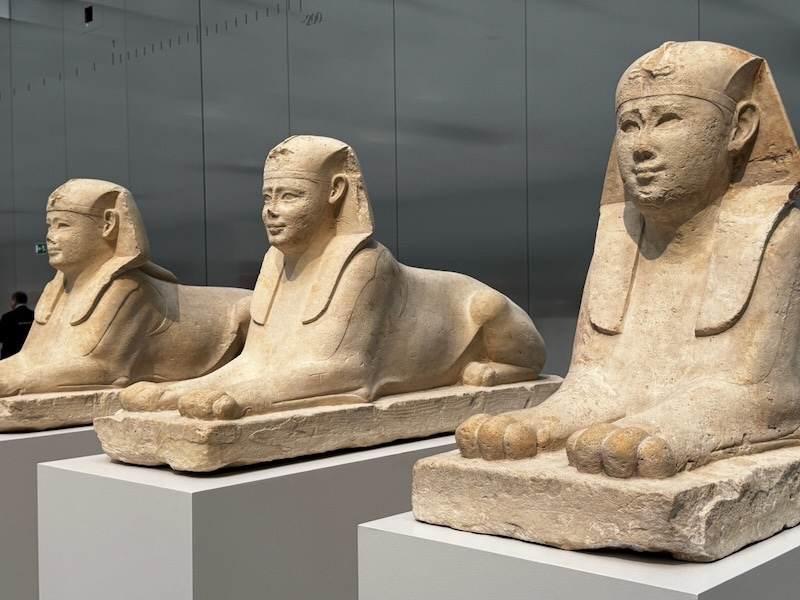 Egyptian sphinxes, 4th century BCE, found in the Serapeum at Saqqara, the burial complex for the sacred Apis bulls. Their human heads and lion bodies combine royal power with the strength of the animal ©️OffbeatFrance
This group of sphinxes shows us another aspect of ancient Egypt.
They date from the 4th century BCE and came from the Serapeum at Saqqara, an ancient Egyptian burial complex near Memphis, south of modern Cairo, associated with the sacred Apis bulls.
The Apis bull was regarded as sacred and when he died, he was mummified and buried in the Serapeum.
The sphinxes, royal creatures with a lion's body and a pharaoh's head, were part of the monuments along the approach to the complex.
The first thing of note is that a sphinx with a human body and animal head represents a deity. The reverse, a lion's body with the head of a pharaoh, is a powerful royal creature associated with the temple.
And there is an entertaining detail that has nothing to do with the official religious meaning. Look for the graffiti when you visit ᠆ it was left by visitors long ago, who visited ancient Egypt well before mass tourism arrived.
6. Heroic statue of (maybe) Julius Caesar
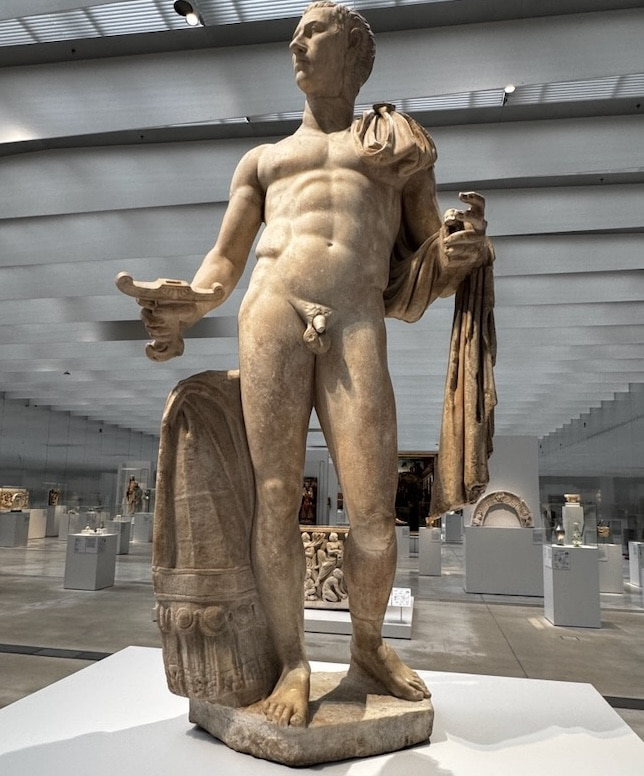 Probable portrait of Julius Caesar in the 1st century BCE. Not confirmed, but art historians generally consider its identity plausible. The head does not belong to the original body, illustrating how ancient sculptures were sometimes assembled or altered over time. The figure wears the military cloak of a Roman general and holds a sword scabbard ©️OffbeatFrance
This statue is traditionally identified as Julius Caesar, although no one has been able to confirm it.
The interesting thing is that it is not simply a matter of looking at a familiar face and deciding whether it resembles the Caesar we have seen in books.
Roman sculpture inherited heavily from Greek sculpture, and the relationship between the head and body can tell us something about how a statue was constructed, except that in this case, the head and the body probably come from different sculptures.
No matter, but there's something else to notice: the space between the arm and the body.
In prehistoric sculpture, the arms and body often remain connected because separating them would weaken the stone. Greek sculptors developed techniques that allowed much more open space, and Roman sculptors inherited them.
It is a small detail, but it helps explain how sculpture changed technically as well as artistically.
7. Musical contest between the god Apollo and the satyr Marsyas
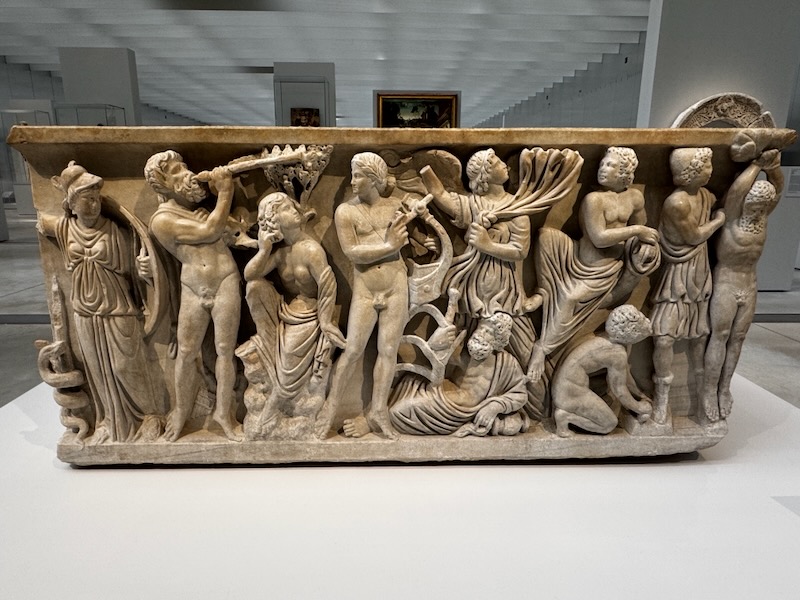 Sarcophagus depicting the contest between Apollo and Marsyas, Roman. Marsyas challenged Apollo to a musical contest after taking up Athena’s flute. Apollo won, and Marsyas was punished by being flayed alive. The scene includes Athena, Aphrodite and a winged Victory, who crowns Apollo ©️OffbeatFrance
This is one of the pieces I lingered over and represents a story from Greek mythology involving Apollo and Marsyas.
Marsyas was a satyr who challenged Apollo to a musical contest. He played the flute; Apollo played the lyre.
Apollo won.
The punishment for Marsyas was horrific. He was flayed alive.
The sarcophagus shows the story unfolding, including the figures preparing to carry out the punishment.
Look for the winged female figure of Victory. Despite the wings, she isn't an angel. In ancient art, a winged woman often represents Victory, and here she is associated with Apollo's triumph.
There is also an interesting technical detail: have a look behind the sarcophagus and you'll see the back of it is largely unfinished, because it would have stood against a wall.
So Roman sculpture could be highly detailed where viewers could see it but much less concerned with parts they couldn't.
8. The Saint-Louis chessboard
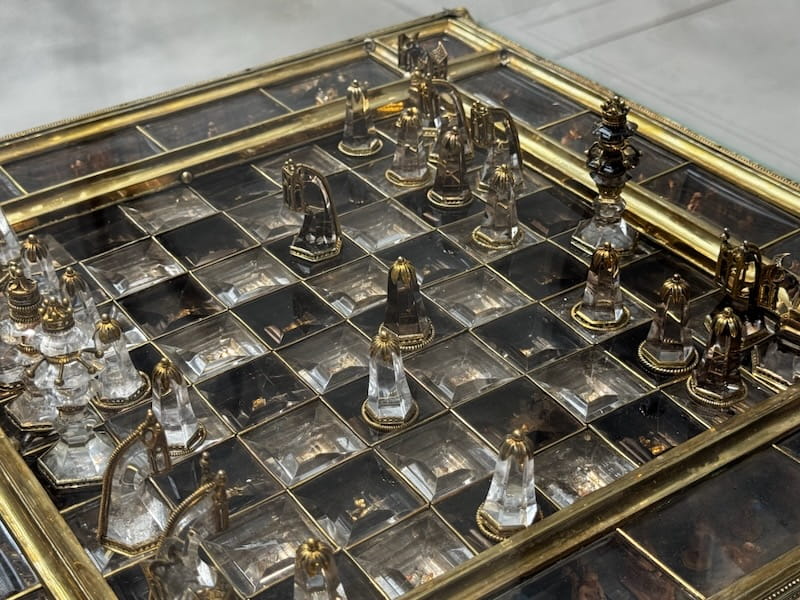 Late 15th-century European chess set, assembled from pieces made in Germany, France, and Italy. It once belonged to Gabrielle d’Estrées, mistress of King Henry IV ©️OffbeatFrance
As I said, this list is totally subjective so this is my favorite piece, a chess set made from rock crystal, smoky quartz and gilded silver, with tiny carved figures around the board.
The chessboard was made in Germany around 1490, and the Louvre dates the pieces to the same century. It's called the Saint-Louis chessboard, but the name is misleading, since the set was made more than two centuries after the king died.
I love the details. There are tiny flowers under the transparent crystal on each square. The tiny figures around the board are carved from boxwood, an exceptionally hard wood that made it possible to produce tiny swords and spears.
And then there is the missing piece. Can you spot what's not there? Perhaps you'll have to go see for yourself...
The chess set eventually entered the French royal collections and survived the French Revolution. Louis XVIII later gave it away to his valet, and it passed through private hands and the Musée de Cluny before reaching the Louvre.
So this is not just a chess set - it traces the history of European craftsmanship, royal collecting, the French Revolution and the movement of works of art between museums.
9. Arcimboldo's Four Seasons
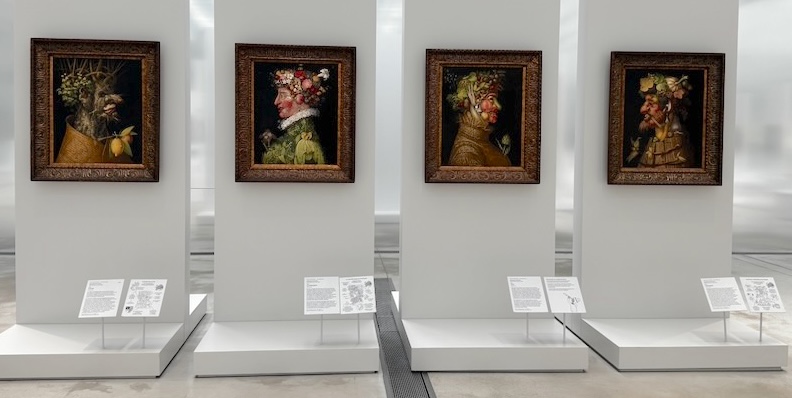 The Four Seasons, Giuseppe Arcimboldo, 16th century. Spring, summer, autumn, and winter also symbolize the cycle of human life ©️OffbeatFrance
You may have seen these before, Giuseppe Arcimboldo's Four Seasons — Spring, Summer, Autumn and Winter — which turn human faces into arrangements of plants, fruit, vegetables and other natural objects.
While the obvious joke is that Arcimboldo was very good at painting faces out of food, his 16th-century audience saw quite a bit more here.
The seasons could represent so much:
- cyclical time, of course
- the four stages of human life: spring as youth, summer as adulthood, autumn as maturity and winter as old age
- the four elements
- different temperaments
- the geographical reach of the Habsburg empire, which commissioned him, showing off exotic plants and produce
I can't do them justice here but each of these deserves a close look, in which you'll keep discovering something new as the minutes go by.
10. Goya's portrait of Luis María de Cistué y Martínez
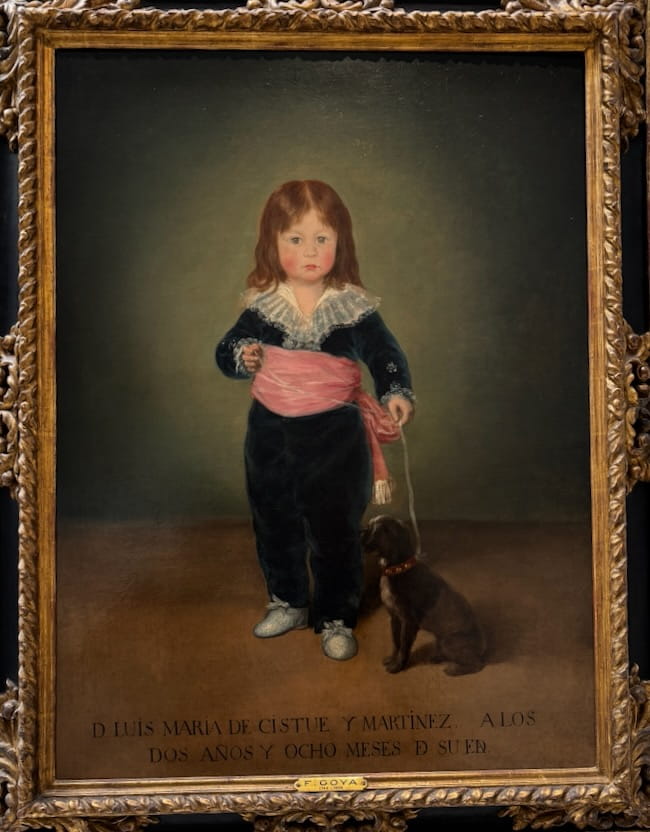 Portrait of Luis María de Cistué, Francisco de Goya, 1791. The aristocratic boy wears blue velvet, lace, and a pink sash; his uneasy expression gives the formal portrait an unusual sense of personality ©️OffbeatFrance
Goya's portrait of little Luis María de Cistué y Martínez is easy to walk past, and I'd hate for you to do that.
The inscription says he was only 2 years and 8 months old, which is hard to believe when you see how seriously he stands there in his lace collar and pink sash. He isn't smiling and he looks straight at us. A small dog beside him is looking up at him, probably hoping the sitting will end soon so they can go and play.
My guide pointed out something I would have missed. Goya gives the boy almost no space around him. The brown and green background looks like a wall and a floor at first, but you can't tell where one becomes the other, so there is nothing to look at but the child.
The painting once belonged to Yves Saint Laurent, who loved it and drew on it for his own designs. In 2009, after his death, his partner Pierre Bergé donated it to the Louvre.
11. Cupid and Psyche by Canova
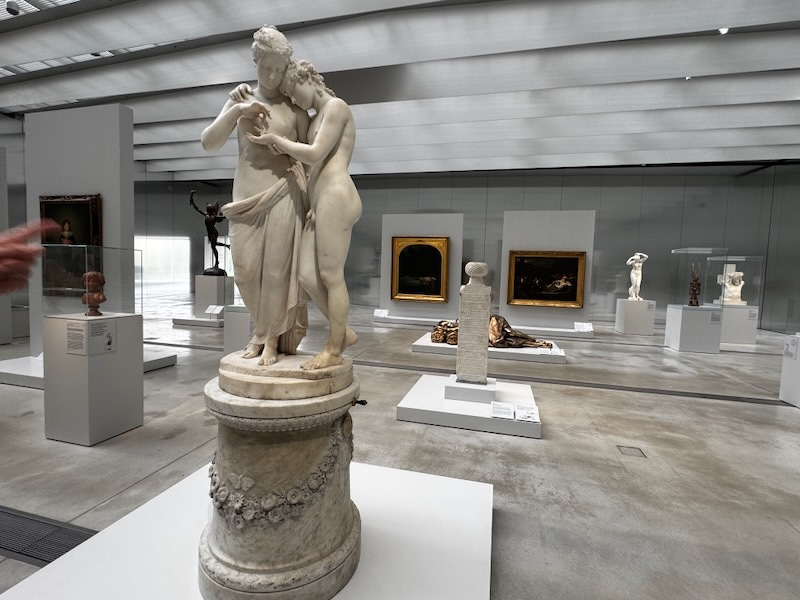 Cupid and Psyche, Antonio Canova, about 1797. Both are looking at a butterfly resting in Cupid's hand ©️OffbeatFrance
You may know Canova's other Cupid and Psyche, the reclining one in Paris. This is a different composition, with the two standing close together and looking at a butterfly. In Greek, psyche means both soul and butterfly, which is why it appears here.
The sculpture belonged to Napoleon's brother-in-law, Joachim Murat, who passed it on to Napoleon, and it entered the Louvre in 1822. There is plenty of room around it, so walk all the way around.
Look at the way the figures are arranged: Cupid's wings rise above Psyche while the two bodies form an almost circular movement.
Then look at the drapery around Psyche ᠆ it seems to be slipping, a small movement that adds an erotic element to the sculpture without making it explicit.
And this is exactly the sort of work that benefits from seeing it in Lens rather than in a list of famous works.
You have space around it, so you can walk around it and compare it with other sculptures nearby.
And you can take your time.
PRACTICAL INFORMATION
- Getting there: Take the high-speed TGV line to Arras or Lille and change there, or take the single daily direct train between Paris-Nord and Lens just past noon. Do check because train service does change. The direct train takes a good hour, and add 15 minutes for the connection from Arras. You can also get here from other cities but it takes longer. Check the schedules for the latest details. The Louvre-Lens is a 25-min walk from the station, but you can reserve a taxi.
- How long to stay? You'll get through the Gallery in half a day, but if there's a temporary exhibition, you might decide to spend a few extra hours. Add a couple of side trips and you can easily fill two days.
- Where to stay: My favorite is the Louvre-Lens Hotel, right across the street from the museum (the beds are a dream). Otherwise, you can compare hotels and guesthouses in Lens.
- Where to eat: For an excellent lunch during your museum visit, reserve a table at L'Atelier du Cerisier, on your right before you reach the museum's entrance.
- More information: Check with the tourist office for tour listings and special events. Make sure you ask for the cycling and hiking brochures which trace paths in and around Lens.
- Best for: travelers interested in history, art, architecture and industrial heritage.
Also in or near Lens
While the museum might be what gets you to Lens, there's more to see once you arrive:
- Hunt for Art Deco: Lens has an impressive Art Deco heritage, given that so much had to be rebuilt after World War I. The tourist office itself is housed in one of the town's spectacular Art Deco buildings.
- Climb a terril: At Loos-en-Gohelle, you can climb Terril 74, one of the two enormous conical slag heaps left by coal mining. From the top (among the highest in Europe) on a clear day you can see the Louvre-Lens and Vimy Memorial.
- Search the Ring of Memory: If you lost an ancestor during World War I, look for their name among the nearly 580,000 soldiers listed on the circular memorial of the Anneau de la Mémoire.
- Visit Notre-Dame-de-Lorette: Next door you'll find France's largest military cemetery and the Basilica of Notre-Dame-de-Lorette and an ossuary, in honor of the thousands of French soldiers who died in the battles for the hill during World War I.
- Stand before the Canadian National Vimy Memorial: This giant structure commemorates the more than 11,000 Canadians killed or presumed dead in France who have no known grave.
Sporty Lens
Before you go...
The best thing about the Louvre-Lens isn't that it lets you see famous works without going to Paris (although this is certainly a good thing).
It's that the museum changes how you see them.
A prehistoric horse sits within sight of Egyptian sculpture. Roman art sits near Renaissance painting. A 16th-century portrait made from vegetables is not isolated in a room devoted to one artist. A 15th-century European chess set becomes part of a much bigger theme about craftsmanship and collecting.
These connections between themes and eras – even more than the famous name on the building – are what attracted me in the first place.
Did you enjoy this article? I'd love if you shared it!

🇫🇷

Bonjour! I'm Leyla.
Born in Paris and now based in eastern France between Lyon and Annecy, I've spent years exploring the places and stories that explain why France is the way it is.
Offbeat France is for curious francophiles, whether you're planning a trip or simply fascinated by France. Here you'll discover the history behind the villages, castles, traditions, landscapes and everyday details that most visitors notice but few can explain.
Alongside practical travel advice, I share the context that helps you make sense out of France. The more you understand, the more rewarding every visit becomes.
If you finish an article thinking, "I never knew that... now I want to know more," then I've done my job.
Learn more about me!
Read my Substack historical essays
🇫🇷

🇫🇷
Booking.comWhat's New!


-
The Louvre-Lens Museum: How A Former Mining Town Got The Louvre
Sep 21, 26 07:51 AM
Discover why the Louvre-Lens Museum brought the Louvre to a former mining town, plus 11 remarkable works worth the trip from Paris. -
Poitiers in France: Why This Historic City Deserves More Visitors
Aug 02, 26 03:05 PM
Discover the best things to do in Poitiers, France, from Roman ruins and medieval streets to Eleanor of Aquitaine's legacy and remarkable architecture. -
Limoges, France: Much More Than Porcelain
Jul 25, 26 09:14 AM
Limoges France is more than porcelain. Discover medieval streets, enamel masterpieces and centuries of history. -
Saint-Quentin, France: The Art Deco City No One Talks About
Jul 15, 26 05:31 AM
Saint-Quentin France rebuilt itself in Art Deco after WWI left it in ruins. It's now one of France's most striking architectural cities. -
Visiting France In A Heatwave: What You Need To Know
Jun 26, 26 12:45 PM
Visiting France during a heatwave? Learn how to stay cool and enjoy your trip despite the heat.