Fascinated by Gallo-Roman history? Click Here to download > > > Here are 6 ways Rome affected France





Follow me on
- Home ›
- Destinations ›
- Northern France ›
- Compiegne Museum of Figurines
Museum of Figurines, Compiegne: Where Toy Soldiers Are Only Part of the Story
Published 12 October 2026 by Leyla Alyanak — Parisian by birth, Lyonnaise by adoption, historian by passion
What do ancient religious objects, Napoleon's armies, paper dolls and Warhammer characters have in common? They're all part of the surprisingly varied world of figurines displayed in Compiègne's Musée de la Figurine.
I went to the Musée de la Figurine in Compiègne expecting soldiers, as you would to a museum that boasts nearly 155,000 figurines.
And yes, there were soldiers and several spectacular military scenes, including an enormous reconstruction of Waterloo. If you like military history, you will have plenty to look at.
But what if military history makes your eyelids droop?
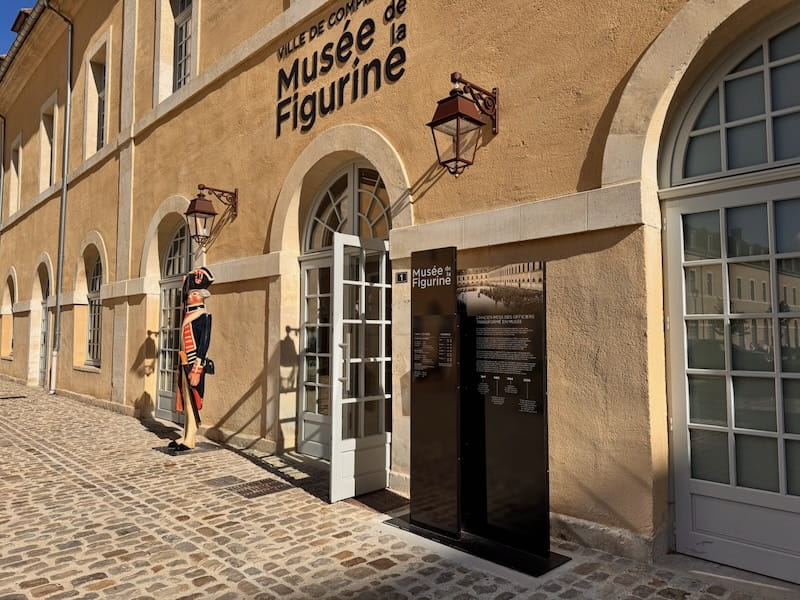 The Musée de la Figurine opened in May 2026 in Compiègne's former École d'état-major, a short walk from the historic center ©OffbeatFrance
As it turns out, soldiers are only part of the figurine story. According to the experts at this unique museum in the town of Compiègne, in the Oise department, a figurine can be a religious object, a toy, a chess piece, a work of art or even an advertising gimmick.
You can add to the list such items as Provençal santons, the tiny hard bean hidden inside a galette des rois, or the fantasy creatures used in modern tabletop games.
A figurine's only requirement is size – it must measure less than 25 centimeters, or 10 inches in height.
With this definition, you'll realize you've probably been surrounded by figurines all your life.
NOTE: Pages on this site may contain affiliate links, which support this site. See full Privacy Policy here.
A museum that is about much more than toy soldiers
What on earth has compelled people to make these miniature objects for thousands of years?
Depending on the century, the answer changes.
Among the oldest objects in the museum is a fragment of a prehistoric female figurine found at nearby Thourotte. Such figures were once routinely described as fertility symbols, but archaeologists now admit that we don't really know what they represented.
In ancient Egypt, small figures called ushabtis were placed in tombs to work on behalf of the deceased in the afterlife. In the ancient Mediterranean world, people left figurines in sanctuaries as religious offerings.
Medieval pilgrims even bought small lead or tin badges depicting religious figures. These inexpensive souvenirs were also objects of devotion, believed to offer protection during their journeys. The tradition continued for centuries.
Even chess pieces have a story. The rook, which looks like a castle tower in European chess sets, developed from a piece associated with a chariot in the game's earlier Asian forms. As chess traveled westward, its pieces changed to reflect the cultures that adopted it.
Then there were the paper figures that children could cut out and color. Some represented famous women, including the empresses Joséphine and Eugénie while others, of course, represented soldiers. Before technology took over, children could create their own miniature worlds with cardboard and a bit of imagination.
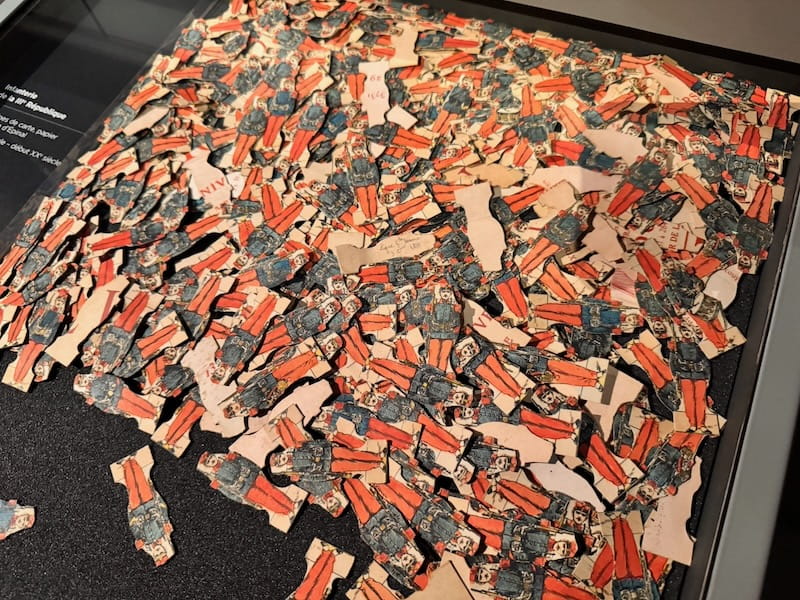 Before plastic toy soldiers, there were paper and cardboard ones. These brightly colored soldiers were printed and cut out, a far cheaper alternative to metal figurines ©OffbeatFrance
So look around you now, if you're at home: can you spot a figurine?
The people behind the tiny figures
The Museum of Figurines also gives plenty of attention to the figurinistes, the artists and craftspeople who created these miniature worlds.
Take Vladimir Douchkine, a Ukrainian-born artist who became known for painting flat tin figures. Using tiny touches of color, he created the illusion of depth on surfaces barely thicker than a hair. Look at his horses and flags and you could almost believe they were three-dimensional.
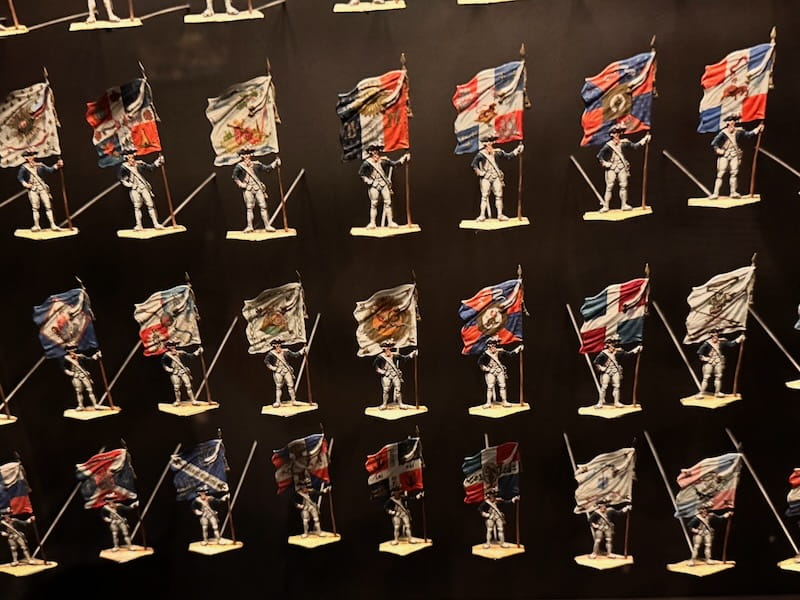 Ukrainian-born Vladimir Douchkine (1900–1989) arrived in Paris penniless in 1926 and went on to become a master of painting flat tin figurines. Inspired by the Impressionists, he used tiny brushstrokes and touches of color to create remarkable illusions of depth and movement ©OffbeatFrance
The museum also showcases the materials and techniques used to make figurines. Some artists work with extraordinarily fine brushes, painting details so small that you need a magnifying glass to appreciate them.
And not everything requires expensive materials. One artist used ordinary vermicelli to create icicles on a miniature winter landscape.
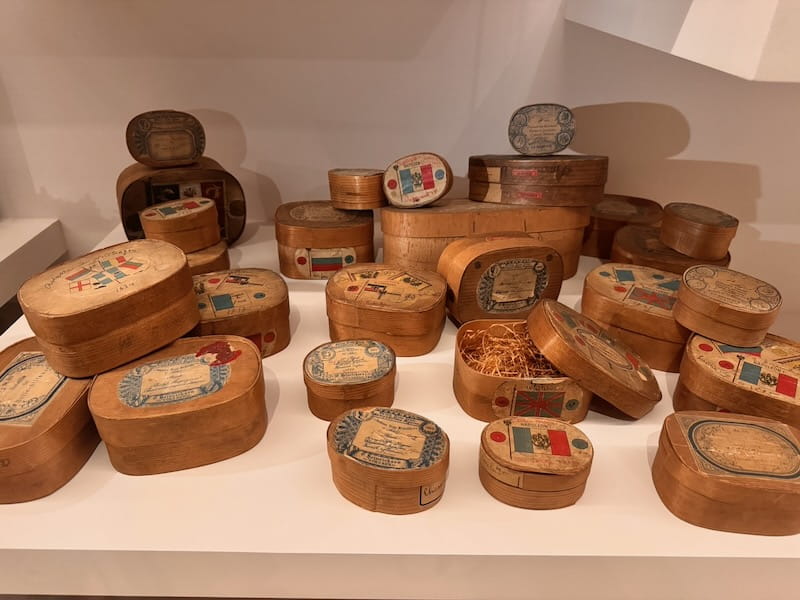 From the 18th century onward, figurines were sold in boxes that doubled as miniature stages. These often recreated historical events and everyday life, and sometimes even imaginary worlds ©OffbeatFrance
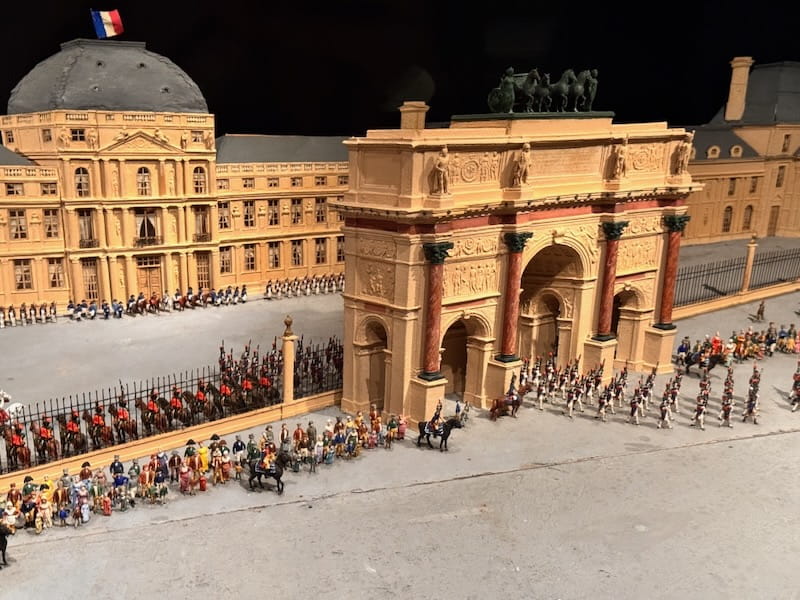 Paris as it once looked: a miniature military parade passes beneath the Arc de Triomphe du Carrousel, with the Tuileries Palace behind it. The arch still stands beside the Louvre, but the palace was burned down during the Paris Commune in 1871 and never rebuilt ©OffbeatFrance
Waterloo, but not as you've seen it before
Talk about figurines and, eventually, you'll circle back to military scenes – not just toy soldiers, but full-blown and historically accurate battle scenes, as is the case with the museum's Waterloo diorama.
If you recall, Waterloo, fought in present-day Belgium in 1815, was the battle in which Napoleon suffered his final defeat (against the British and the Prussians), bringing his brief return to power to an end.
The scene's creator, Charles Laurent, spent nearly 20 years building a replica of the battle. Covering some 21 square meters (226 sq ft), it contains around 12,000 figures, with each of those figurines representing ten men.
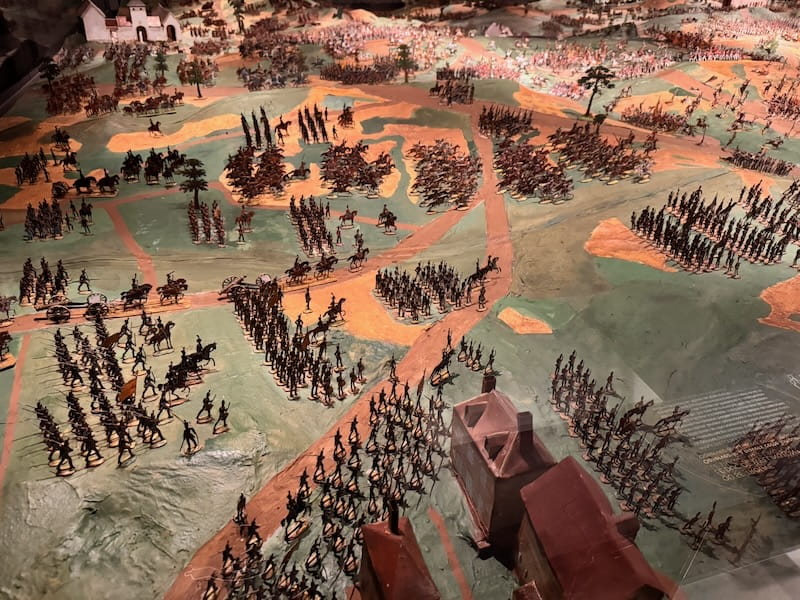 The Battle of Waterloo, 18 June 1815: Napoleon's final defeat, reconstructed in miniature. The scene captures the battlefield at precisely 4:30 p.m., with terrain so carefully reproduced that Laurent personally surveyed the site in Belgium ©OffbeatFrance
Laurent researched the battlefield and even traveled to Waterloo. When he needed to reproduce its uneven terrain, he soaked and shaped pieces of cardboard before painting them, a bit like papier maché.
The result is an extraordinary piece of craftsmanship. You can walk around the battlefield and examine the formations in detail. More to the point, you can appreciate the vast amount of work involved in creating thousands of individually painted figures.
And there's a challenge for visitors: can you find the Duke of Wellington among those 12,000 tiny figures? A telescope helps you search the battlefield.
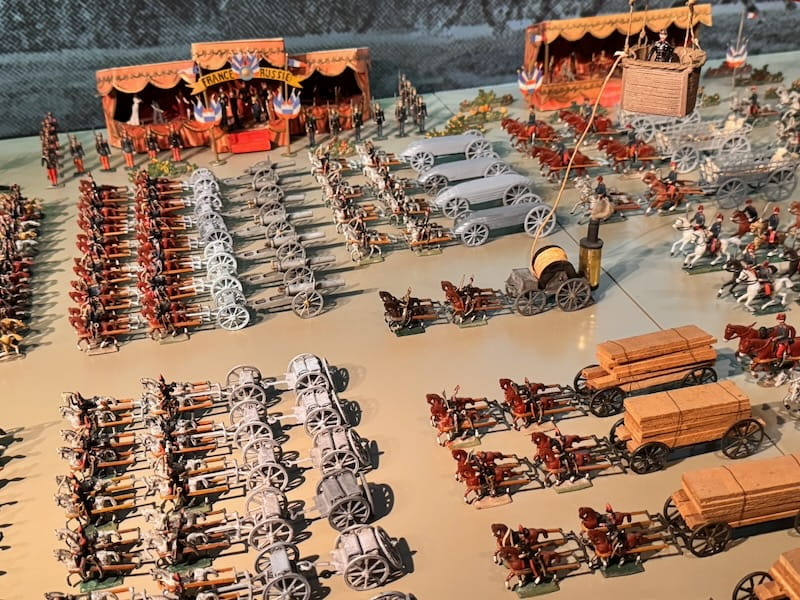 In 1901, Tsar Nicholas II and Tsarina Alexandra of Russia visited France to celebrate the Franco-Russian alliance. Their visit included a spectacular military review at Bétheny, near Reims, attended by nearly 100,000 spectators. This miniature scene recreates the occasion ©OffbeatFrance
From childhood toys to collector treasures
If you grew up collecting little figures from cereal boxes or other products, another section of the museum may bring back memories.
Manufacturers discovered long ago that a small collectible could encourage customers to buy their products (don't we know it!). Coffee companies, breakfast makers, candy manufacturers and even detergent brands offered figurines.
This being France, the museum includes such popular European-born characters as Tintin, Astérix and the Smurfs, but also the more international Harry Potter and Star Wars, along with advertising collectibles and familiar childhood toys.
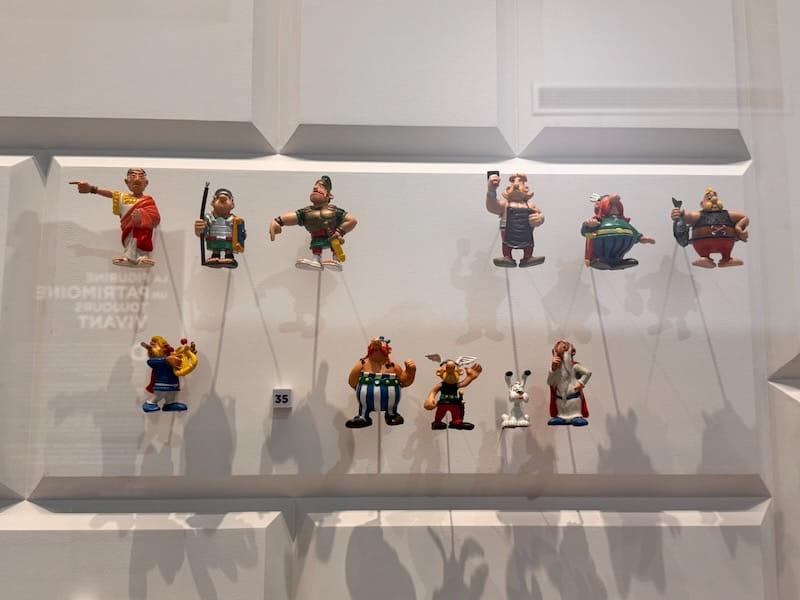 Astérix and his friends have joined the miniature world, too, an example of how figurines have moved into popular culture ©OffbeatFrance
Phones may have replaced a lot of entertainment forms, but figurines aren't going anywhere.
These days, modern enthusiasts still paint their own characters and build imaginary landscapes. Some even compete in international Warhammer tournaments (Warhammer is a tabletop strategy game in which players command miniature armies in fantasy or science-fiction battles). The museum has a display devoted to this elaborate game, of which I was blissfully unaware before visiting the museum.
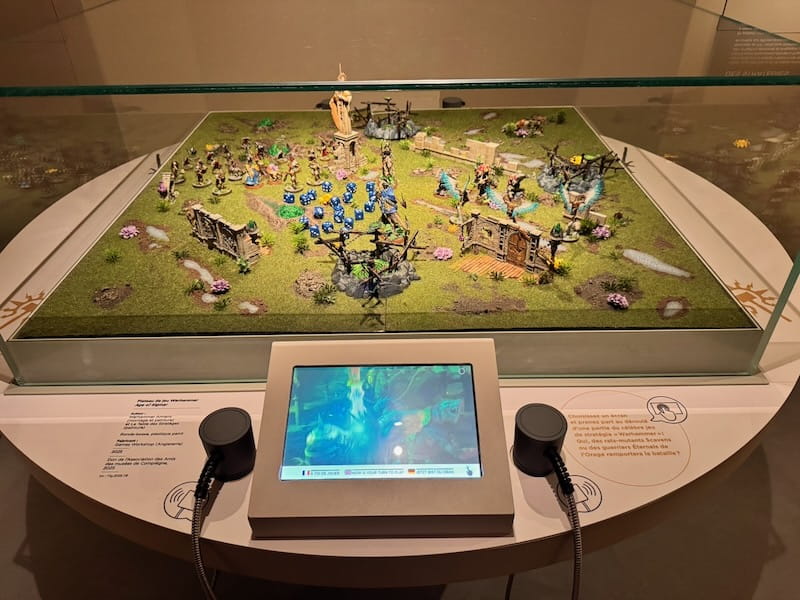 Warhammer brings figurines into the modern age. Players collect and paint miniature armies, then use them in tabletop battles set in elaborate fantasy and science-fiction worlds. Painting the figures is an art in itself, with enthusiasts taking part in international competitions ©OffbeatFrance
WHY DO WE LOVE MINIATURE WORLDS?
From Gulliver's Travels to Honey, I Shrunk the Kids, we've been fascinated by the idea of changing size. What would the world look like if we were tiny? Or huge?
Miniatures let us play with that idea. We can examine an entire battlefield at a glance without resorting to a drone, or we can peer into a room smaller than a shoebox, filled with people leading lives just like ours. Places like the Museum of Miniatures in Lyon will have us spending hours gazing at mini-worlds that somehow feel vastly more interesting than larger ones.
Then there's our urge to collect. People collect everything from stamps and coins to dolls and toy soldiers. According to psychologists, collecting can satisfy several needs, such as organizing our world, preserving memories, expressing our personal interests, or simply enjoying the challenge of finding the next missing piece (as a former stamp collector, I get that).
Why visit the Musée de la Figurine?
The museum's collection began with donations from private collectors, including wooden soldiers made in the late 18th century. Over time, it grew into one of Europe's major collections of figurines.
The museum is rather fun. Yes, it has thousands of objects in display cases, but it also uses other techniques – historical scenes, audiovisual displays, interactive installations and demonstrations of craftsmanship to explain the relationships between people and their figurines.
I came expecting toy soldiers. I left having learned about everything from Egyptian funerary customs to Warhammer (but no, I still couldn't tell you how to play the game).
PRACTICAL INFORMATION
- Getting there: The museum is at 1 place d'Orléans in Compiègne, a short walk from the historic center. You can find more information on their website (site in French).
- How long do I need? The visit can be done in an hour, two if you'd like to linger and take advantage of the interactive displays.
- Best for: curious travelers, history buffs, collectors, and fans of miniature worlds.
Before you go...
I admit I have a passion for unusual museums, so this one fits perfectly.
But don't rush away from Compiègne once you've seen the figurines. This town has been home to kings and emperors, witnessed some of France's most important historical events, and has plenty of surprises of its own.
While in Compiègne, do visit the Château de Compiègne, and if at all possible, the historic Armistice Wagon located outside town.
Did you enjoy this article? I'd love if you shared it!

🇫🇷

Bonjour! I'm Leyla.
Born in Paris and now based in eastern France between Lyon and Annecy, I've spent years exploring the places and stories that explain why France is the way it is.
Offbeat France is for curious francophiles, whether you're planning a trip or simply fascinated by France. Here you'll discover the history behind the villages, castles, traditions, landscapes and everyday details that most visitors notice but few can explain.
Alongside practical travel advice, I share the context that helps you make sense out of France. The more you understand, the more rewarding every visit becomes.
If you finish an article thinking, "I never knew that... now I want to know more," then I've done my job.
Learn more about me!
Read my Substack historical essays
🇫🇷

🇫🇷
Booking.comWhat's New!


-
Figurines Compiegne Museum: More Than Toy Soldiers
Oct 12, 26 05:10 AM
Visit the Museum of Figurines, Compiegne, where thousands of toy soldiers share the stage with ancient objects comic-book heroes. -
The Strange Story of Compiegne’s Armistice Wagon
Oct 07, 26 04:08 AM
Discover the strange story of the Compiegne Armistice Wagon, where Germany signed an armistice in 1918 and France signed one in 1940. -
Arras, France: Where Things Are Not What They Seem
Sep 30, 26 04:34 AM
Discover things to do in Arras France, from grand Flemish-style squares to a hidden underground city, a curious citadel and a rebuilt historic center. -
Chateau De Pierrefonds: The Strange Curse Of A Fairy-Tale Castle
Sep 26, 26 02:16 PM
Discover Château de Pierrefonds, a fairy-tale castle in northern France with a turbulent history, spectacular restoration and plenty of strange surprises. -
The Louvre-Lens Museum: How A Former Mining Town Got The Louvre
Sep 21, 26 07:51 AM
Discover why the Louvre-Lens Museum brought the Louvre to a former mining town, plus 11 remarkable works worth the trip from Paris.