Fascinated by Gallo-Roman history? Click Here to download > > > Here are 6 ways Rome affected France





Follow me on
- Home ›
- Destinations ›
- Northern France ›
- Pierrefonds
Chateau De Pierrefonds: The Strange Curse Of A Fairy-Tale Castle
Published 26 September 2026 by Leyla Alyanak — Parisian by birth, Lyonnaise by adoption, historian by passion
Just north of Paris, in the département of the Oise, the Château de Pierrefonds looks like a fairy-ale castle – but almost nothing about it is quite what it seems. Built, destroyed, abandoned and eventually transformed into the spectacular château you see today, it is full of strange details and surprises that will bewitch you. You'll just have to take a closer look.
The Château de Pierrefonds looms above the village of the same name like a benevolent medieval giant, all turrets and towers watching over it citizens. If you were a child, this is the castle you would draw when dreaming about knights and princesses.
It looks so thoroughly medieval that you might assume it has stood here for centuries, more or less as you see it today.
You would be wrong.
Pierrefonds is medieval, but it is also a 19th-century creation. It was built centuries ago, destroyed, left to become a romantic ruin, and then reconstructed by the architect Eugène Viollet-le-Duc for Napoleon III.
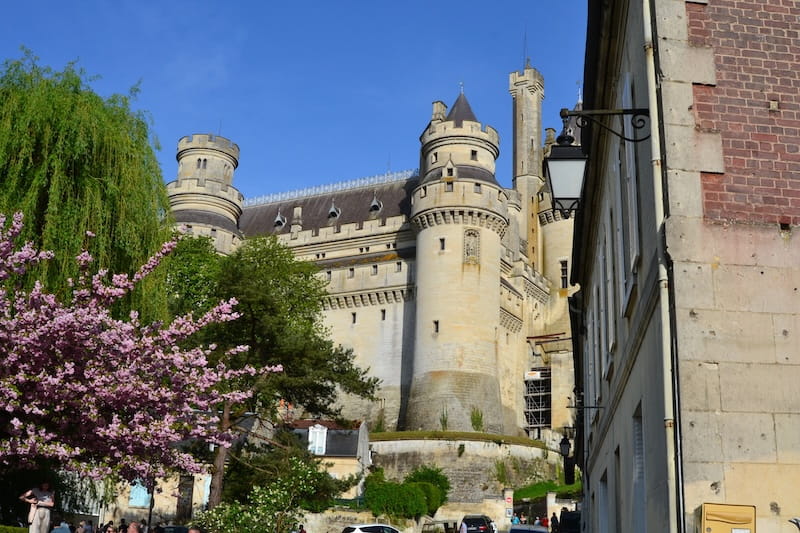
My guide during the château's visit, Charlene Goffart, made a comment that instantly focused how I would see this castle: “La malédiction de Pierrefonds, c’est qu’il ne sera jamais habité.” The curse of Pierrefonds is that it will never be inhabited.
Not literally, of course. Plenty of people occupied the site at various times. But those who dreamed of making Pierrefonds a grand residence never got to enjoy it as they had planned. History kept interrupting them.
NOTE: Pages on this site may contain affiliate links, which support this site. See full Privacy Policy here.
Louis d'Orléans builds Pierrefonds
It all began with Louis d'Orléans, younger brother of King Charles VI.
In 1393, Louis received the duchy of Valois as an appanage, a grant of territory and its revenues awarded to a member of the royal family. He ordered the building of a fortified residence at Pierrefonds, where an earlier fortress already stood.
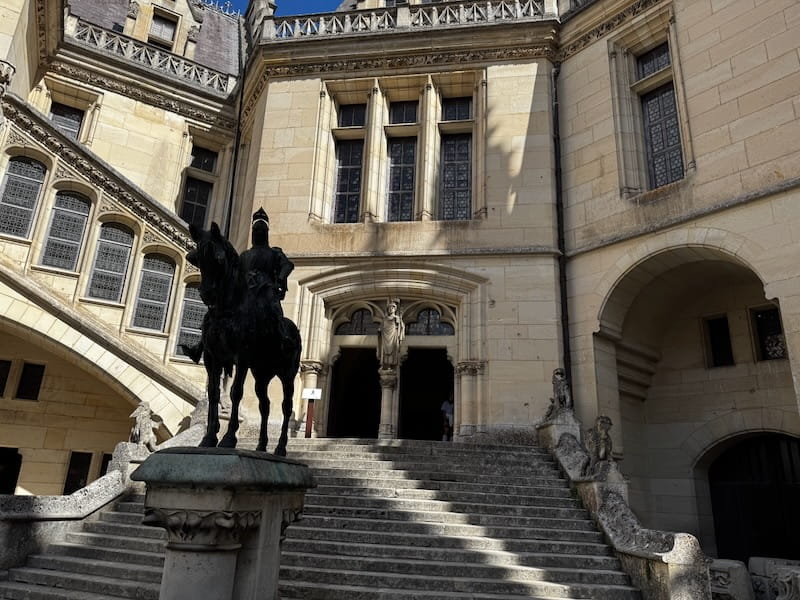 Louis d'Orléans sits proudly on his horse at Pierrefonds' entrance ©OffbeatFrance
The location made sense strategically: Pierrefonds could protect the routes that led to the Duke of Burgundy's territories – Louis was in increasing competition with the duke, Jean sans Peur, who also happened to be his cousin. Pierrefonds would also allow him to keep an eye on the key roads north toward Flanders.
Charles VI suffered periods of severe mental illness and was sometimes unable to rule, leaving Louis and Jean competing for control of the government in a struggle that became increasingly violent.
Louis would only get as far as the château's footprint – he established the foundations and the castle's basic size, but he would never see the building of the comfortable apartments a prince would need to make this into a proper home. In 1407, Jean had Louis assassinated in the streets of Paris, leaving the castle at Pierrefonds unfinished.
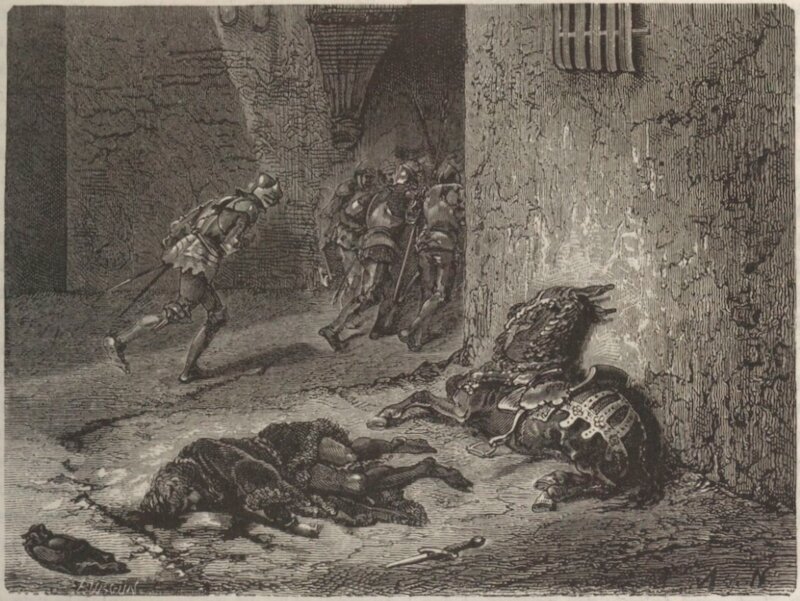 Assassination of Louis d'Orleans by Alphonse de Neuville, Public domain, via Wikimedia Commons
The Burgundian duke would later attack Pierrefonds and burn part of its roof.
So the man who built it never completed it, and the man who had him murdered helped damage it. The curse had begun.
Louis XIII and the destruction of Pierrefonds
Pierrefonds remained in the hands of the royal family after Louis d'Orléans' murder, eventually ending up in the hands of Antoine d'Estrées, father of Gabrielle d'Estrées, the famous mistress of Henri IV. When Antoine died in 1609, the château passed to his son, François-Annibal d'Estrées.
When Henri IV was assassinated in 1610, his young son became Louis XIII, with his mother, Marie de Médicis, governing as regent until he came of age. François-Annibal d'Estrées was part of a group of nobles who challenged the growing power of the crown, making Pierrefonds a potential stronghold for those opposed to the king.
In 1617, royal troops attacked the château, and within weeks Louis XIII ordered it dismantled: the floors and roof structures were burned and the towers split open.
 Louis XIII, King of France by Balthasar Moncornet c. 1600 - 1668 National Gallery of Art
But Pierrefonds was not razed: its ruins were deliberately left standing, a clear royal message to other recalcitrant nobles – this is what happens to a fortress when its owner opposes the crown.
Pierrefonds, now derelict, remained this way through the 17th and 18th centuries, with local people helping themselves to the free building materials.
But the pile of stones was also becoming something else: it was becoming picturesque.
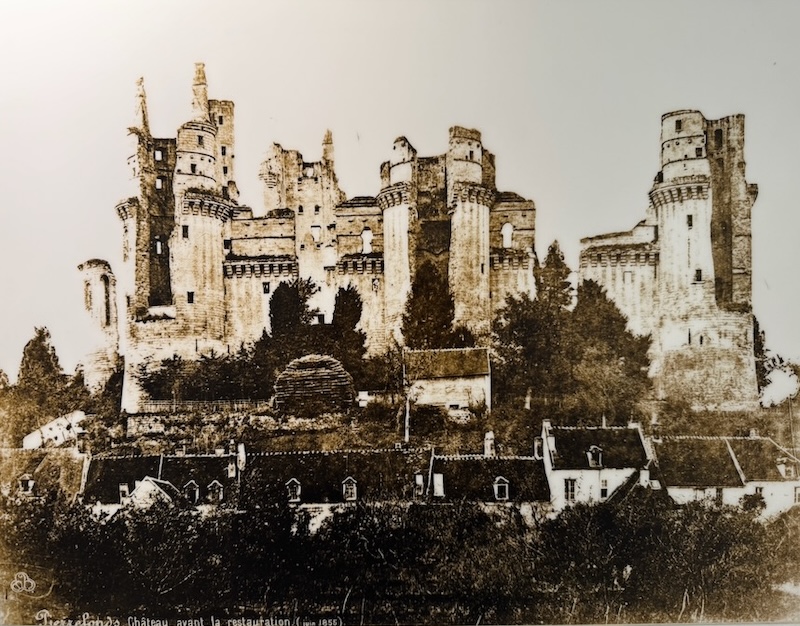 Ancient photo of Pierrefonds in ruins
Romantic Pierrefonds
By the 19th century, Pierrefonds was very much in fashion.
Romanticism had sparked a taste for medieval ruins, which people viewed as atmospheric reminders of the past, much as the nostalgia many of us experience today. Artists and visitors flocked to the château, poking through what was left.
The tourists included Alexandre Dumas, who came from his home in nearby Villers-Cotterêts, and Pierrefonds appears in The Three Musketeers, where Porthos is given the title of Seigneur de Pierrefonds. Even Louis-Philippe, who would be the last king of France, used the ruins for a grand occasion, holding his daughter's wedding there.
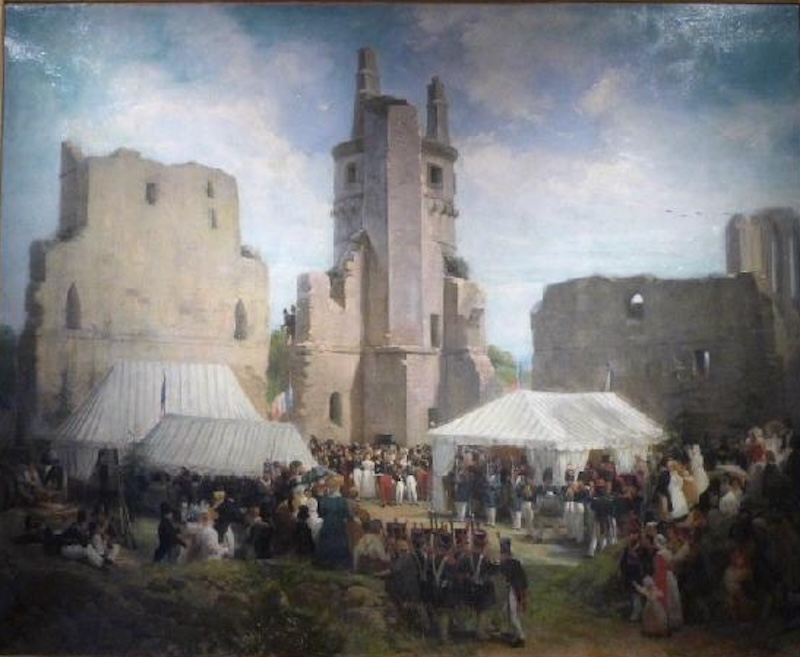 Louis-Philippe and his family at Pierrefonds. Painting by Féron Éloi Firmin (1802-1876). Musée des Beaux-Arts, Tours
And then someone came up with a brilliant idea: they installed harpes éoliennes, or wind harps, in the surviving towers. Wooden boxes fitted with strings were placed in the old openings and when the wind passed through them, the strings vibrated and produced a strange, melancholy sound, almost haunted. This attracted even more people.
Rather than a functioning medieval fortress, Pierrefonds had been transformed into a romantic relic – and that was precisely what made it attractive. Napoleon I eventually bought it, but didn't restore it, also enjoying the picturesque attraction it exercised on artists and visitors.
Pierrefonds' real transformation would take place under his nephew, Napoleon III.
Napoleon III decides to rebuild
Around 1857, Napoleon III decided to bring Pierrefonds back to life, initially as a retreat near his favorite imperial residence at Compiègne.
He had already visited the ruins a few years earlier, before becoming emperor, and had been enchanted. Once crowned, he decided to restore Pierrefonds and consulted Prosper Mérimée, the writer and inspector of historic monuments, who recommended Eugène Viollet-le-Duc for the job.
Viollet-le-Duc was already one of France's leading experts on medieval architecture. He had worked on major Gothic restoration projects and had already written about Pierrefonds. He wasn't just a builder brought in to repair an old castle but an architect with very definite ideas about medieval architecture.
WHO WAS VIOLLET-LE-DUC?
Eugène-Emmanuel Viollet-le-Duc (1814–1879) was the 19th-century architect behind some of France's most famous medieval restorations. He worked on the restoration of Notre-Dame de Paris and the medieval city of Carcassonne, among many other monuments.
His approach was controversial: he did not always restore buildings exactly as they had been, but sometimes reconstructed the medieval architecture he believed should have existed. Pierrefonds is one of his most ambitious examples.
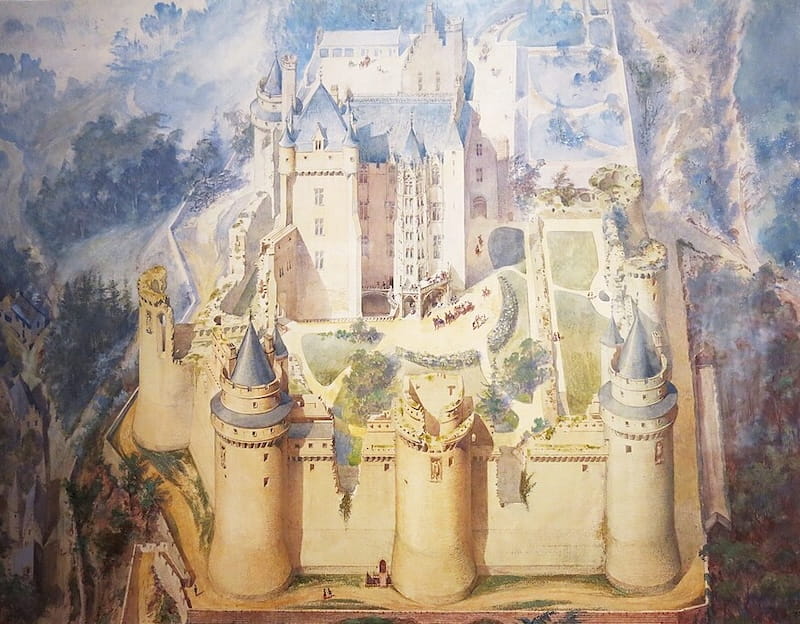 Viollet-le-Duc’s 1858 plan for the restoration of Pierrefonds
Early plans were relatively restrained and Viollet-le-Duc was initially asked to restore the donjon – the main fortified tower – and two corner towers, leaving the rest of the Romantic ruins as they were.
The restored section was intended as a relais de chasse, essentially a hunting lodge. Visitors could hunt in the nearby forest of Compiègne and stop at Pierrefonds afterward.
Eventually, Napoleon III decided to go all in and turn the entire castle into an imperial residence. Viollet-le-Duc was probably ecstatic.
Viollet-le-Duc's reconstruction
Since the medieval castle had never been completed, there was no final building to reproduce: the architect would have to "embellish", creating his vision of an ideal medieval fortress and using Pierrefonds as a sort of laboratory for his ideas.
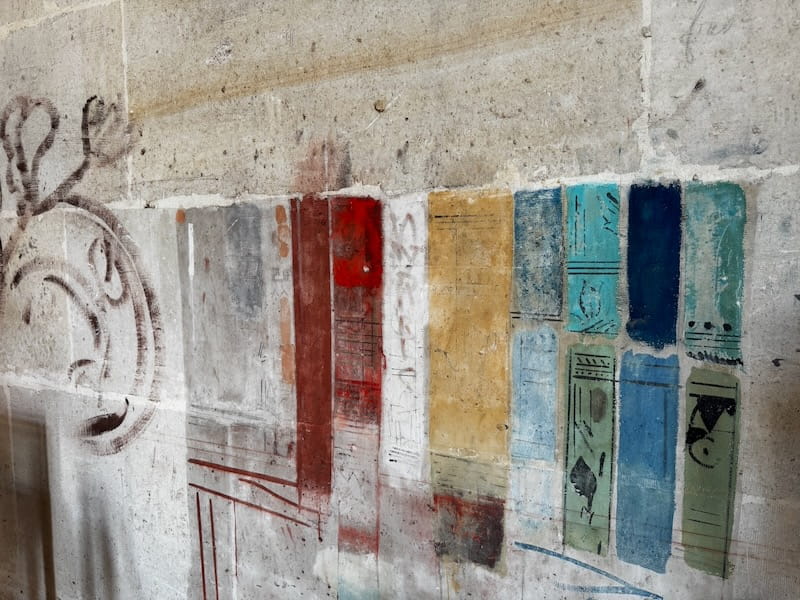 This color chart gives us a peek into Viollet-le-Duc's creativity – it is a surprising leftover and would normally have been painted over had Pierrefonds been completed ©OffbeatFrance
This is precisely why when you walk through Pierrefonds, you are walking through both the Middle Ages and the Middle Ages as imagined by Viollet-le-Duc.
And everywhere you look, you'll think your eyes are playing tricks on you.
Some of the stones really are medieval; others are from the 19th century. Some features reproduce what Viollet-le-Duc found; others are entirely his invention. You may be hard-pressed to tell the difference.
And then there are the monsters, the chimères, or hybrid creatures: a unicorn, a mermaid looking into a mirror, a creature with an enormous beak and an escargot perched on it, and another with a woman's head and the body of a dragon or lizard.
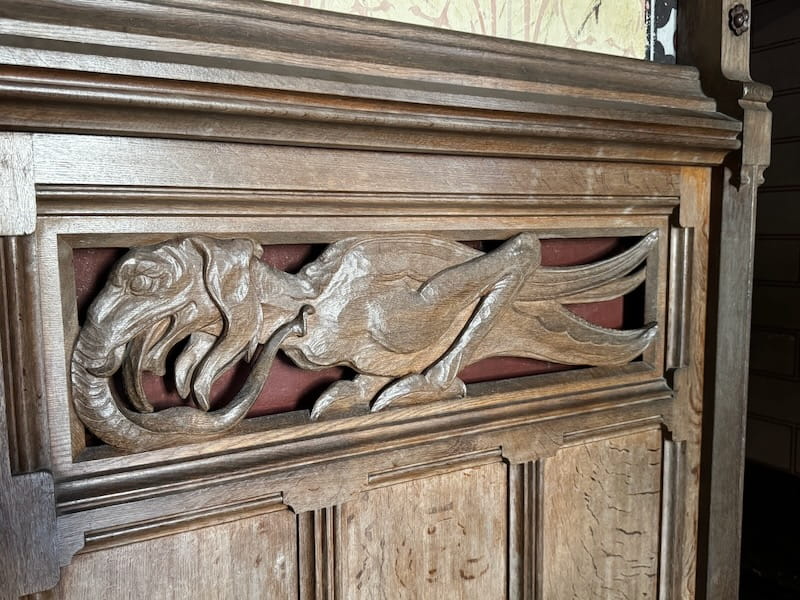 It's impossible to know what might have been going through Viollet-le-Duc's mind as he designed this birdlike reptile ©OffbeatFrance
The courtyard alone has more than 250 ornaments.
You'll find 32 felines – cats or cat-like gargoyles or chimera – on the dormer windows, one supposedly representing Viollet-le-Duc's own cat. He may have decided that his pet belonged in his ideal medieval world, too.
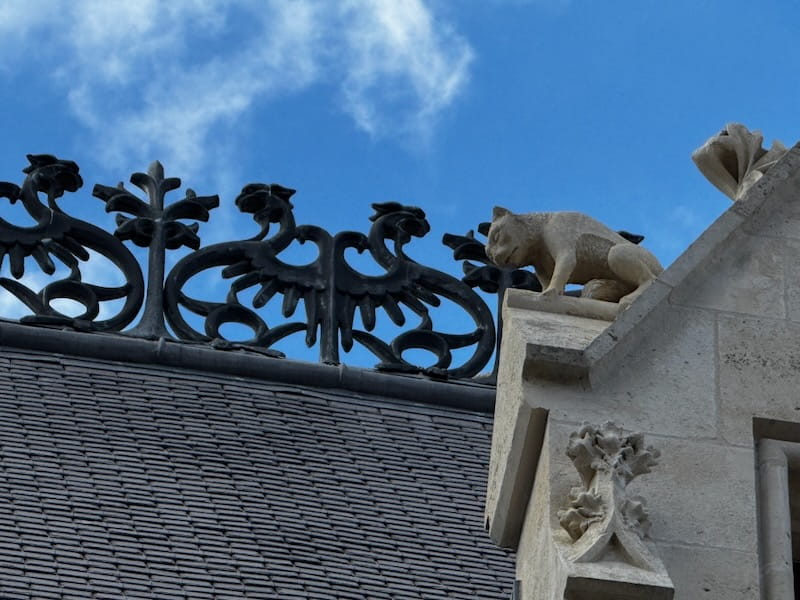 One of the many sculpted cats along the castle roof. Could THIS be Viollet-le-Duc's own pet? ©OffbeatFrance
The visual tricks continue inside.
The monumental staircase leading to the grand hall of the Salle des Preuses is deliberately spectacular, designed to impress visitors approaching the great reception room.
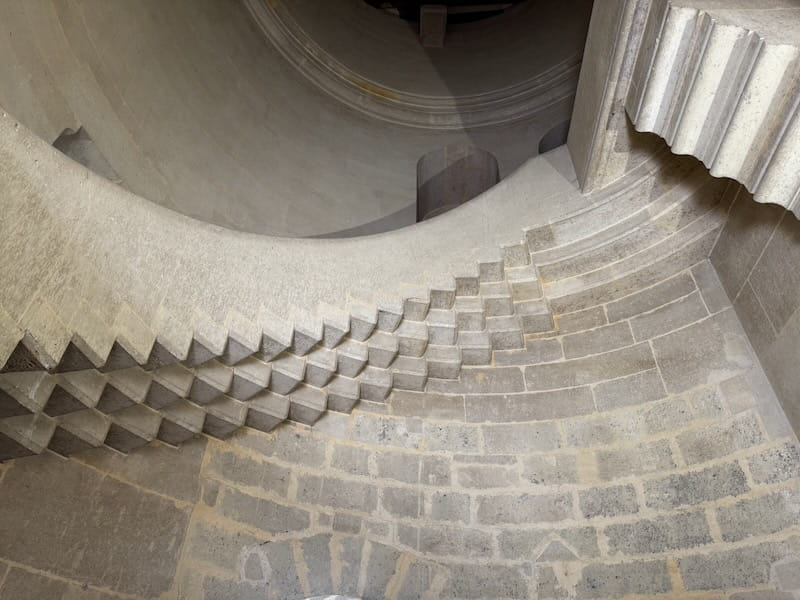 The monumental staircase, which looks stunningly modern ©OffbeatFrance
There is also a double staircase, with two separate flights so that soldiers and guests could use different routes, possibly to keep drunken soldiers away from ladies wearing their enormous 19th-century crinolines.
Unlike the Chambord staircase, which dominates the château's central design, Pierrefonds' double-stairway is tucked into the building and has a practical use as well as a decorative one.
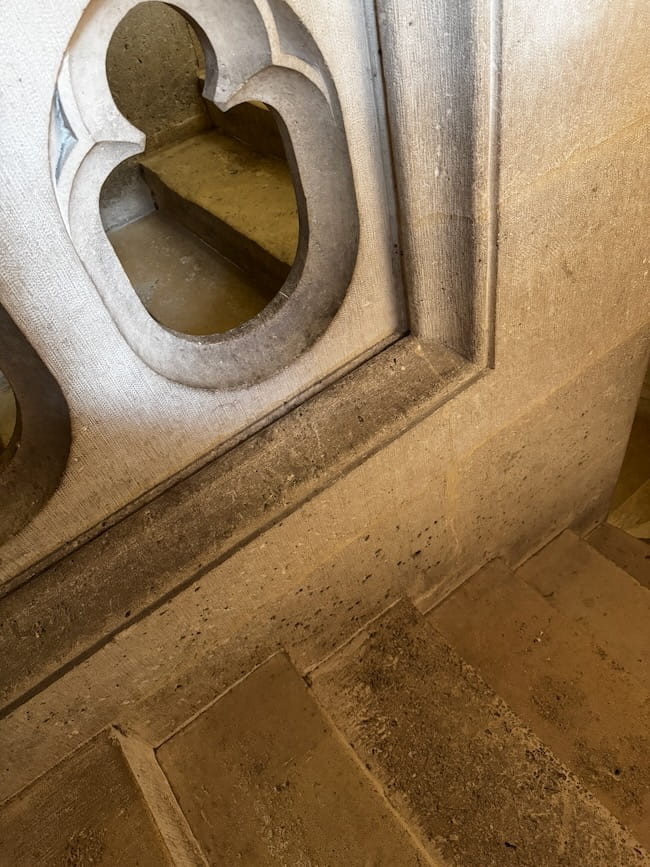 As you go down on the right, you won't be able to identify who is coming up on the left ©OffbeatFrance
My one regret at Pierrefonds was being unable to visit the Salle des Preuses because its paintings were being restored. I asked if I could take a peek but since the paintings contain lead, a major security protocol was in place, involving masks, clothing changes and showers.
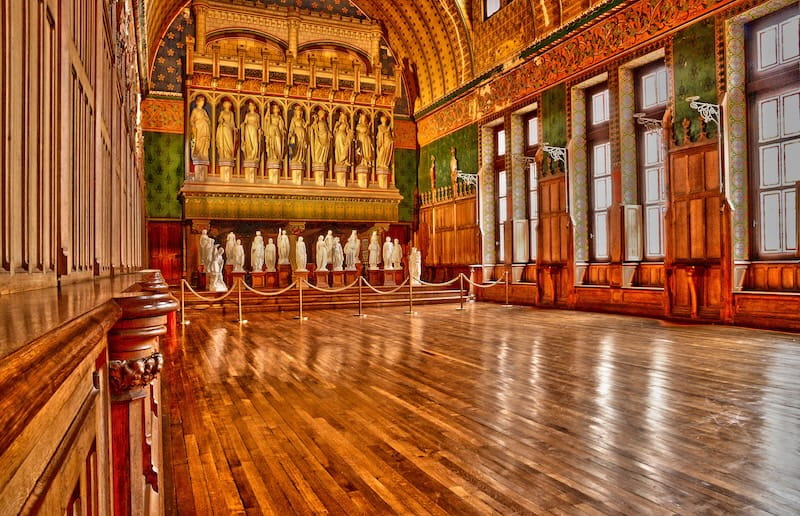 The Salle des Preuses, as it should look next time I visit: 52 m long (170 ft) and 12 m (39 ft) high
But we weren't completely bereft – the château designed a small-scale facsimile of this grand room so that we could get closeups of its statues, the nine Preuses, female counterparts of the medieval Neuf Preux, or Nine Worthies.
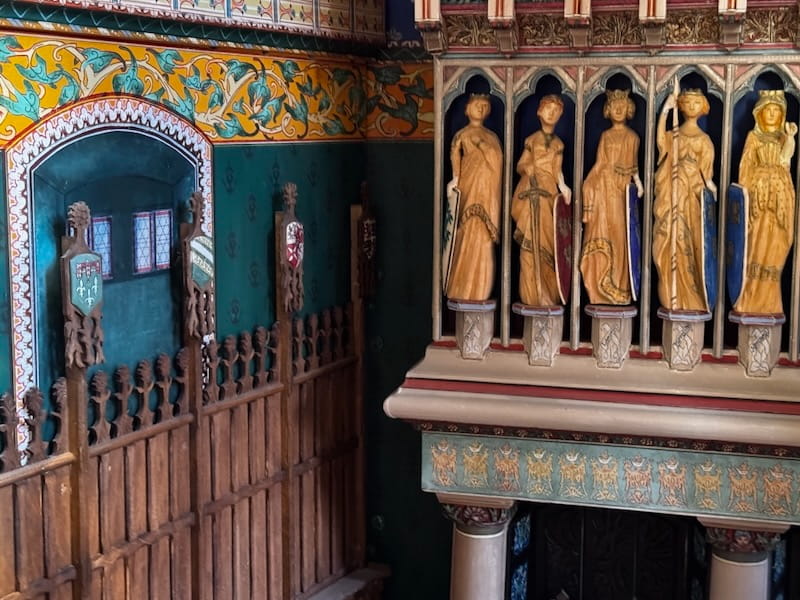 This is part of a small model of the Salle des Preuses, which has been under restoration ©OffbeatFrance
And then there are the squirrels.
Nobody is quite sure why they are there. There is a theory involving the heraldry of Louis d'Orléans, but nothing definite.
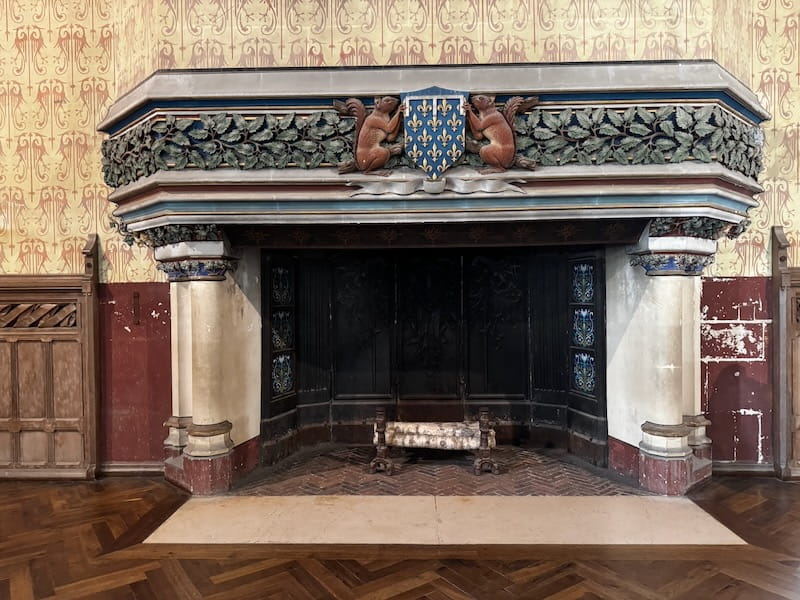 The role or meaning of these squirrels isn't known. Here, they're next to Louis d'Orléans coat of arms. Note the M-like silver bar along its upper edge - that symbolizes royal kinship, as in sibling, ancestor or descendant of a king ©OffbeatFrance
One of Pierrefonds' most spectacular surprises is downstairs, out of sight.
This cavernous space is part of Louis d'Orléans' medieval castle, although Viollet-le-Duc altered it during his 19th-century restoration. Today it is filled with 96 gisants, or recumbent funerary sculptures. They are plaster casts, not medieval tombs: Louis-Philippe commissioned them in 1833, but they only made it to Pierrefonds in the early 1950s. Among them are figures such as Catherine de Médicis, Louis XII, Louis d'Orléans and Richard the Lionheart.
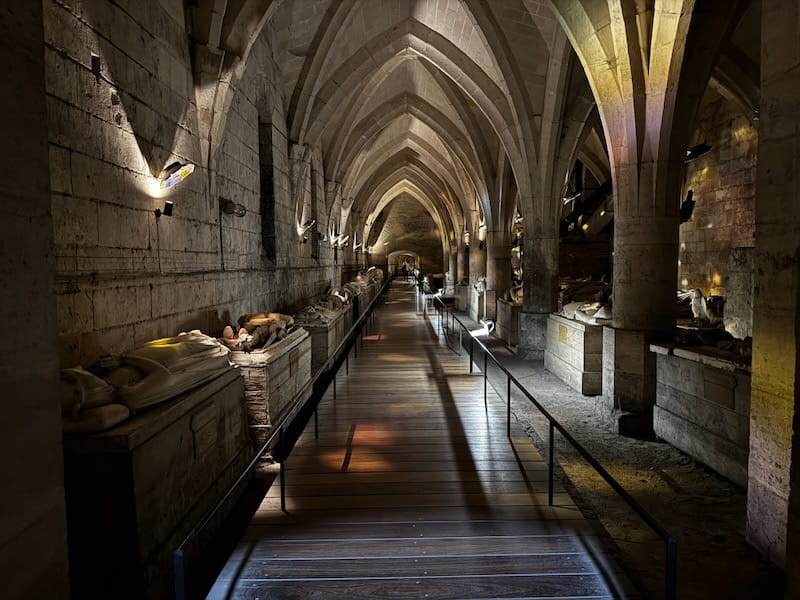
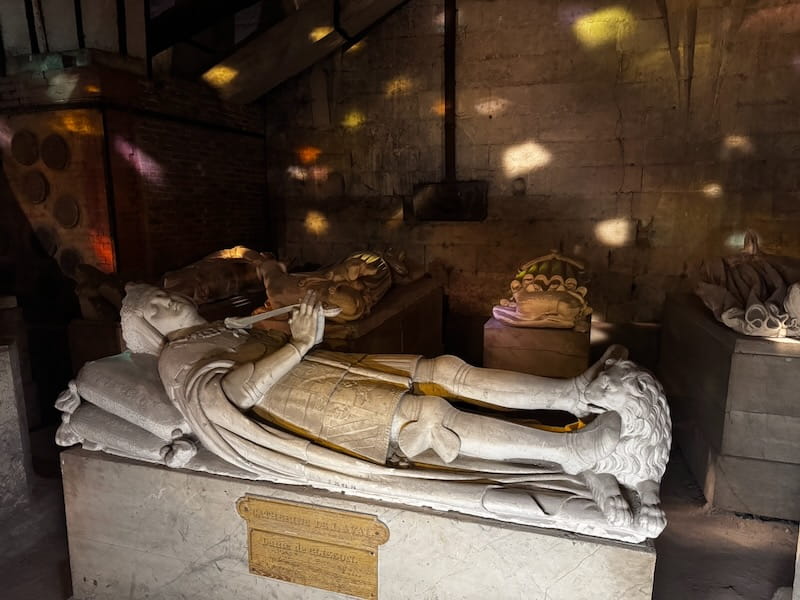 Top: the castle's remarkable crypt; above: a closeup of one of the "gisants" ©OffbeatFrance
So even here, Pierrefonds is mixing the centuries: medieval stone, a 19th-century restoration and a collection of 19th-century casts that only arrived in the 20th.
Napoleon III's imperial residence
Napoleon III's château was designed as an imperial residence and its apartments were decorated accordingly.
Imperial symbols are everywhere: Napoleon I's imperial bee makes a few appearances, but Napoleon III's imperial eagle and N are far more prevalent.
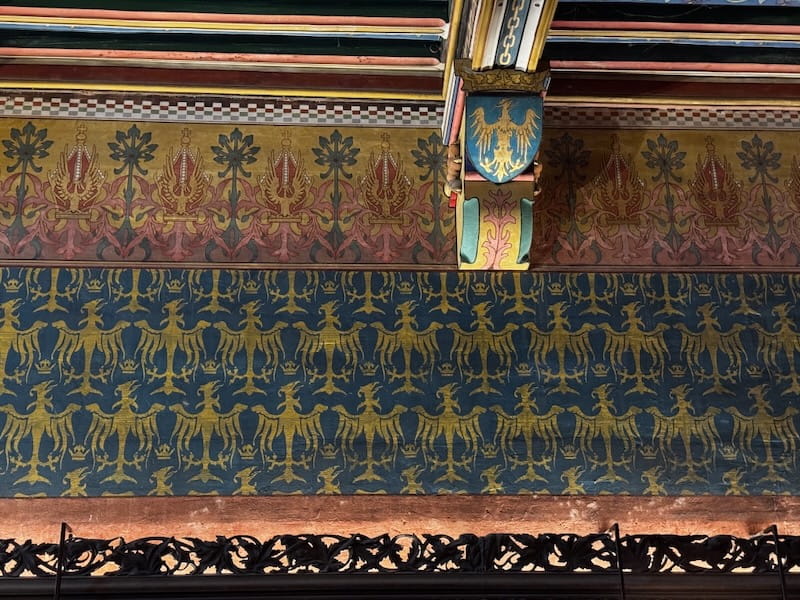 Imperial eagles, Napoleon III's symbol - on the wallpaper but also on the wooden cornice near the ceiling ©OffbeatFrance
Eugénie's rooms have thistles, a reference to her Scottish ancestry, along with flowers, birds and other natural motifs. The decoration also brings in the medieval world of Louis d'Orléans and the legends of King Arthur.
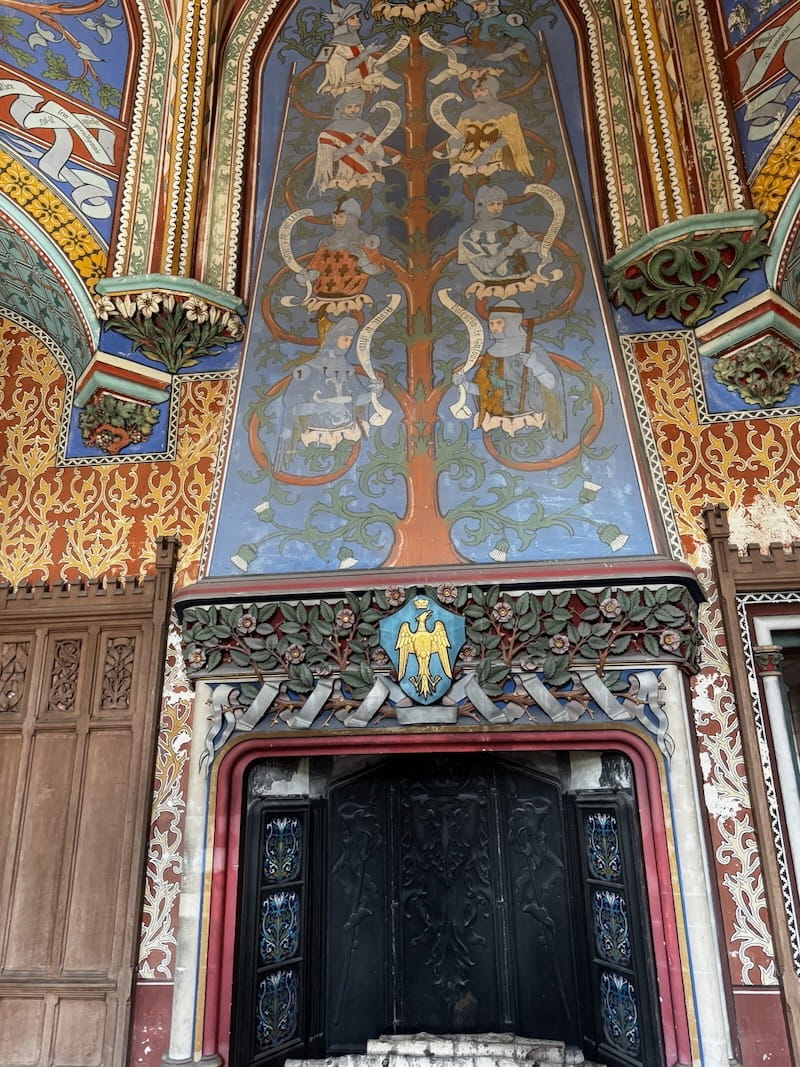 Part of the elaborate decor of Eugénie's room, with a tall painting referencing King Arthur above the fireplace (and of course an imperial eagle) ©OffbeatFrance
Throughout the castle, you'll notice the startling contrast of finished vs unfinished. At times, intricately painted ceilings sit atop bare stone walls, waiting for a decorator's hand to apply its magic.
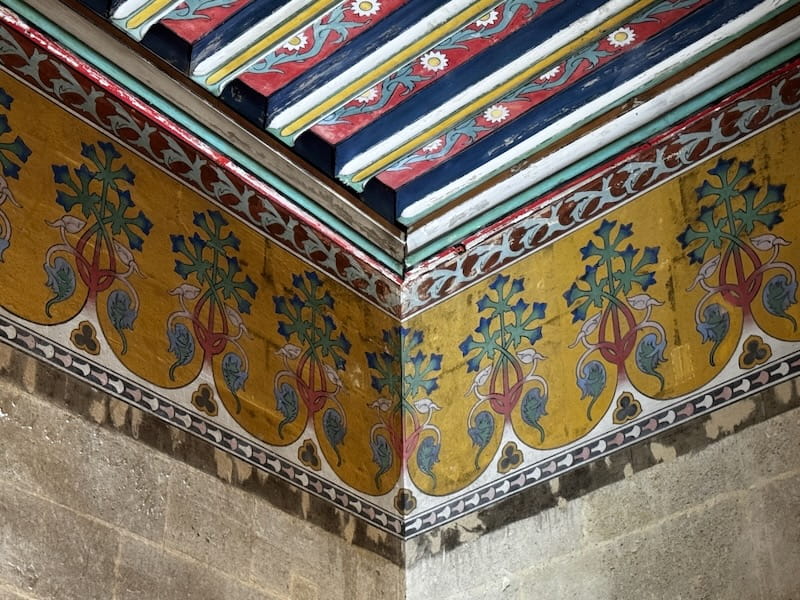 Many of Pierrefonds' ceilings were painted but renovations often didn't make it as far as the walls ©OffbeatFrance
At one point, Napoleon III decided to turn part of Pierrefonds into a museum, exhibiting his collection of medieval armor and weapons.
The museum attracted visitors who came partly to see the collections and partly to see the enormous restoration project in progress.
Despite all the work, Napoleon III, Eugénie and their son would never spend a night at Pierrefonds.
The end of the Second Empire
Everything ground to a halt when in 1870, France was defeated in the Franco-Prussian War and the Second Empire of Napoleon III collapsed. Reconstruction didn't stop, but the state budget was drastically cut, from around 20 million of today's Euros to about three million.
Viollet-le-Duc himself died in 1879, before he could complete the work, which was taken over for a few years by his son-in-law and successor, Maurice Ouradou.
In the end, the man who had been given the chance to create his ideal medieval castle never saw his entire project finished.
But Pierrefonds was changing in other ways, too.
With its several thermal springs, the village eventually became a fashionable spa town until World War I, known as Pierrefonds-les-Bains. You'll see the legacy of that period in its aristocratic homes and Belle Epoque architecture.
PRACTICAL INFORMATION
- Getting there: You can reach Compiègne, the nearest train station, by train from Paris in under an hour. From Compiègne you can catch a bus to Pierrefonds, including from the railway station.
- Getting around: There's a fantastic cycling infrastructure throughout the Oise and you can easily ride from Compiègne to Pierrefonds in an hour on gravel paths through the stunning forest. The local tourist office in Compiègne has plenty of cycling information, or you can check the Oise tourist site and download maps from there (site in French).
- How long do you need? The château itself requires two hours so if you're coming from Compiègne, schedule half a day and make time for lunch.
- How to visit: You can explore Pierrefonds independently with a free English-language visitor description, join a free guided tour (usually in French) at set times, or rent an audioguide in English. Pierrefonds is on a hill, with plenty of uphill walking, and there are no elevators inside.
- Where to stay: Pierrefonds has a number of guest houses if you'd like to stay in the village, or you can stay in the much larger Compiègne (compare prices here).
- Where I ate: I had a lovely lunch at the Chalet du Lac, right on the water with a fantastic view of Pierrefonds' "other" chateau and good local and traditional dishes. You should also drop by the Charcuterie Bigot across the square and try to take some home – they have won every prize imaginable!
- Best for: travelers interested in history, architecture and unusual castles.
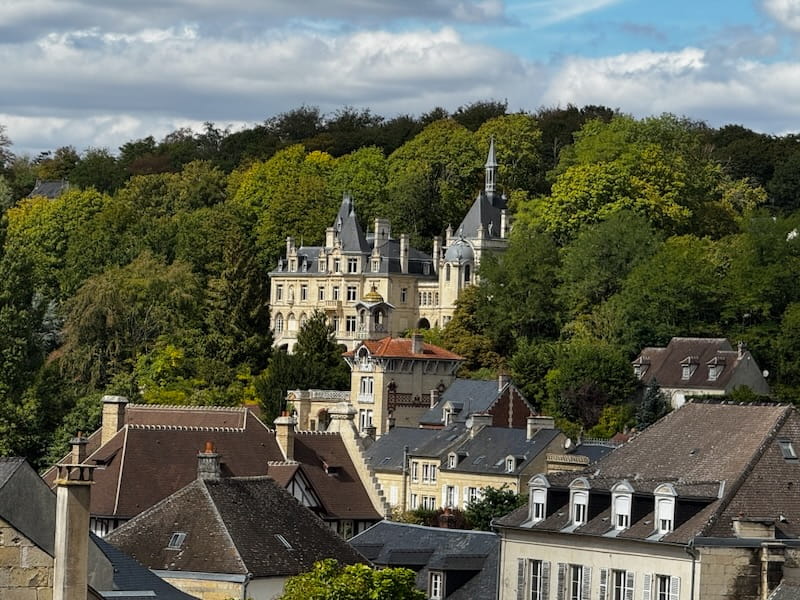 You can see the wealth of this town in its buildings. In the distance the Château de Jonval, a private home ©OffbeatFrance
So what do you think? Is Pierrefonds really cursed?
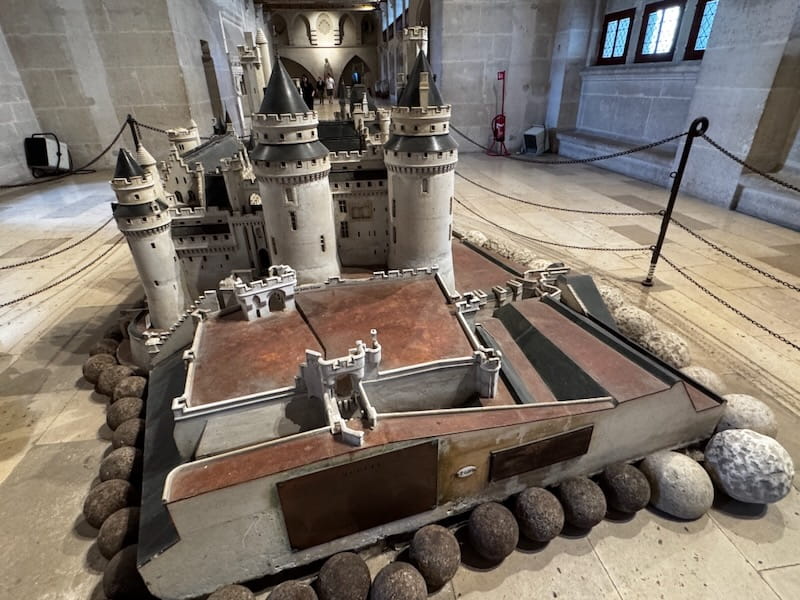 This stone model of Pierrefonds provides an excellent aerial view of the castle ©OffbeatFrance
Perhaps not in the supernatural sense, but you have to admit it has accumulated an unusually convincing record of plans that went wrong:
- Louis d'Orléans built it and was murdered before it was finished
- then it was caught up in political conflict
- Louis XIII destroyed it
- for generations, it stood as a ruin
- then Napoleon III decided to turn it into an imperial residence, but his empire fell before he could sleep there
- and Viollet-le-Duc himself died before he could see the work finished.
And yet Pierrefonds not only survived, but became a monument to an idea of the Middle Ages, a dazzling, remarkable work of architecture. It is regularly used as a backdrop for movies – there's a reason it's nicknamed "Merlin Castle" (from the BBC television series Merlin, which used Pierrefonds as Camelot, King Arthur's castle).
So while the château may not have been particularly successful as a residence, it succeeded spectacularly as a spectacle. The "curse" just provides it with that little extra frisson.
 An imposing view of Pierrefonds castle ©OffbeatFrance
Before you go...
Once you've explored the château, don't miss nearby Compiègne, with its own extraordinary history, from royal hunting parties to the Second Empire – and, much later, the signing of the 1918 Armistice.
Did you enjoy this article? I'd love if you shared it!

🇫🇷

Bonjour! I'm Leyla.
Born in Paris and now based in eastern France between Lyon and Annecy, I've spent years exploring the places and stories that explain why France is the way it is.
Offbeat France is for curious francophiles, whether you're planning a trip or simply fascinated by France. Here you'll discover the history behind the villages, castles, traditions, landscapes and everyday details that most visitors notice but few can explain.
Alongside practical travel advice, I share the context that helps you make sense out of France. The more you understand, the more rewarding every visit becomes.
If you finish an article thinking, "I never knew that... now I want to know more," then I've done my job.
Learn more about me!
Read my Substack historical essays
🇫🇷

🇫🇷
Booking.comWhat's New!


.png)
-
Chateau De Pierrefonds: The Strange Curse Of A Fairy-Tale Castle
Sep 26, 26 02:16 PM
Discover Château de Pierrefonds, a fairy-tale castle in northern France with a turbulent history, spectacular restoration and plenty of strange surprises. -
The Louvre-Lens Museum: How A Former Mining Town Got The Louvre
Sep 21, 26 07:51 AM
Discover why the Louvre-Lens Museum brought the Louvre to a former mining town, plus 11 remarkable works worth the trip from Paris. -
Poitiers in France: Why This Historic City Deserves More Visitors
Aug 02, 26 03:05 PM
Discover the best things to do in Poitiers, France, from Roman ruins and medieval streets to Eleanor of Aquitaine's legacy and remarkable architecture. -
Limoges, France: Much More Than Porcelain
Jul 25, 26 09:14 AM
Limoges France is more than porcelain. Discover medieval streets, enamel masterpieces and centuries of history. -
Saint-Quentin, France: The Art Deco City No One Talks About
Jul 15, 26 05:31 AM
Saint-Quentin France rebuilt itself in Art Deco after WWI left it in ruins. It's now one of France's most striking architectural cities.