Fascinated by Gallo-Roman history? Click Here to download > > > Here are 6 ways Rome affected France





Follow me on
- Home ›
- Destinations ›
- Northern France ›
- Things To Do In Amiens
The Unexpected Side of Amiens, Historical Capital Of Picardy
Published 11 July 2026 by Leyla Alyanak — Parisian by birth, Lyonnaise by adoption, historian by passion
Amiens is world-famous for its Gothic cathedral, but an equally rich story is to be found in its floating gardens, industrial heritage, cultural traditions, and connection to Jules Verne, all of which helped create one of northern France's most distinctive regional capitals.
It would be easy to spend a few hours in Amiens, visit the cathedral and head for the next town. It's not far from Paris, and it has railway links to most other major cities in northern France.
But if you did that, you'd be missing much of what makes this city unique.
Beyond the famous cathedral façade lies a network of canals and floating gardens that somehow manages to weave together such disparate elements as fantasy author Jules Verne, a party neighborhood, and dilapidated industrial quarters.
The cathedral may be Amiens's most famous landmark, but its waterways are an important part of its story. Given its notoriety, though, we'll start at Notre-Dame d'Amiens, the city's Gothic jewel.
QUICK FACTS ABOUT AMIENS
- Population: 133,000
- Region: Hauts-de-France
- Département: Somme (80)
- Known for: France's largest Gothic cathedral by volume, the Hortillonages floating gardens
- Historic industries: Textile manufacturing, market gardening
- Major landmark: Notre-Dame d'Amiens Cathedral
- Literary connection: Jules Verne lived and wrote here for 34 years
- Language: (in addition to French) Picard, a regional language, still spoken and being revived
- Day trip potential: Somme battlefields, Baie de Somme
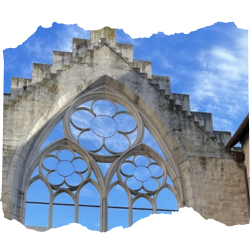


Notre-Dame d'Amiens Cathedral
Even if you normally skip religious buildings, this one is difficult to ignore: it's France's largest Gothic cathedral by volume. To put that into perspective, I'm told Notre-Dame de Paris could fit into it. Twice.
It also happens to be one of the finest examples of medieval architecture in Europe. Unlike many cathedrals that evolved over centuries, Amiens was started in 1220 and mostly finished a speedy 68 years later, thanks to the city's prosperity, so it's not a hodge-podge of styles stretching over centuries.
Another reason the cathedral stands out is the survival of its medieval sculptures. While many French churches lost their statues and decorative details during the French Revolution, Amiens is still mostly intact, at least on the outside.
DID YOU KNOW? ➽ UNESCO recognized Amiens Cathedral in 1981 as a masterpiece of Gothic architecture and one of the buildings that shaped the future of Gothic design across Europe. Its harmonious proportions, remarkable sculptures and exceptional state of preservation make it one of the finest surviving cathedrals of the Middle Ages.
 The façade of Notre-Dame d'Amiens at nightfall
Amiens in the 13th century was in the enviable position of being able to afford a grand cathedral.
It was home to one of medieval Europe's most important relics: the reputed head of Saint John the Baptist (which, by the way, still rests in the cathedral but is only brought out for public viewing once or twice a year). Hosting this relic helped establish Amiens as a major pilgrimage destination.
The relic's importance is visible inside: much of the sculpture around the choir focuses on the life of Saint John the Baptist.
 The cathedral's medieval labyrinth marks the symbolic path of pilgrimage, guiding worshippers who could not travel to Jerusalem ©OffbeatFrance
But none of that prepares you for what happens when you walk through the door. When I looked up I felt dizzy, a feeling I normally associate with looking down from great heights. The soaring interior exudes such a feeling of space — it's 42.30 meters (138.8 feet) high, to be exact — that for a moment, you'll forget which way is up
THE WEEPING ANGEL

This little statue is tucked around the back of the cathedral next to one of the side chapels and has become one of Amiens's best-known symbols.
The chapel itself narrowly escaped destruction during World War I when an artillery shell struck the building but failed to explode. Had it detonated, significant parts of the choir might have been damaged.
During the war, postcards of the angel were popular with Commonwealth soldiers stationed nearby. Many mailed these home, giving this small sculpture an unexpected international reputation.
The cathedral's survival despite two successive world wars is nothing short of miraculous.
During World War I, sandbags protected vulnerable sculptures and furnishings.
In 1940, during World War II, fires devastated much of Amiens but the cathedral was unscathed - some say strong winds pushed the flames away from the building as the surrounding city burned.
If you're visiting in summer, come back in the evening for the Chroma light show, which recreates the colors that once covered the medieval façade.
A brief history of Amiens
Amiens is the capital of the Somme départment and the historic capital of Picardy, a former province of northern France known for its fertile farmland, Gothic cathedrals, and World War I battlefields.
While Picardy disappeared from France's administrative map in 2016, it remains very much alive as a cultural region, complete with its own language, traditions, and strong local identity.
That should be no surprise, given that Amiens has been an important settlement for more than 2000 years.
Before the Romans arrived, it was the headquarters of the Ambiani, a Belgic Gallic tribe that gave the city its name. The Romans transformed it into Samarobriva, the Roman name for Amiens and an important crossroads linking northern Gaul to the rest of the empire.
Amiens became politically ambitious: in 1113, it was one of the first cities in France to obtain a commune charter, giving its citizens a degree of self-governance that was unusual for the time.
The city prospered throughout the Middle Ages thanks to its position on the Somme and, later, to the lucrative trade in woad, the plant used to produce blue dye. Woad was the only reliable source of blue dye in Europe until indigo arrived from the colonies in the 17th century and destroyed the market almost overnight.
Not all of its history has been prosperous. Amiens was fought over repeatedly during the Hundred Years' War and was occupied by Spanish forces in 1597 for six months — Henri IV had to buy the city back for a million gold écus.
In 1802, the city lent its name to one of Napoleon's most significant diplomatic achievements: the Treaty of Amiens, which briefly ended hostilities between France and Britain and gave Europe an uneasy year of peace.
During World War I it became an important rear-area city serving Allied troops fighting on the Somme, with soldiers from across the British Empire passing through, many sending home postcards of the cathedral and its famous Weeping Angel.
Launched on 8 August 1918, the Battle of Amiens helped trigger Germany's final retreat, the opening move in what became known as the Hundred Days Offensive, a string of Allied successes that ended the war.
The city suffered heavily during World War II – German bombing in 1940 destroyed large sections of Amiens, while later Allied bombing caused further damage. For those interested in exploring the wider story, the Somme battlefields lie just beyond the city and can easily be visited on a day trip from Amiens.
AMIENS TIMELINE
- Before Roman conquest – Settlement of the Ambiani tribe
- Roman era – Samarobriva becomes a major regional crossroads
- 1206 – Arrival of the head of Saint John the Baptist
- 1220 – Construction begins on Amiens Cathedral
- 1871 – Jules Verne settles in Amiens
- 1918 – Battle of Amiens helps launch the Allied Hundred Days Offensive
- 2016 – Picardy becomes part of the Hauts-de-France region
Yet Amiens survived.
Not only did the cathedral escape major destruction during both world wars, but so did the old quarter of Saint-Leu, which retained much of its historic character. The network of waterways that once shaped the city's development also survived.
The waterways of Amiens
To understand Amiens, you have to start at the water.
For centuries, the waterways touched nearly every aspect of life here. They transported goods, irrigated farmland, powered industry, supplied the floating gardens, and helped determine where people lived and worked. Even today, much of Amiens' identity remains tied to the canals and marshes around it.
The Hortillonnages
Just east of the city center, the Hortillonnages — a stunning network of islands, canals, and market gardens covering some 300 hectares — have defined life in Amiens since the Middle Ages.
 The serene waterways of the Hortillonnages ©OffbeatFrance
For centuries, market gardeners known as hortillons supplied the city with vegetables grown on these fertile plots, transporting their produce to market by flat-bottomed boat.
On Saturday mornings, the floating market brings hortillons back to the water with their produce, a faint echo of what this neighborhood once was built around.
Large-scale commercial production has mostly disappeared, but the landscape survives, and the best way to experience it is by boat.
Each year from May to October, the Hortillonnages take on an additional dimension when the Art, Cities and Landscape Festival installs contemporary works among the waterways and islands.
To view the artwork, you can either rent a self-guided electric boat, or walk around part of the site. The contrast between modern sculpture and centuries-old market gardens is unexpected and worth the detour.
 One of the works of art along the water at the festival ©OffbeatFrance
Saint-Leu
Next to the Hortillonnages is Saint-Leu, a riverside neighborhood which for centuries was the working heart of Amiens. Here, textile workers, tanners, dyers, and millers depended on the canals that flowed through the district.
Many of those industries disappeared during the 20th century, leaving parts of the area neglected for decades.
Recent restoration efforts have brought it back: today Saint-Leu is known for its colorful houses and student atmosphere, preserving plenty of reminders of its industrial past if you know where to look.
 L'Homme sur sa bouée ("The Man on His Buoy") has watched over Saint-Leu since 1993. The original oak sculpture, damaged after years in the water, is now in the Musée de Picardie, while the figure you'll see today is a replacement.
Along the Quai Bélu, café terraces now occupy what were working riverbanks, and on a warm evening, with the cathedral visible above the rooftops and boats moving slowly below, it's one of the better places to sit in northern France.
Amiens's cultural traditions
For a city of 133,000, Amiens has an unusually rich cultural life – a literary giant, a puppet tradition performed in a dying language, and a culinary heritage that reflects centuries of market gardening and northern French thrift.
Musée de Picardie
The Musée de Picardie was a bit of a surprise.
From the outside it's quite imposing, as you would expect from a Second Empire palace that was the first building in France designed specifically to house and display art (it served as the model for other regional museums).
 The handsome exterior of the Musée de Picardie ©Céline Pégard
Inside, after a major renovation completed in 2020, it's something else entirely: the original wall colors are back, the parquet floors gleam, and the Grand Staircase is worth inching your way up, slowly.
 The museum's Grand Staircase ©OffbeatFrance
 The dazzling entryway to the museum's collections ©OffbeatFrance
 Inside one of the main exhibition rooms ©OffbeatFrance
The museum's collections cover prehistory to the 19th century, but don't rush past the Puys d'Amiens, unique to the city.
Each year between the 15th and 17th centuries, the city's merchant guilds commissioned a large painted panel (or puy) as an offering to the cathedral.
Each was commissioned by the winner of the annual puy competition, a religious and literary confraternity dedicated to the Virgin Mary – hence her presence at the center of each puy.


The museum also holds a mummified Egyptian woman from the 7th century BCE, a Gallo-Roman statuette known as the God of Amiens, and — if you've visited Saint-Leu — the original oak figure of L'Homme sur sa bouée, the sculpture of the young boy which spent years in the river before being replaced.
The Jules Verne connection
Jules Verne, the author of (among others) Twenty-Thousand Leagues Under the Sea, spent more than three decades of his life in Amiens – and a lot of it had to do with water.
Verne was fascinated by the sea. His brother served in the French navy, he himself owned several boats, and the nearby Bay of Somme allowed him to remain close to the maritime world that inspired so much of his writing.
 Jules Verne's house ©Somme Tourisme - AC
Even today, his Amiens home – now a museum – is filled with nautical references, a curious reminder that some of literature's greatest voyages were imagined in a city built around waterways.
Amiens has embraced its most famous resident: his name appears on buses, schools, restaurants, and public spaces throughout the city. He's everywhere.
NEED TO SPRUCE UP ON YOUR JULES VERNE?
A puppet tradition
I didn't know until I visited the Chés Cabotans d'Amiens theater that Amiens had its own puppet tradition, quite different from the famous Guignol shows of Lyon.
The city's best-known puppet, Lafleur, first appeared around 1811 and became a local folk hero known for his Picard language and his habit of poking fun at authority.
WHY THE FUSS ABOUT PICARD?
Picard is a Romance language spoken across northern France and parts of Belgium. It predates modern French and was once the language of an entire region. But no more. French has asserted its mastery, to the dismay of many Picards.
In Picardy it is called Picard; further north, around Lille and Valenciennes, what goes by Ch'ti or Ch'timi is considered by many linguists to be a dialect of Picard, although the distinction is still debated, and whether Ch'ti is a dialect of Picard or a closely related variety often depends on whom you ask.
In 1998, UNESCO classified Picard as severely endangered, with around 700,000 native speakers, most of them elderly. By 2023 it had been reclassified as merely "vulnerable". It's a sign, however modest, that things are moving in the right direction.
In Amiens, the puppet theater is one of the most visible places where Picard is still performed for a general audience.
The shows only last an hour, and five puppeteers handle all the characters. This may sound simple, but having gone backstage, I tried out a bit of puppeteering myself and after a minute my back ached from their weight, my crouching position, and the contortions I had to go through when strings became tangled (and they do).
 Amiens puppets use both rods and strings, an unusual technique that gives them a surprisingly lifelike range of movement. It is one of the features that sets the city's puppet tradition apart from others in France ©OffbeatFrance
Festivals worth planning around
Every June, the Halle Freyssinet – a former railway hall near the city center – hosts the Rendez-Vous de la BD, one of northern France's most important comic strip festivals.
Running since 1996 and entirely free, it draws thousands of visitors to mix with authors and illustrators over three weekends of signings and exhibitions.
In November, the city shifts to cinema. The Festival International du Film d'Amiens (here's their Facebook page) is one of the five largest film festivals in France and has built its reputation on showing what most European festivals ignore: films from Africa, Asia, Latin America, and the diaspora. Nine days, around 300 films, 65,000 spectators – the kind of festival where you discover a director or a documentary you'd never have found otherwise.
Picardy's palate
Picardy has a reputation as a land of hearty, unfussy food and Amiens lives up to this reputation.
Specialties reflect its history: medieval recipes that survived because they worked, vegetables from the Hortillonnages, and a cheese so powerful it has been known to clear a room.
 A classic leek flamiche
- Ficelle picarde — literally 'Picard string,' named for the thin rolled pancake at its heart — is one of northern France's most comforting dishes. Each pancake is filled with ham, mushrooms and cream, rolled up, topped with cheese, and baked until golden. Simple, rich, and exactly what the region's grey winters call for. (It's great in summer, too – I tested it.)
- Tarte au Maroilles is not for the faint-hearted – Maroilles is one of France's most pungent cheeses. The smell can be formidable, but the taste is considerably gentler. It's a northern classic so try it at least once.
- Flamiche aux poireaux is a leek tart, common across Picardy, and sometimes made with Maroilles as well.
- Andouillette d'Amiens (pretty much every andouillette, frankly) is an acquired taste, the Amiens version even more so since it is rougher and more pungent than its cousins further east. Usually served grilled, with a mustard cream sauce. (I have acquired the taste and it is now one of my favorite dishes.)
- Gâteau battu is Amiens's most distinctive cake — shaped like a chef's toque, golden, and impossibly light — it gets its brioche-like texture from an extraordinary amount of butter and egg yolks beaten into the dough.
- Macaron d'Amiens: Unlike the delicate Parisian macaron, this is a small, dense almond biscuit made with honey and almond paste. It's closer to a medieval confection than a patisserie creation, and one of the city's oldest specialties.
If you see soupe des hortillons on a menu, order it — the recipe changes with the season and the cook, depending on what the market gardeners happen to be growing. It's the most direct connection between the Hortillonnages and the Amiens table.
PRACTICAL INFORMATION
- Getting there: Amiens is about 1h20 by train from Paris, with about 20 trains a day.
- How long to stay? It's an easy day trip from Paris but spending a night allows you to visit the canals, the cathedral, Saint-Leu, and one or two of the World War I sites outside the city.
- Where to stay: I spent several nights in the lovely Blue Room at L'Annexe, a small guest house with three bedrooms. It's a 15-minute walk to the train station or a five-minute bus ride.
- Where I ate: I can recommend both the Brasserie Jules Verne and Le Sept for their varied menu and good ingredients. For a pizza or burgers, try l'Edito. All three are within a block of the train station.
- Best for: travelers interested in history, Gothic architecture, literary trails, WWI heritage, canal walks and rides. The city is also a perfect base for exploring the wider Somme region.
FAQ
What are the Hortillonnages?
What are the Hortillonnages?
The Hortillonnages are a network of floating gardens and canals covering roughly 300 hectares on the edge of Amiens.
Why is Amiens Cathedral famous?
Why is Amiens Cathedral famous?
It is France's largest Gothic cathedral by volume and one of the best-preserved examples of Gothic architecture in Europe.
Did Jules Verne really live in Amiens?
Did Jules Verne really live in Amiens?
Yes. He settled in Amiens in 1871 and spent more than thirty years here, writing many of his best-known works.
What language is spoken in Picardy?
What language is spoken in Picardy?
French is the everyday language, but Picard, a regional language with deep historical roots, is still spoken and promoted by some residents and cultural organizations.
Before you go...
Amiens is often underestimated, even by the French. It's not on the standard tourist circuit, it doesn't have the profile of Bordeaux or Strasbourg, and most visitors who come for the cathedral leave without seeing much else.
Amiens is often underestimated, even by the French. It doesn't enjoy the same recognition as cathedral cities such as Chartres or Reims, and many visitors who come for the cathedral leave without exploring the rest of the city.
Did you enjoy this article? I'd love if you shared it!

🇫🇷

Bonjour! I'm Leyla.
Born in Paris and now based in eastern France between Lyon and Annecy, I've spent years exploring the places and stories that explain why France is the way it is.
Offbeat France is for curious francophiles, whether you're planning a trip or simply fascinated by France. Here you'll discover the history behind the villages, castles, traditions, landscapes and everyday details that most visitors notice but few can explain.
Alongside practical travel advice, I share the context that helps you make sense out of France. The more you understand, the more rewarding every visit becomes.
If you finish an article thinking, "I never knew that... now I want to know more," then I've done my job.
Learn more about me!
Read my Substack historical essays
🇫🇷

🇫🇷
Booking.comWhat's New!


-
Poitiers in France: Why This Historic City Deserves More Visitors
Aug 02, 26 03:05 PM
Discover the best things to do in Poitiers, France, from Roman ruins and medieval streets to Eleanor of Aquitaine's legacy and remarkable architecture. -
Limoges, France: Much More Than Porcelain
Jul 25, 26 09:14 AM
Limoges France is more than porcelain. Discover medieval streets, enamel masterpieces and centuries of history. -
Saint-Quentin, France: The Art Deco City No One Talks About
Jul 15, 26 05:31 AM
Saint-Quentin France rebuilt itself in Art Deco after WWI left it in ruins. It's now one of France's most striking architectural cities. -
Visiting France In A Heatwave: What You Need To Know
Jun 26, 26 12:45 PM
Visiting France during a heatwave? Learn how to stay cool and enjoy your trip despite the heat. -
Angoulême: From Medieval Stronghold To France's Capital Of Comics
Jun 26, 26 12:44 PM
Medieval streets, a Romanesque cathedral, five centuries of papermaking, and giant comic murals. Angoulême surprises most visitors.