Fascinated by Gallo-Roman history? Click Here to download > > > Here are 6 ways Rome affected France





Follow me on
- Home ›
- Destinations ›
- Lyon ›
- Pierres Dorées
Pierres Dorées: The Golden Stone Villages of The Beaujolais
Published 04 January 2026 by Leyla Alyanak — Parisian by birth, Lyonnaise by adoption, historian by passion
There's a cluster of golden-stone villages in the Beaujolais that get their warm rusty color from iron-rich limestone. They're not over-touristed and make for a lovely day trip from Lyon, filled with beauty, wine, culture and quiet rurality.
They're called the Golden Stones, or Pierres Dorées, a string of small villages ensconced in the Beaujolais region north of Lyon.
The second you get here, you'll know why.
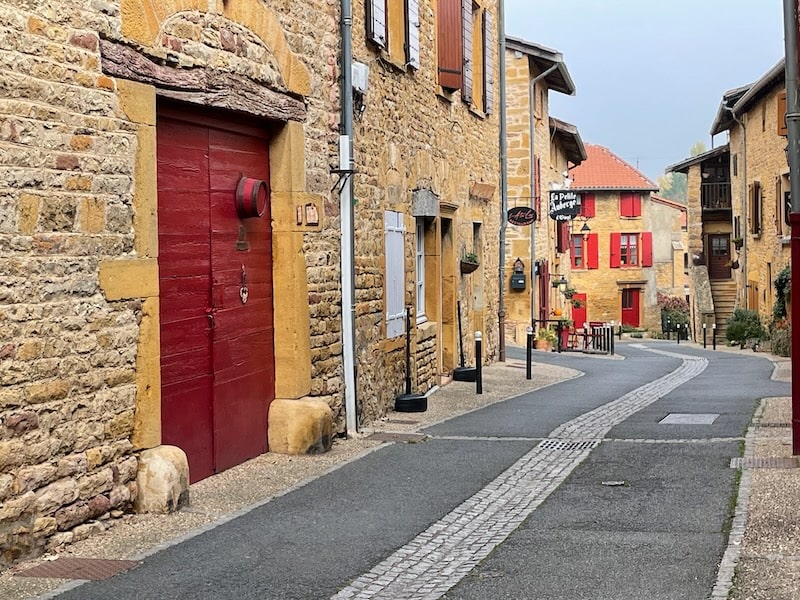 The quiet streets of the village of Oingt ©OffbeatFrance
In 2018, Beaujolais received UNESCO Global Geopark status to protect a landscape that has changed over millions of years to finally yield the soil, the stone, the wine, and ultimately the villages themselves we have today.
The stones here shimmer somewhere between gold and rust, whatever the weather. There's plenty to do and see here: you can explore the rural village architecture, cycle or hike through the vineyards, or go wine-tasting.
For a few hours, you'll be plunged into gorgeous surroundings that have somehow escaped the "prettification" of mass tourism.
Using local stone to build beauty
The Pierres Dorées villages are the result of centuries of use of local limestone rich in iron, which oxidizes when exposed to air – hence the rusty colors.
In many villages across France, stones needed for building are brought in from other parts of the country. Not here. In the Pierres Dorées, everything is made with the same local stones, from house walls to churches and barns.
The result may be a certain uniformity, but don't be fooled, it's far from monotonous. On the contrary, each village retains its own personality and even the color of the stone is slightly different.
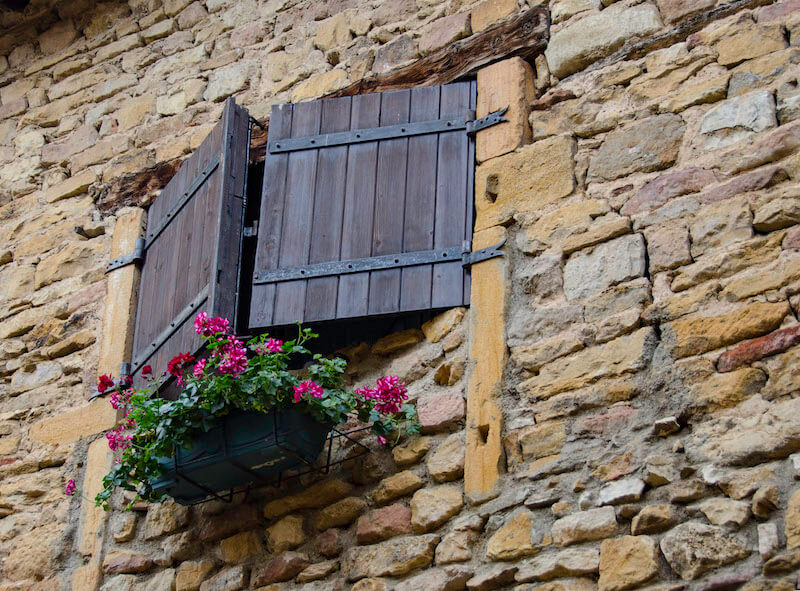
The Pierres Dorées are made up of around 40 communes, or villages, and until 1914, almost every one had its own quarry. The most active didn't just supply local needs but shipped stone to Lyon and as far as Switzerland.
The quarries have since been abandoned and are being reclaimed by nature, with the exception of the Bonave quarry at Theizé, where a lone stonemason continues to cut stone the traditional way for restoration work.
From Lyon to the vineyards
The Pierres Dorées sit at the southern tip of the Beaujolais, where Roman civilization spread up the Saône corridor. The villages developed to their fullest a bit later, during the Middle Ages, and like many villages in France, several sit at the top of hills, a position that protected them from invasion.
Small castles dotted the region (some still do, like Montmelas, which I detail below), providing protection to locals and demonstrating a certain authority over the land. And of course, each village had its church.
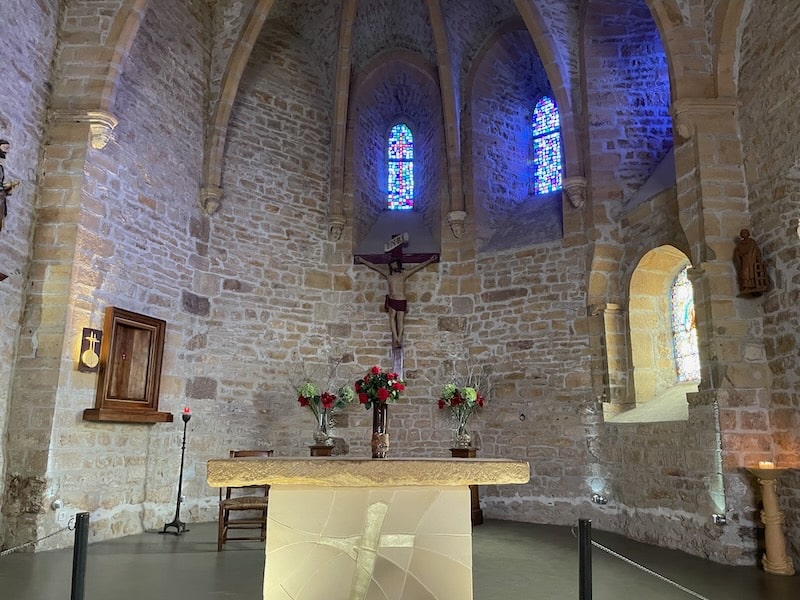 Interior of the church in Oingt ©OffbeatFrance
Between villages are the vineyards, often as far as the eye can see, but the villages stayed small, huddled inwards, but prosperous because of the wine.
The villages here didn't modernize, at least not much, and of course that is a great part of their appeal. If you wanted excitement and the pace of modern life, Lyon was close enough. With escape at hand, there was little need to alter or "improve" local daily life.
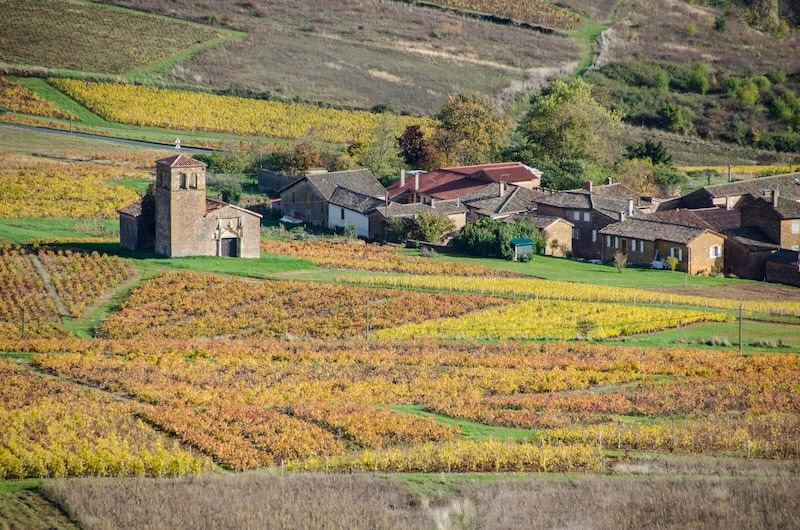 A typical village of the Pierres Dorées ©OffbeatFrance
The result is a comforting stability.
Mostly, the villages remain as they were, bar a few signs or road fixes here and there, some extra eating places, a café or two and maybe a tourist office.
Rather than destroy old buildings to build new ones over their foundations, the old buildings stayed, still used much as they were in the past.
Things to see and do in the Pierres Dorées
That isn't to say there's nothing to do here – on the contrary. Between hiking and cycling and wine-tasting and simply taking the time to stroll and admire, you'll easily be able to fill your hours, or even days.
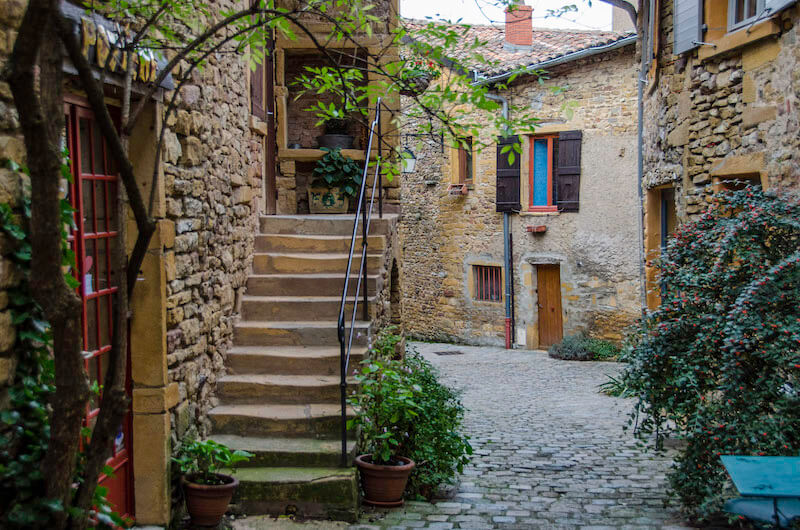
Oingt and the art of staying put
Oingt is the best known of the Pierres Dorées, classified as one of Les Plus Beaux Villages de France, the listing of France's most beautiful villages. That label brings visitors, but the village doesn't seem to have sacrificed its authenticity to it.
Oingt still looks medieval, and its layout hasn't changed in centuries. Nor is it full of souvenir shops – and if you're looking for a meal, there are a few restaurants, mostly outside the village, and a crêperie but that's it. Streets still follow the curve around the hill and you'll step into a tiny entrance only to be confronted by a quiet courtyard within.
One "modernization" effort involves opening artists' workshops to visitors for a fee, a recent effort launched in 2025 (and which I have not had the chance to personally experience, since I mostly travel off-season). You might see a calligrapher working letters or a glassmaker spinning a creation but these all take place in Oingt's buildings, not in modern or built workshops.
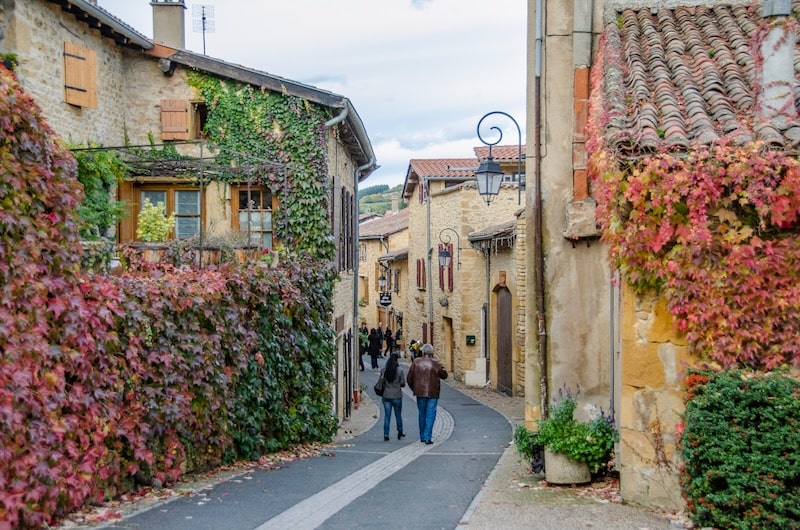 Autumn in the streets of Oingt, on the lead-up to the Beaujolais Nouveau
Enjoying Beaujolais Nouveau
The third Thursday in November shifts the pace here. That's when Beaujolais Nouveau is released, and while the main celebrations happen farther north in the heart of Beaujolais country, the Pierres Dorées villages join in without the tourist crush.
Wineries open their doors and locals gather to taste the new vintage, still young and bright with fruit. It's not fine wine - it's meant to be drunk young, within months - but that's not the point. It's about the ritual, the getting together to celebrate the end of yet another harvest.
You'll find impromptu celebrations at vineyards, people spilling out of cellars with glasses in their hand, comparing notes on this year's wine. The atmosphere is friendly rather than commercial and if you visit during this time, you too are becoming part of a tradition. (If you don't drink wine, there's plenty of grape juice to go around!)
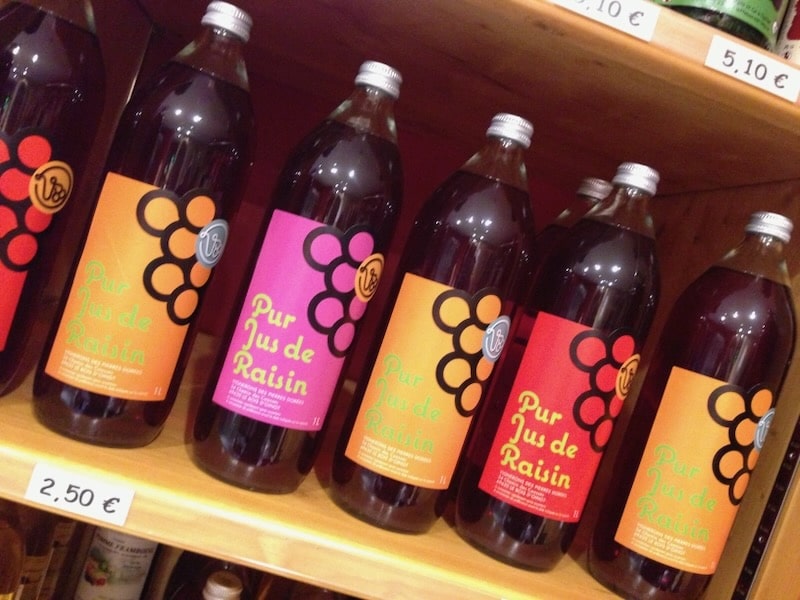
Beaujolais Nouveau brings energy in November, but the Pierres Dorées sit just far enough from the epicenter of wine country to avoid chaos and feel the season without the crush.
The crèches of Oingt
By the time Beaujolais Nouveau is out, something else begins to happen, specifically in Oingt: the first nativity scenes show up in windows and doorways around the village. Not all at once, but gradually, as households prepare for December.
You might spot an angel here, a small stable there, hints of what's coming. The decorations grow more elaborate as the month progresses, until the village becomes a full scavenger hunt of sacred scenes.
The combination – wine celebrations giving way to Christmas preparations, autumn yielding to winter – makes late November an unexpectedly rich time to visit. The vineyards have been harvested, the Nouveau has been released, and the villages are settling into the quieter rhythm of the off-season.
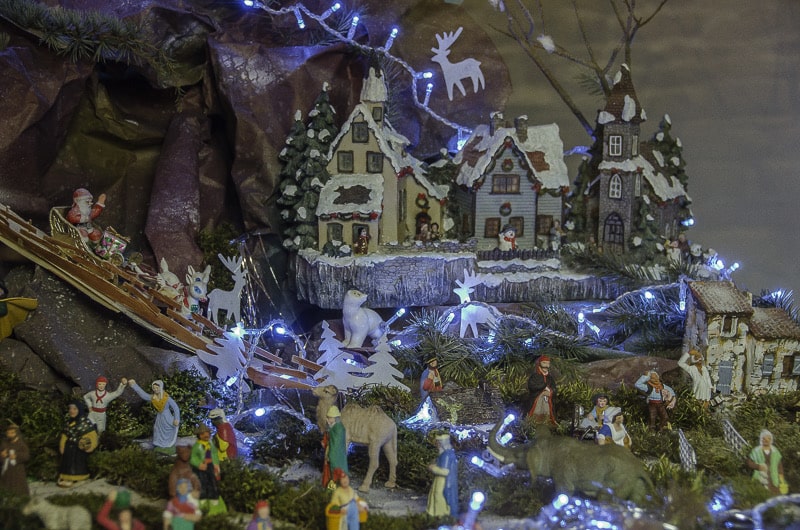 One of many nativity scenes in Oingt at Christmas ©OffbeatFrance
Other villages of the Golden Stones
Oingt may be the most visited of the villages but several others deserve to be explored if you have the time.
Ternand was once fortified, and you can still see traces of its defensive past in the towers and ramparts that remain. The village climbs a hillside, its narrow lanes opening onto unexpected views of the surrounding vineyards. The 11th-century church of Saint-Victor is worth seeking out, with its simple Romanesque lines and peaceful atmosphere. Ternand feels less visited than Oingt, which means you're more likely to have streets to yourself, especially outside summer months.
Theizé sits higher than most villages in the region, which gives it commanding views across the Beaujolais. The village is known for its active quarry where traditional stone-cutting techniques are still practiced for restoration work. A short walk from the center, you'll find the ruined Château de Rochebonne perched on a rocky outcrop, its remaining walls offering panoramic views that make the climb worthwhile. The village maintains a working relationship with its past rather than treating it as museum piece.
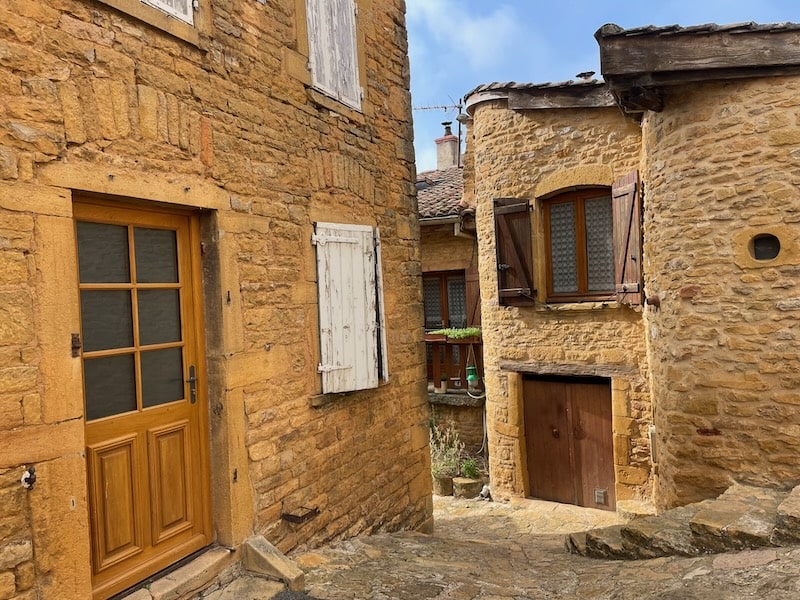 The village of Theizé, one of the Pierres Dorées ©OffbeatFrance
Châtillon-d'Azergues sprawls along the Azergues river at the southern edge of the Pierres Dorées. Its 14th-century castle, complete with round towers, dominates the village and now houses the town hall. The medieval bridge crossing the Azergues is one of those structures that's been repaired and rebuilt so many times it tells the story of centuries of floods and crossings. The village feels more lived-in than polished, with everyday shops alongside the golden stone facades.
Bagnols brings a slightly different atmosphere with its Renaissance château, built in the 15th century and lavishly restored. Unlike many châteaux that feel frozen in time, Bagnols operates as a luxury hotel, which means the building continues to serve a purpose rather than simply be admired. The village itself remains small and agricultural, with vineyard work visible in the surrounding landscape. It's a place where historic grandeur meets working viticulture.
How to get around
The most revealing way to understand the Pierres Dorées is on foot. Paths link villages through vineyards, forests, and open hills, though some distances are too long for a single day. Many hikers come up from Lyon for country walks, though where they get their stamina I do not know. I kept running into the same group village after village – they were walking, while I was driving. Of course, they cut across vineyards. A car could not.
Because the land is hilly, you never quite know what will appear over the crest. Another village, a church, a cluster of stone houses, all quietly luminous.
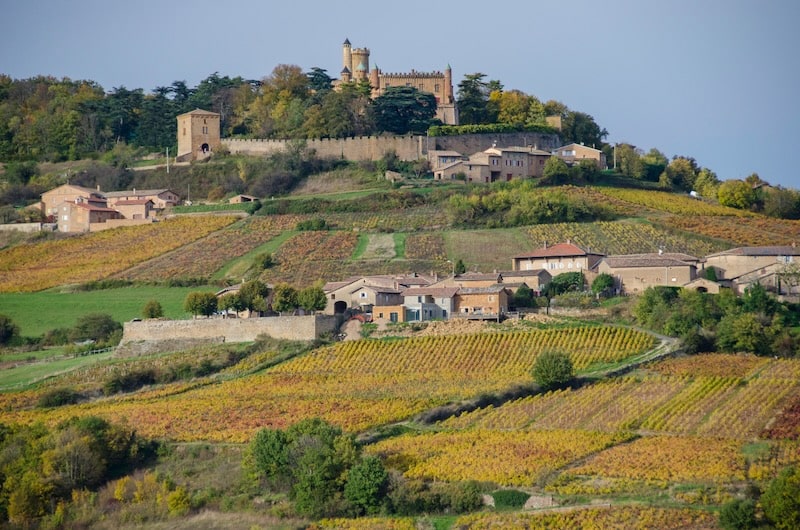 What the Pierres Dorées look like on a sunny autumn day ©OffbeatFrance
Cycling is another option. Climbs make it difficult for beginners, but it's hard to drive more than a few kilometers without meeting cyclists weaving through the vines. An electric bicycle is a good option for those who need a bit of help.
For families or casual riders, La Voie Verte offers about 15 km of car-free cycling between Belleville and Beaujeu, following an old railway line through wine country. It's flat, safe, and includes a stop at the Maison du Terroir Beaujolais, where you can meet winemakers and sample local products.
If your time is limited, a car is unfortunately the only way to get around. Villages can be several kilometers apart and you'll be able to visit most of the area if you have transport.
Practical notes for visitors
The beauty of the Pierre Dorées is that the villages are stunning in every season, because of the changing light. I have now visited twice in November and the liveliness around the Beaujolais Nouveau has been a part of the experience.
If you only have half a day, choose one or two villages and wander around. For a hike between villages, you'll need a full day, so staying nearby makes it easier.
For wine tasting, you'll find shops and cellars open during the Beaujolais Nouveau season and in summer. Outside these times, you can call ahead and make an appointment.
CHÂTEAU DE MONTMELAS
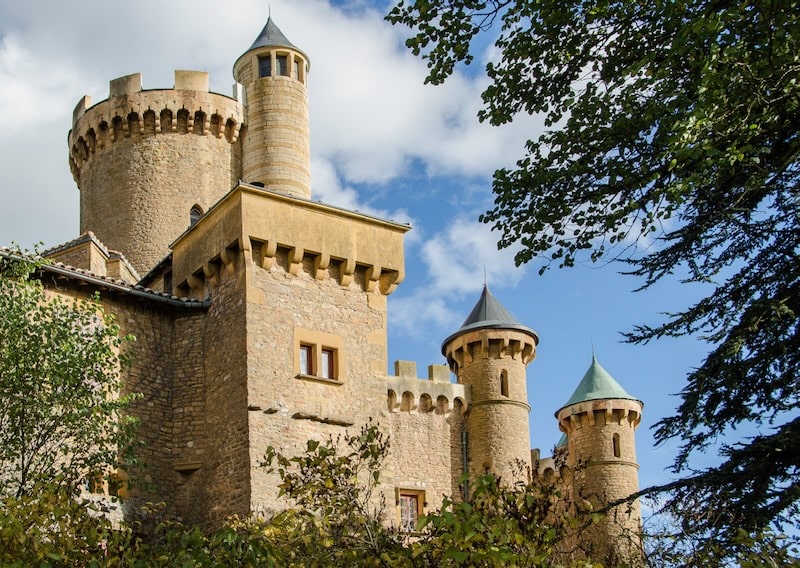
If you want the full golden stone experience, you can sleep in a castle tower or right next to its walls. Château de Montmelas sits on a rocky outcrop in Montmelas-Saint-Sorlin with views across the vineyards toward Mont Blanc on clear days. Construction began in the 10th century, when it served as a garrison for the Sires de Beaujeu who controlled this territory. It has been in the same family since 1566.
The castle has plenty of stories. During the Revolution, when lord Gaspard de Montmelas was imprisoned in Lyon, villagers marched to the city to free him. One resident was Marguerite-Catherine Haynault, mistress of Louis XV, who married into the family and lived here from 1766 until 1823. The current neo-Gothic appearance dates from an 1828 rebuild by Lyon architect Louis Dupasquier.
Today it is a working wine estate (Marquis de Montmelas, 50 hectares) run by the d'Harcourt family. You can visit in summer or by appointment, or better yet, spend the night in gîtes converted from castle outbuildings and towers.
FAQ
How many villages make up the Pierres Dorées?
How many villages make up the Pierres Dorées?
About 40, depending on how strictly you define golden stone architecture. The most visited include Oingt, Theizé, Ternand, Châtillon-d'Azergues, and Bagnols.
Is the Pierres Dorées region the same as Beaujolais?
Is the Pierres Dorées region the same as Beaujolais?
The Pierres Dorées sit within the Beaujolais wine region, at its southern end closest to Lyon. While all Pierres Dorées villages are in Beaujolais, not all Beaujolais villages use golden stone.
Can you visit the Pierres Dorées as a day trip from Lyon?
Can you visit the Pierres Dorées as a day trip from Lyon?
Yes. The region lies about 30-40 minutes north of Lyon. You can visit two or three villages comfortably in a day, or focus on one and add a walk or wine visit.
What's the best time of year to visit?
What's the best time of year to visit?
There is no bad season. Autumn brings harvest activity and color. December adds nativity scenes in Oingt. In winter, you have clear light and fewer visitors. Spring and early summer turn the vineyards green.
Can you walk between villages?
Can you walk between villages?
Yes. Paths link many villages through vineyards and woods. Distances vary from short strolls to full-day walks, with rolling rather than extreme terrain.
Where should I stay to explore the region?
Where should I stay to explore the region?
Staying in one of the villages offers the richest experience. Oingt, Theizé, and Châtillon-d'Azergues have gîtes and chambres d'hôtes. Château de Montmelas offers something different and historical.
Before you go...
The Pierres Dorées sit at the edge of Lyon’s long story. After villages shaped by medieval stone and vineyard work, it makes sense to return to the city where that story began. Roman Lyon (called Lugdunum) still anchors the hill of Fourvière, with its theaters, baths, and traces of an imperial capital.
Or, you could go on and explore the region on one of the many day trips you can take from Lyon...
Did you enjoy this article? I'd love if you shared it!

🇫🇷

Bonjour! I'm Leyla.
Born in Paris and now based in eastern France between Lyon and Annecy, I've spent years exploring the places and stories that explain why France is the way it is.
Offbeat France is for curious francophiles, whether you're planning a trip or simply fascinated by France. Here you'll discover the history behind the villages, castles, traditions, landscapes and everyday details that most visitors notice but few can explain.
Alongside practical travel advice, I share the context that helps you make sense out of France. The more you understand, the more rewarding every visit becomes.
If you finish an article thinking, "I never knew that... now I want to know more," then I've done my job.
Learn more about me!
Read my Substack historical essays
🇫🇷

🇫🇷
Booking.comWhat's New!


-
Poitiers in France: Why This Historic City Deserves More Visitors
Aug 02, 26 03:05 PM
Discover the best things to do in Poitiers, France, from Roman ruins and medieval streets to Eleanor of Aquitaine's legacy and remarkable architecture. -
Limoges, France: Much More Than Porcelain
Jul 25, 26 09:14 AM
Limoges France is more than porcelain. Discover medieval streets, enamel masterpieces and centuries of history. -
Saint-Quentin, France: The Art Deco City No One Talks About
Jul 15, 26 05:31 AM
Saint-Quentin France rebuilt itself in Art Deco after WWI left it in ruins. It's now one of France's most striking architectural cities. -
Visiting France In A Heatwave: What You Need To Know
Jun 26, 26 12:45 PM
Visiting France during a heatwave? Learn how to stay cool and enjoy your trip despite the heat. -
Angoulême: From Medieval Stronghold To France's Capital Of Comics
Jun 26, 26 12:44 PM
Medieval streets, a Romanesque cathedral, five centuries of papermaking, and giant comic murals. Angoulême surprises most visitors.