Fascinated by Gallo-Roman history? Click Here to download > > > Here are 6 ways Rome affected France





Follow me on
- Home ›
- Ze French ›
- La Gastronomie ›
- Unique Food Festivals
Unique Food Festivals In France By Season
Published 23 February 2026 by Leyla Alyanak — Parisian by birth, Lyonnaise by adoption, historian by passion
Across France, entire towns devote a weekend — sometimes several — to a single ingredient. These festivals follow the agricultural calendar, moving from winter truffles and citrus to spring asparagus, summer seafood and autumn harvest crops: one product, one place, one moment in the year. Here are some of the most interesting.
It all started with a visit to l'Alicoque in the town of Nyons, in the Drôme Provençale, sandwiched between Provence and the foothills of the Alps.
The town turned green for an entire weekend — from olive-themed foods to the long capes worn by the Confrérie des Chevaliers de l'Olivier, the brotherhood in charge of protecting the local olive. The air smelled of fresh-pressed oil, and every conversation circled back to the same ingredient.
That particular festival is no longer held, but it stuck with me.
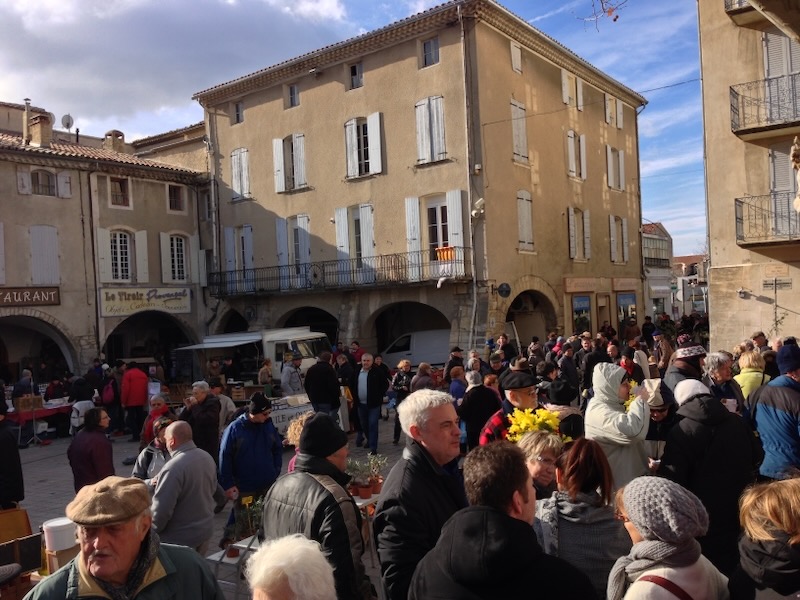 Braving the cold a the Alicoque in Nyons ©OffbeatFrance
France is full of food festivals. The big ones — Lyon's street food festival, the Taste of Paris — are deliberately eclectic: energy, crowds, plenty of choice.
But single-food festivals work differently. They're about depth, usually about one ingredient only, often represented by a confrérie, a historic brotherhood established to defend and publicize regional foods and wines.
For a few days, an entire town might live and breathe lemons or scallops or geese. Streets, menus, markets and rituals all fall into line and everything, it seems, is dedicated to that one special thing.
In France, these festivals reflect agricultural products which have existed for years or sometimes centuries, and are often protected by an AOP, or Appellation d’Origine Protégée, a European quality label linking a product to a specific place).
Here are some intriguing single-food festivals, the kind that genuinely take over a town, divided by season. And for each one I've listed, there are certainly half a dozen I've left out!
NOTE ➽ I've linked where possible to their official sites, but most are in French (and some don't update their sites regularly). For the latest information, you can contact the town's tourist office.
- Richerenches, Vaucluse – Messe aux Truffes
- Menton, Alpes-Maritimes – Fête du Citron
- Le Bar-sur-Loup, Alpes-Maritimes – Fête de l'Orange Amère
- Mont-de-Marsan, Landes – Fête du Bœuf Gras
- Mortagne-au-Perche, Orne – Foire au Boudin
- Sarlat-la-Canéda, Dordogne – Fest'Oie
- Bessières, Haute-Garonne – Fête de l'Omelette Géante
- Landes – Asparagus festivals
- Saint-Quay-Portrieux, Côtes d'Armor – Fête de la Coquille Saint-Jacques
- Céret, Pyrénées-Orientales – Fête de la Cerise
- Plougastel-Daoulas, Finistère – Fête de la Fraise
- Saint-Gilles-Croix-de-Vie, Vendée – Fête de la Sardine
- Saint-Pierre-d’Oléron – Fête du Sel
- Lautrec, Tarn – Fête de l’Ail Rose
- Uzès, Gard – Fête de la Truffe d’Été
- Mirande, Gers – Fête du Porc Noir Gascon
Winter food festivals in France
Richerenches, Vaucluse – Messe aux Truffes (3rd Sunday, January)
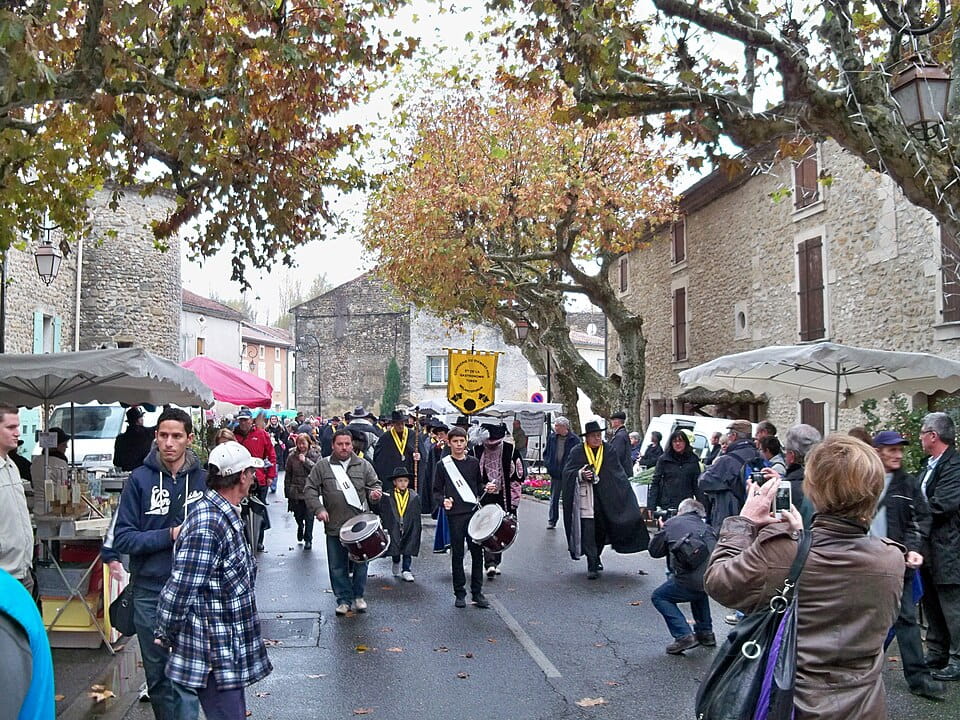 Photo Véronique Pagnier via CC BY-SA 3.0
Each winter, this small village becomes one of France’s most important centers for black truffles, the prized Tuber melanosporum. While the Saturday markets run from December through February, the defining moment comes on the third Sunday of January.
That day, fresh truffles are brought to the church of Saint-Denis for a ceremonial mass. The offerings are later auctioned publicly for the benefit of the parish, attracting buyers and onlookers from across the region.
Members of the Confrérie du Diamant Noir (the brotherhood of the black diamond) appear in formal dress, and the streets fill with stalls and tastings, all about one little fungus.
Menton, Alpes-Maritimes – Fête du Citron (February)
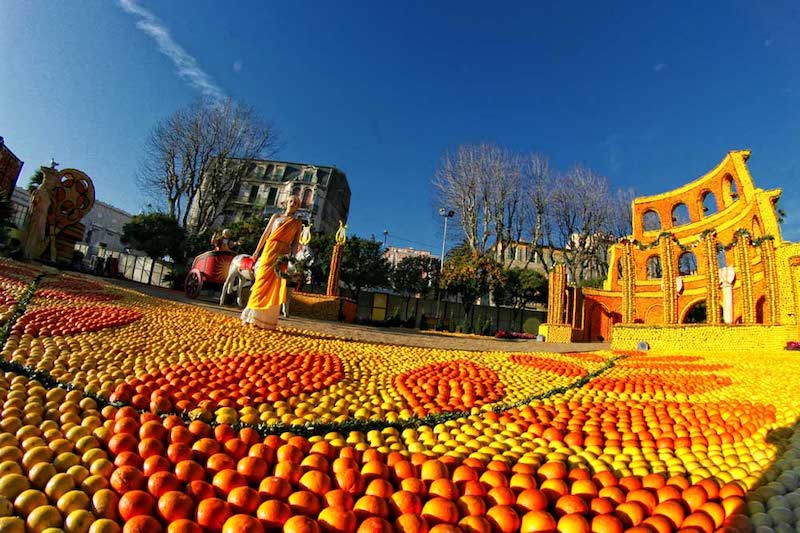 These monumental sculptures are not made from Menton lemons - these are too rare and precious, so the float citrus are imported, usually from Spain
This is the largest and most theatrical of food festivals. For two weeks, monumental sculptures built from 140 tons of lemons and oranges line the streets. You'll be swept up by parades and citrus-based foods, in a town that smells like one enormous marmalade, all paying homage to the Menton lemon grown in the surrounding hills.
The Menton lemon holds IGP (Indication Géographique Protégée) status, meaning its cultivation is officially tied to this stretch of the Riviera.
Le Bar-sur-Loup, Alpes-Maritimes – Fête de l'Orange Amère (February)
If Menton is too large or organized for you, head for this smaller and more intimate festival. The bitter orange is this hilltop town's historical crop. The festival focuses on marmalades, pastries and traditional dishes, with stands filling narrow streets and a pace that stays absolutely local.
Mont-de-Marsan, Landes – Fête du Bœuf Gras (February)
Held in late winter, the Fête du Bœuf Gras celebrates beef at the height of the season, just before Lent.
The event reflects a long pastoral tradition in southwest France, where cattle breeding has influenced both landscape and cuisine.
Prize cattle are presented by breeders and later showcased by local butchers. The emphasis is on regional breeds and traditional know-how rather than entertainment.
Markets and tastings take place, and restaurants feature special menus built around beef cuts that reflect Gascony's culinary traditions.
Mortagne-au-Perche, Orne – Foire au Boudin (early March)
This Norman market fair showcases artisans from across Europe who produce boudin noir, (blood sausage), boudin blanc, tripe and charcuterie.
Charcuterie in this region developed as a practical way to preserve pork through the winter months, long before refrigeration.
Markets spill out along medieval streets, and demonstrations run continuously. The crowd knows exactly what it's there for. Some come for the food, others for the atmosphere.
Sarlat-la-Canéda, Dordogne – Fest'Oie (early March)
This is a town-wide celebration of the goose, tied to the Dordogne's traditions.
For centuries, raising geese has been central to the rural economy of the Dordogne, where confit and foie gras developed as a way to preserve food, not only as much as delicacies.
Producers bring geese into town as a reminder of the region’s long-standing foie gras and confit traditions. The Sunday banquet serves some 15 goose dishes to 900 guests – tickets sell out in minutes.
Spring food festivals in France
Bessières, Haute-Garonne – Fête de l'Omelette Géante (Easter Monday)
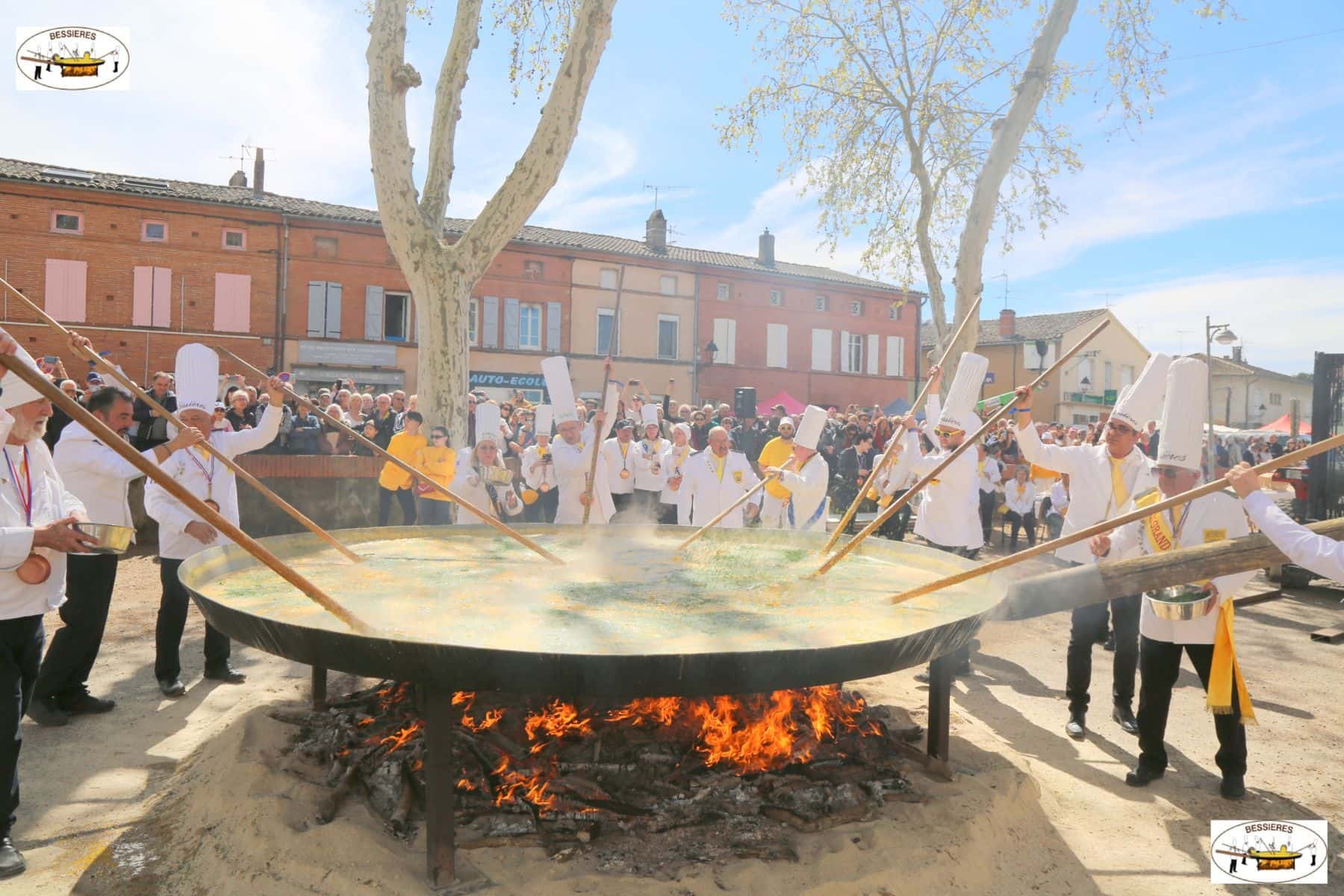 The making of the giant omelette ©Bessieres/Haute-Garonne Tourisme
The entire village gathers to make a massive omelette from thousands of eggs. The tradition supposedly dates back to Napoleon (though the festival itself started in 1973), but what matters is the ritual: cracking eggs, everyone pitching in to stir and then eating together.
The omelette is cooked in a giant pan over an open fire and served free to the public - it's a communal event rather than a commercial one.
Landes – Asparagus festivals (March-April)
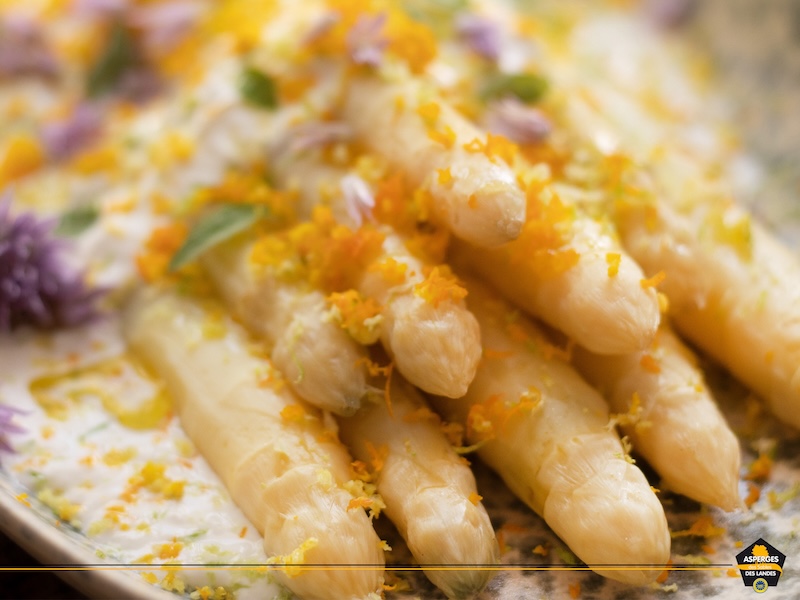
Several towns in the Landes in western France celebrate the start of white asparagus season with markets and communal meals. The better ones pull entire towns in, with growers front and center and menus temporarily showcasing a single vegetable.
The asparagus grown in the Landes holds IGP status, and many festivals are organized by producer groups rather than event companies.
Saint-Quay-Portrieux, Côtes d'Armor – Fête de la Coquille Saint-Jacques (April)
This is one of several rotating Breton scallop festivals marking the end of the fishing season. Ports close to traffic and stalls take over the waterfront. If you love scallops, they'll appear grilled, stewed and shelled on the spot.
In Brittany, the scallop season is tightly regulated, and these festivals coincide with the authorized fishing period.
Céret, Pyrénées-Orientales – Fête de la Cerise (late May)
When France's first cherries ripen in the Pyrénées-Orientales, Céret celebrates with markets, tastings and brass bands. Interestingly, the first crate goes directly to the President of the Republic at the Elysée Palace, a custom dating from 1932. It's a point of fierce local pride.
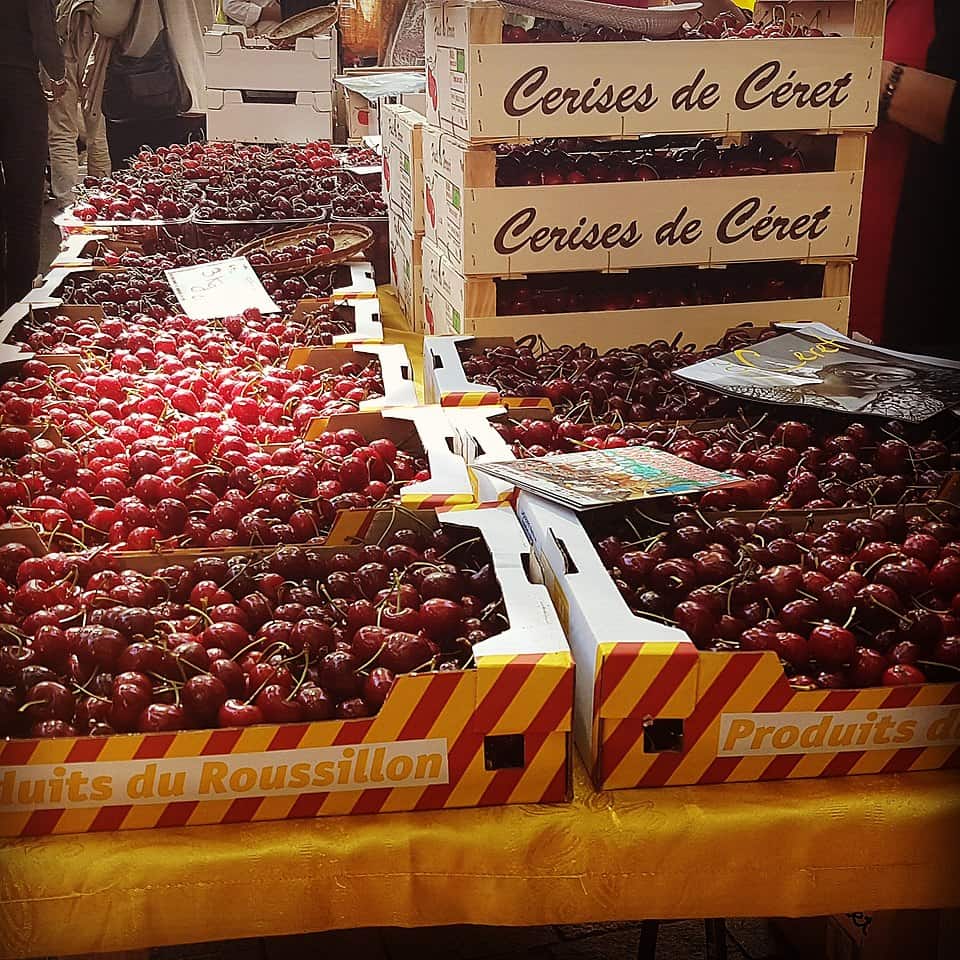 Cherries from Céret by Fabricio Cardenas via CC BY-SA 4.0
Plougastel-Daoulas, Finistère – Fête de la Fraise (late May)
By late spring, this Breton town pivots entirely around strawberries including parades, desserts, competitions and a giant tart made from hundreds of kilos of berries. It's agricultural pride on a large scale.
Plougastel once supplied a large share of France’s early strawberries, and the festival continues to promote local growers rather than outside vendors.
Summer food festivals in France
Saint-Gilles-Croix-de-Vie, Vendée – Fête de la Sardine (July)
In this Vendée port, the sardine defines both economy and reputation. During the July festival, grills line the waterfront and thousands of sardines are cooked and handed out to visitors. The event showcases fishing traditions and includes boat displays and music.
The sardine fishery has long underpinned the town’s development, and the celebration highlights that link. For one evening, the harbor becomes a communal dining space built around a single catch.
Saint-Pierre-d’Oléron – Fête du Sel (July or August)
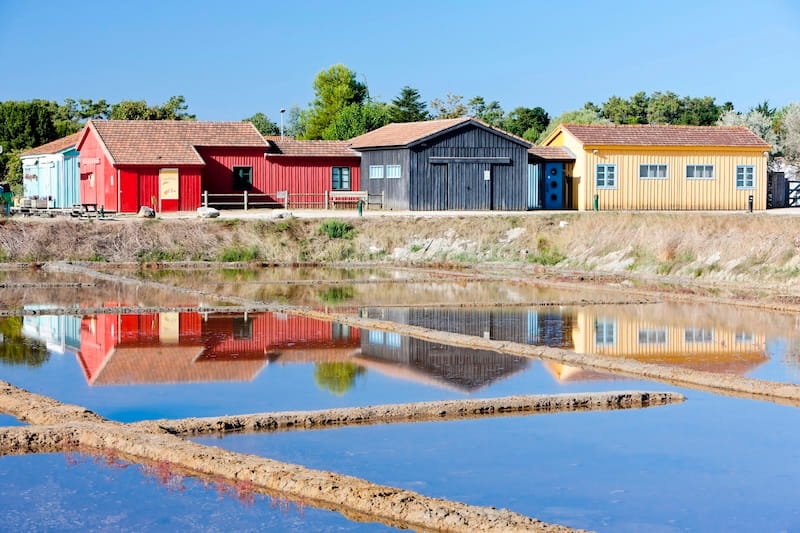
Salt marshes dot the western edge of the Île d’Oléron, and this festival centers on the men and women who harvest sea salt by hand. There are plenty of explanations and guided visits that explain how fleur de sel and coarse salt are collected from evaporation basins. (If you're curious about the process, I've written about salt harvesters further north, in the Guérande.)
Stalls sell salts blended with herbs or left natural, and local dishes incorporate the island’s signature product, so dependent on weather and precise timing.
Lautrec, Tarn – Fête de l’Ail Rose (early August)
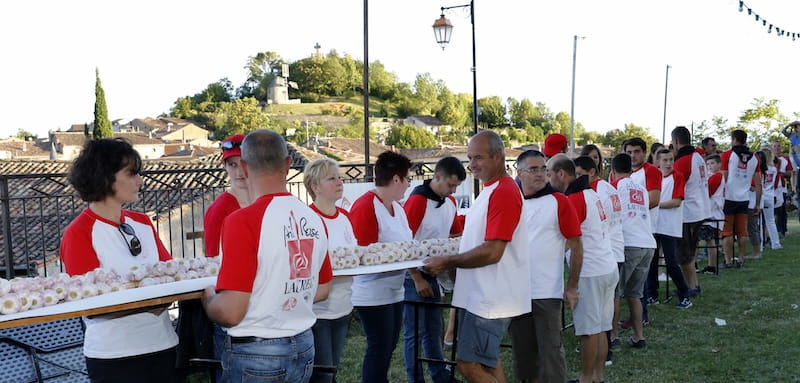
Each summer, this hilltop town in the Tarn is taken over by its most famous crop, the pink garlic of Lautrec. Producers take to the streets to sell braids, fresh bulbs (and garlic-based dishes), while demonstrations explain how the garlic is grown and cured.
The garlic holds Label Rouge and IGP status, linking it formally to this particular territory, and for a weekend, everything in town is focused on garlic - including restaurant menus.
Uzès, Gard – Fête de la Truffe d’Été (August)
In August, Uzès celebrates the summer truffle, Tuber aestivum, a milder cousin of the winter black truffle. Growers and traders gather in the Place aux Herbes for a dedicated market, with cooking demonstrations and tastings.
Unlike the more prestigious winter truffle festivals, this event has a lighter tone, but it still centers the town square on one product, with chefs shaving truffle over simple dishes to highlight aroma over luxury.
Mirande, Gers – Fête du Porc Noir Gascon (August)
In Mirande, the spotlight falls on the Porc Noir Gascon, a heritage breed once nearly extinct. The festival brings breeders, charcutiers and cooks together to showcase cured meats and traditional preparations tied to Gascony.
The usual demonstrations and tastings fill the streets, and let's not forget the communal meals. There's plenty of information about breeding practices and regional labels, a celebration not only of an ancient breed but especially of its revival.
Fall (Autumn) food festivals in France
Mouans-Sartoux, Alpes-Maritimes – Fête du Miel (September)
Each September, Mouans-Sartoux hosts a festival devoted to honey and beekeeping. Producers sell jars from local hives and explain floral sources and extraction methods. They also demonstrate the workings of a hive.
The event emphasizes biodiversity and sustainable agriculture as much as taste. Honey varieties reflect the surrounding Provençal vegetation, from lavender to woodland blossoms. For a weekend, the town square becomes a forum for discussing pollination and the craft of apiculture, which in France is becoming increasingly important as the number of bees diminish.
Romans-sur-Isère, Drôme – Fête de la Raviole (September)
Who doesn't love the plaques of mini cheese-filled raviolis we all know as the ravioles de Romans?
Each September, Romans-sur-Isère celebrates a festival in honor of its signature pasta which, by the way, carries IGP status. Here, producers and manufacturers open their stands to the public, cooking ravioles on the spot and offering variations beyond the classic Comté and parsley fillings.
The event highlights both artisanal and industrial production, since ravioles remain one of the town’s defining food businesses, so come hungry.
Le Bugue, Dordogne – Fête de la Noix (October)
In the Dordogne, Le Bugue dedicates an autumn weekend to the walnut harvest. Markets fill with fresh walnuts, walnut oil, cakes and liqueurs, while producers explain pressing methods and caring for orchards.
Walnuts have long influenced the rural economy of the Périgord, where oil was once a staple fat.
The festival coincides with harvest time, when green husks are removed and the season’s first oils appear. For a few days, the town revolves around a crop deeply rooted in local agriculture.
Monts d'Ardèche - Les Castagnades (October–November)
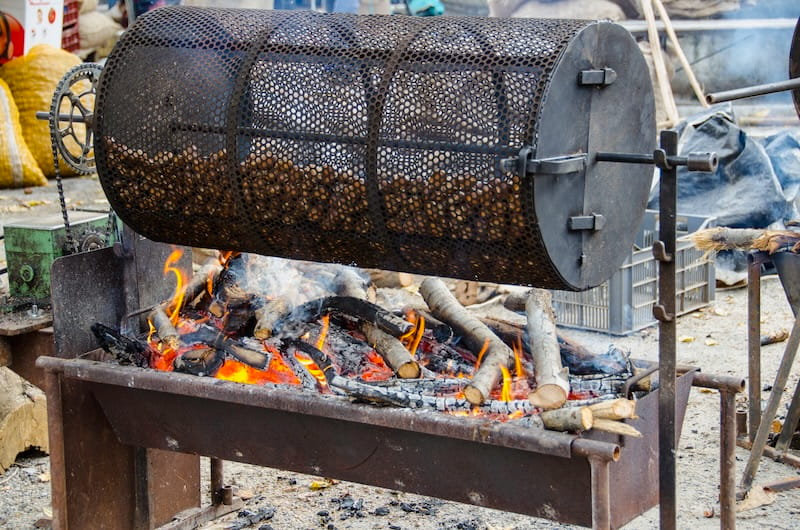 Roasting chestnuts at Les Castagnades ©OffbeatFrance
Come autumn each year, it seems every town in mountainous interior of the Ardèche is celebrating the chestnut.
Joyeuse, Privas, Antraigues, Saint-Pierreville – each hosts its own castagnades with roasted chestnuts, markets and the Ardèche Chestnut Brotherhood in full regalia. I highly recommend it.
Chestnut cultivation dates back centuries and chestnuts were once a staple food in the region. During the festival, you'll find chestnuts served up in every possible form in restaurants throughout the region.
Dieppe, Seine-Maritime – Foire aux Harengs et à la Coquille Saint-Jacques (November)
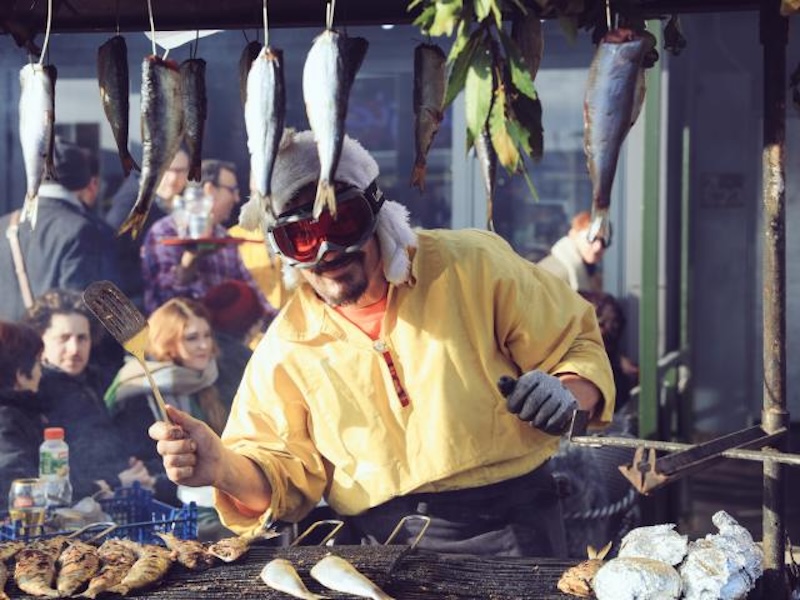 Annual sardine festival in Dieppe ©Marie Joubert/Dieppe Tourisme
The third weekend of November, Dieppe’s quays are lined with grills turning herring over open flames (and scallops too!). Fishermen, vendors and visitors gather as the catch is cooked and handed out in generous portions.
The herring season has historically sustained this Normandy port, and the festival harks back to that era of maritime dependence. It's smoky and loud and not a spectacle - basically it's a large communal meal built around one fish.
How to find festival accommodations
Finding the right place to stay is always a challenge during popular events - these festivals are no exception. Visitors from across France and abroad reserve far in advance, and you should to if you hope to find a room near the main events.
Here are a few tips to help you find those elusive rooms when it's crowded and in demand:
- As soon as you know your dates, book lodging even if you haven’t finalized exact travel plans.
- Expand your search radius to nearby towns and villages within half an hour's drive.
- Use different platforms: booking.com, tripadvisor.com, VRBO...
- And if everything is booked, try calling the hotel directly. Sometimes they hold back some inventory or there may have been cancellations.
- If you're in a bind, do call the local tourist office - they often know of smaller, local accommodations. Ask if they know any chambres d'hôtes, (bed & breakfasts) or gîtes (self-catering rural homes).
- Try to vary your dates, by arriving a day or two early or leaving before the end.
- Make sure you book restaurants ahead because they, too, fill up quickly, and some smaller towns don't have many.
- In a pinch, ask your hotel for local recommendations - they're usually in the know.
These practices work whether the festival is massive (Menton) or regional but intense (Mortagne, Saint-Quay-Portrieux). Booking early and widening your search will save stress and money.
Before you go...
There's something quintessentially French about these festivals. They show us how deeply an entire town can care about a single ingredient which, elsewhere, might not merit more than a footnote.
And if you're planning a seasonal trip to France, here's what France looks like month by month.
In a country where terroir – the link between land, product and identity – remains a living concept rather than a slogan, these single-food festivals knit those connections together.
Did you enjoy this article? I'd love if you shared it!
🇫🇷

Bonjour! I'm Leyla.
Born in Paris and now based in eastern France between Lyon and Annecy, I've spent years exploring the places and stories that explain why France is the way it is.
Offbeat France is for curious francophiles, whether you're planning a trip or simply fascinated by France. Here you'll discover the history behind the villages, castles, traditions, landscapes and everyday details that most visitors notice but few can explain.
Alongside practical travel advice, I share the context that helps you make sense out of France. The more you understand, the more rewarding every visit becomes.
If you finish an article thinking, "I never knew that... now I want to know more," then I've done my job.
Learn more about me!
Read my Substack historical essays
🇫🇷

🇫🇷
Booking.comWhat's New!


-
Poitiers in France: Why This Historic City Deserves More Visitors
Aug 02, 26 03:05 PM
Discover the best things to do in Poitiers, France, from Roman ruins and medieval streets to Eleanor of Aquitaine's legacy and remarkable architecture. -
Limoges, France: Much More Than Porcelain
Jul 25, 26 09:14 AM
Limoges France is more than porcelain. Discover medieval streets, enamel masterpieces and centuries of history. -
Saint-Quentin, France: The Art Deco City No One Talks About
Jul 15, 26 05:31 AM
Saint-Quentin France rebuilt itself in Art Deco after WWI left it in ruins. It's now one of France's most striking architectural cities. -
Visiting France In A Heatwave: What You Need To Know
Jun 26, 26 12:45 PM
Visiting France during a heatwave? Learn how to stay cool and enjoy your trip despite the heat. -
Angoulême: From Medieval Stronghold To France's Capital Of Comics
Jun 26, 26 12:44 PM
Medieval streets, a Romanesque cathedral, five centuries of papermaking, and giant comic murals. Angoulême surprises most visitors.