Fascinated by Gallo-Roman history? Click Here to download > > > Here are 6 ways Rome affected France





Follow me on
- Home ›
- Destinations ›
- Lake Geneva-French Alps ›
- Château Voltaire
ChÂteau Voltaire in Ferney: Inside the Philosopher’s Home
Published 10 November 2026 by Leyla Alyanak — Parisian by birth, Lyonnaise by adoption, historian by passion
What can a visit to Voltaire’s château on the Franco-Swiss border tell us about the man behind the famous name? From an inscription on a church to a painting of his enemies, the Château de Ferney offers a revealing look at his life – and reasons to linger beyond the château gates.
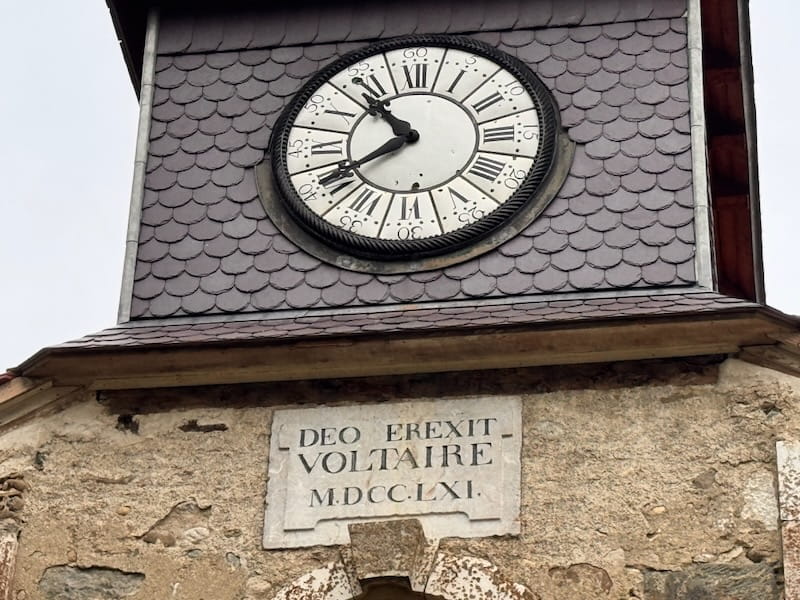
Arriving at the small chapel near the château in which Voltaire spent most of the last 20 years of his life, I saw this inscription: Deo erexit Voltaire, “Erected by Voltaire to God”.
The word VOLTAIRE was larger than the word God.
How typical of the personage! A bit imbued with his own importance, and an anti-clerical activist who strongly opposed religious intolerance.
Voltaire's château is in Ferney-Voltaire, right next to the border with Switzerland, a village those who work in Geneva use as a lunch stop or bedroom community. It makes Voltaire's presence here in the mid-1700s all the more surprising.
Yet his castle would become the place where he wrote and entertained and for a while, a beacon of the Enlightenment.
Voltaire was a writer, playwright and philosopher, and a leading figure of his time. He was also a womanizer and an ambitious social climber. But most of all, he used his pen and his fame to right the wrongs he took to heart.
MORE FRENCH CHÂTEAUX WITH A STORY TO TELL
NOTE: Pages on this site may contain affiliate links, which support this site. See full Privacy Policy here.
Voltaire's château
What follows won't show you every single room or you'd have nothing left to explore, but I did choose those places and items that caught my eye, either because of the way they looked, or because they had an intriguing story behind them.
Once you walk past the chapel near the entrance, you'll follow the circular drive and will be facing a handsome neo-classical residence.
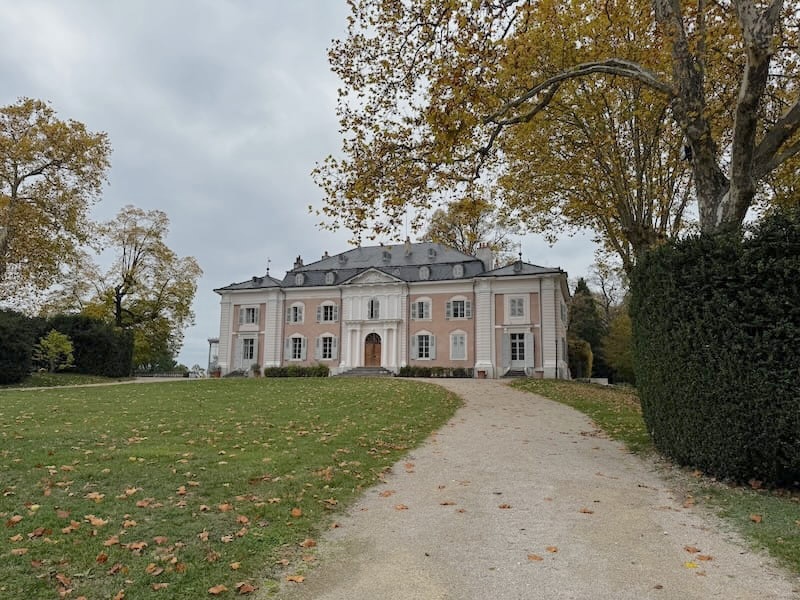 The path to the château ©OffbeatFrance
An old fortress once stood here, which Voltaire rebuilt as his country house, adding more wings and outbuildings as his popularity attracted an ever-growing number of visitors.
When Voltaire died, much of what he had disappeared. What we have here is a reconstruction, but one that is faithful to the original and that sheds light on Voltaire's final years.
Inside Voltaire's castle
Most of the apartments were on the main floor, as was a vestibule through which you had to pass before entering the other rooms. It's small, but two spectacular sculptures – Voltaire (left) and his arch enemy Rousseau – stand on either side of the entrance.
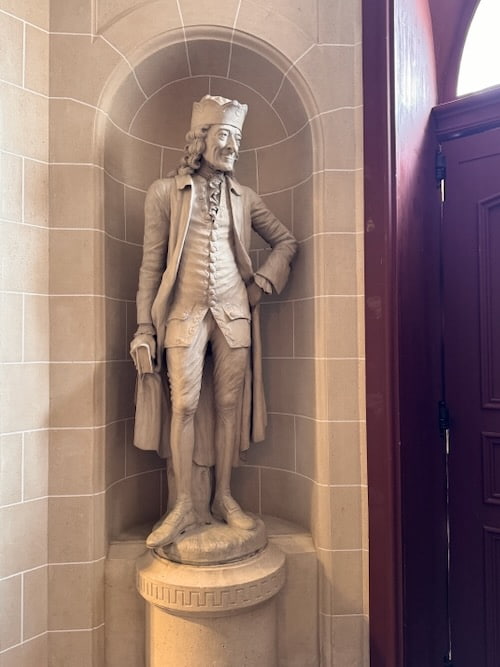
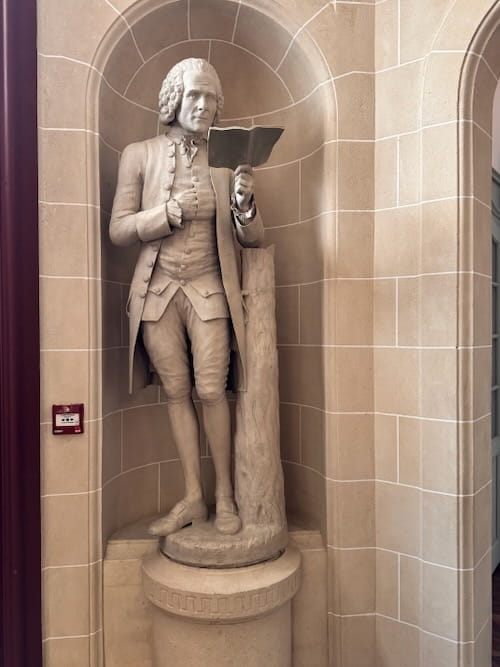
After passing through, the stream of visitors who came to see Voltaire would enter the reception rooms. Here, they would fill every nook and cranny – Voltaire attracted philosophers, writers, artists and members of European high society, which earned him the nickname of “innkeeper of Europe”.
Feeding, lodging and entertaining all these guests was no easy task, hence the large kitchens in the basement and guest accommodations above. These have now been converted into exhibition spaces but can still give you an idea of what once was.
Voltaire may have lived far from the center of things in Paris, but that didn't prevent visitors from cramming the rooms and requesting an audience. At one point, he was besieged so often that he had to cut back on his hospitality.
Nor did Voltaire live alone. He had his trusted valet and servants, of course, but he also shared his life with Madame Denis, his niece – and yes, she was also his mistress.
Their relationship was kept discreet, but people knew. She provided musical entertainment, acted as hostess, and basically mistress of the house. Confirmation of all this only came in the 1950s, when Voltaire's correspondence with Madame Denis was uncovered.
Voltaire's telltale objects
Plenty of fascinating objects and spaces help reveal an older Voltaire to visitors.
Voltaire's bedroom
The reconstructed bedroom is decorated in Voltaire's colors, blue and gold, which also happen to be the traditional colors of French royalty. But what's really interesting in this room is the tiny painting that hangs over his bed, a place usually reserved for a sign of religious devotion.
It is a painting of the Protestant Calas family, ruined after Jean Calas was accused of murdering his son to prevent him from converting to Catholicism. Voltaire fought for three years to clear Calas's name, finally achieving his posthumous exoneration in 1765.
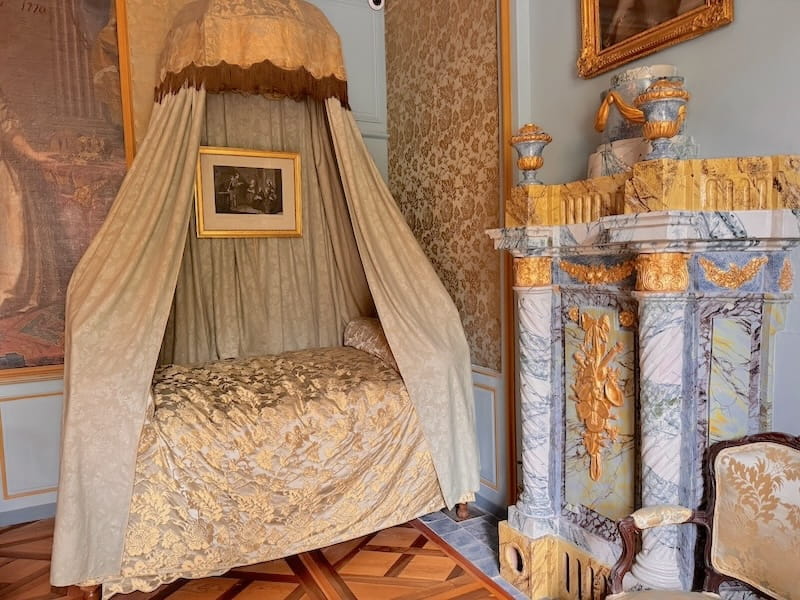 I didn't do a very good job of lighting that small painting of the Calas family (by Jean-Baptiste Delafosse) that hangs above Voltaire's bed, but its positioning gives you an idea of how important he thought it was ©OffbeatFrance
When Voltaire stood up against religious intolerance, he acted. The Calas family was just one example of his activism, but there were others.
His bedroom has a series of other interesting paintings – his own youthful self above the marble stove, then to the left of his bed the Empress Marie-Therese of Austria, and on the left wall Émilie du Châtelet, his lover and companion in earlier years.
The living room
This is Voltaire's living room, the one which dignitaries saw when they visited. Its walls are covered with art, many of them mediocre reproductions painted by one of his nieces. He loved being a collector – he just wasn't very good at it.
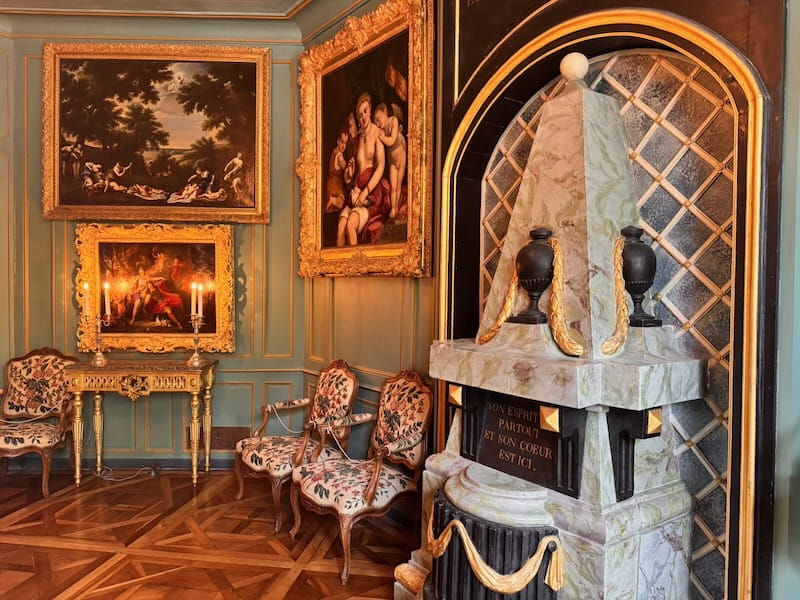 This is perhaps the most elaborately decorated room in the château, the salon, or living room, where Voltaire entertained important guests. On the right is an intriguing cenotaph, a monument designed to hold his heart after death (this was a common custom) – it never did ©OffbeatFrance
The cabinet of paintings
This was actually the original location of Voltaire's bedroom, but was transformed into a sort of exhibition room during the 19th century.
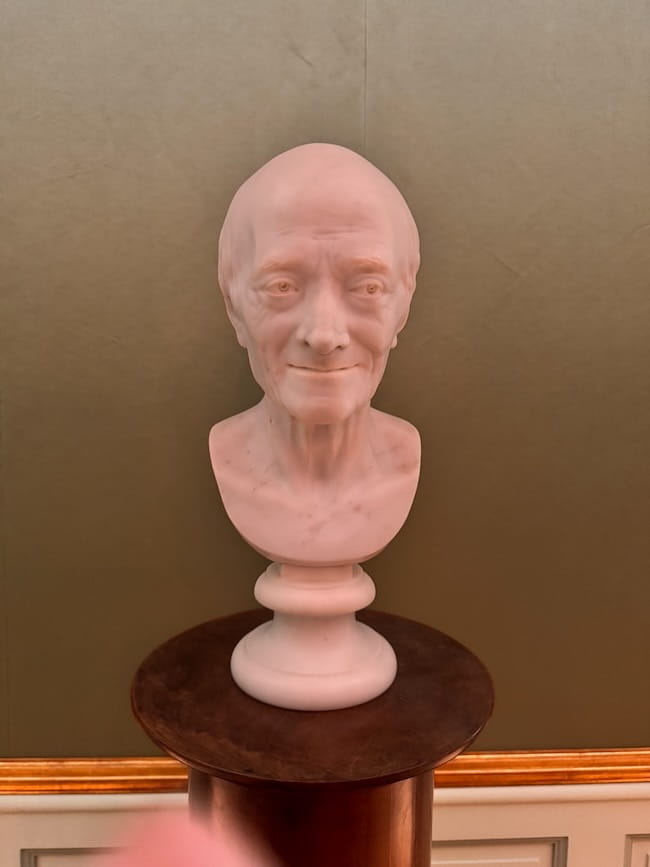 One of several interesting pieces in this room is a vivid bust of Voltaire by Jean Antoine Houdon, showing him in all the glory of his advanced age, 83, the year he died ©OffbeatFrance
Also fascinating is the painting "The Triumph of Voltaire", which celebrates his fame – it's quite detailed and almost biographical. It shows his supporters, like Madame Denis and the Calas family, but also shows his enemies.
It symbolizes the triumph not only of Voltaire but of the forces of Enlightenment against darkness, of tolerance vs intolerance. It's also a great biographical piece because it retraces many of his supporters and adversaries throughout life.
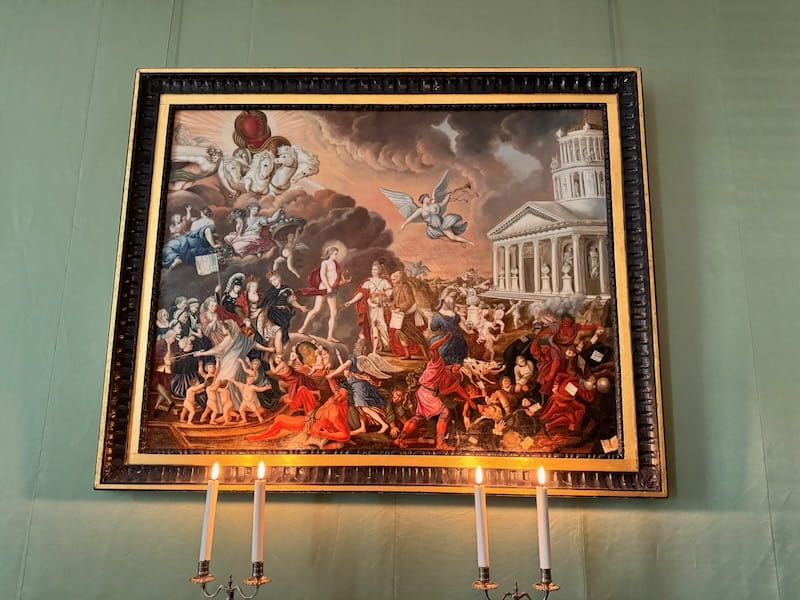 This is one of those paintings with enough detail to keep you busy for a few minutes, trying to identify Voltaire's friends and foes. The Triumph of Voltaire was painted by Duplessis ©OffbeatFrance
Mme Denis' salon
This was the room in which Mme Denis received her guests – often to the sound of her clavichord.
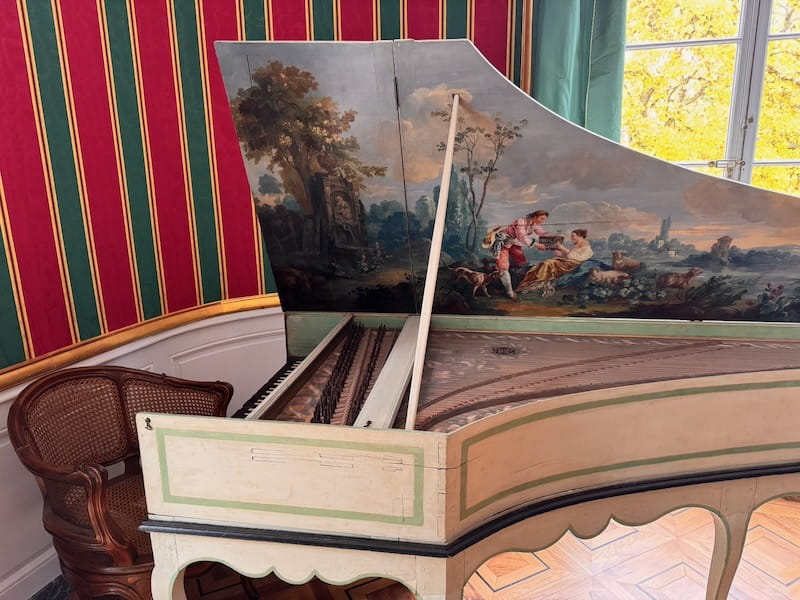 Mme Denis entertained her guests with this clavichord, which you can see in the château. By all accounts, she wasn't an outstanding musician... ©OffbeatFrance
The tapestry on the wall is new, dating from the 2018 restoration. It is always difficult to reproduce the past, especially when all you have are a few drawings or paintings.
But this case was different.
Catherine II of Russia had received an exact scale model of the château, along with tapestry samples, so the walls could be covered with newly-woven materials identical to the originals.
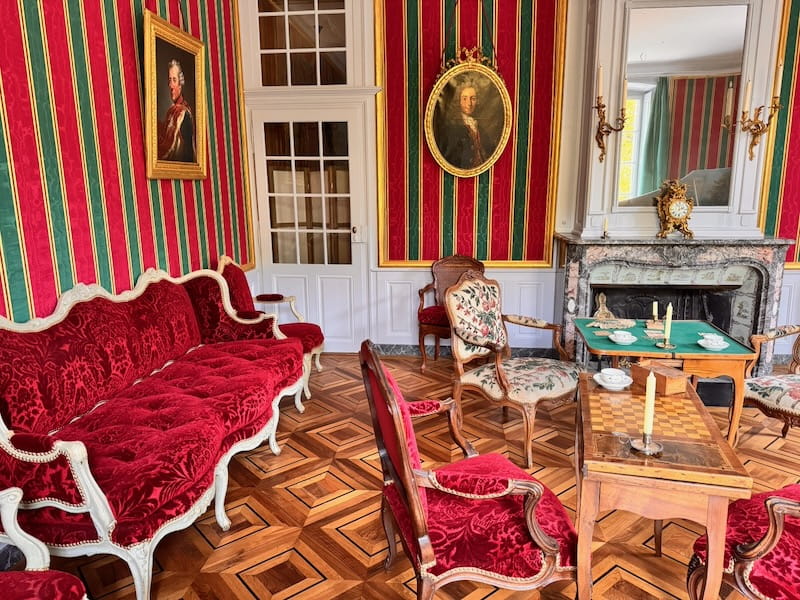
One noteworthy item in this room is a small adjoining space containing a toilet, a huge innovation for the 18th century.
The library (which wasn't there)
At some point you'll walk through a large bare, unfurnished room, strange more for what isn't there than for what is.
One thing you might expect in a home belonging to one of the era's most erudite personalities is a huge library, yet there's not a book to be found.
They do exist, however: they just happen to be in St Petersburg, in Russia.
For years, Voltaire had corresponded with Catherine the Great and when he died, she bought the library of some 7000 volumes he had assembled at Ferney to preserve the collection intact. Voltaire's secretary, Jean-Louis Wagnière, arranged the books in the Winter Palace in the same order they had been arranged in Ferney.
As we'll see shortly, that wouldn't be the only time Catherine of Russia helped protect Voltaire's legacy...
How did Voltaire end up in Ferney?
Let's just say his life wasn't the most calm.
His earlier years had included imprisonment, exile and difficult relationships with powerful patrons.
His father wanted him to have a legal career but he wanted to be a writer. His mocking style landed him in the Bastille, with a second prison stay because of a disagreement with an aristocrat. The result was exile in England, whose political and religious freedoms he would learn to appreciate.
Back in France, his Lettres philosophiques, praising English freedoms (and implicitly criticizing France), prompted yet another arrest warrant. He took refuge at the Château de Cirey with his lover Émilie du Châtelet. It would become his home for 15 years, until her death in 1749.
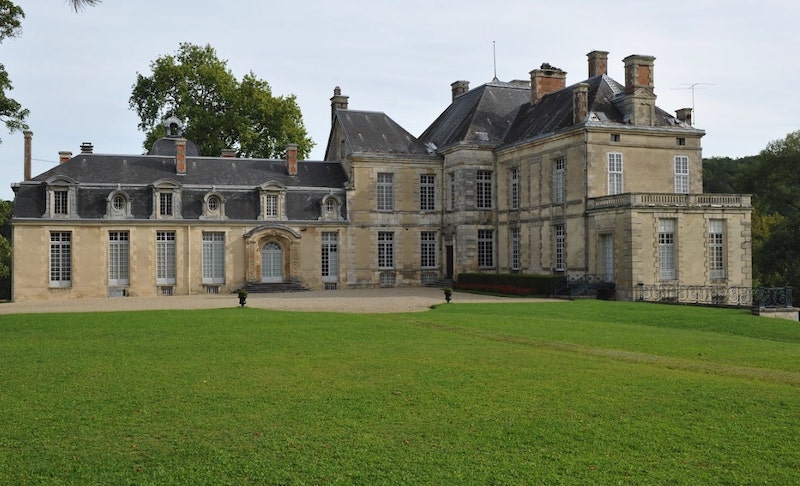 The Château de Cirey in the Haute Marne (former region of Champagne), where Voltaire also lived ©OffbeatFrance
After her death, he accepted Frederick II of Prussia's invitation to join his court at Potsdam, near Berlin. The king admired French literature and had corresponded with Voltaire for years but this, too, ended in quarrels and disagreements.
With Louis XV refusing to let him return to Paris, Voltaire settled on the outskirts of Geneva, but the Calvinist nature of the city proved to be too much – he was a playwright, and the Calvinists were opposed to theatrical performances, so that was the beginning of the end of his stay in Geneva.
Seeking greater independence, in 1758 he found the property in Ferney (then called Fernex). It was located in France but close enough to the border to provide an escape route should any overenthusiastic gendarmes were to make an appearance. Here he would spend most of his remaining years with Mme Denis.
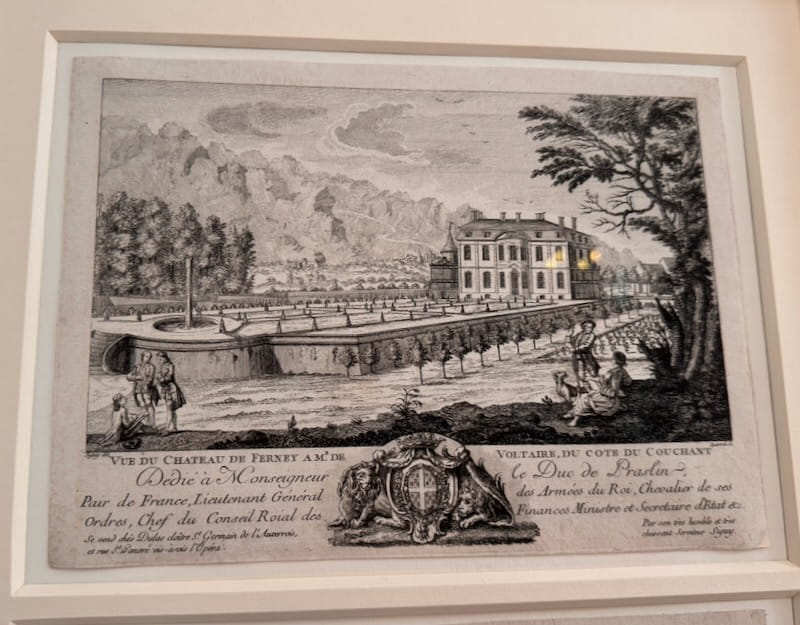 My lopsided photo of an etching on the wall showing the château the way it once was ©OffbeatFrance
The castle grounds
Voltaire seemed to care as much about the outside as the inside of his property.
He built alleyways and a vegetable garden, and particularly enjoyed planting trees and crops with his own hands, a lifelong passion in which he was able to indulge here.
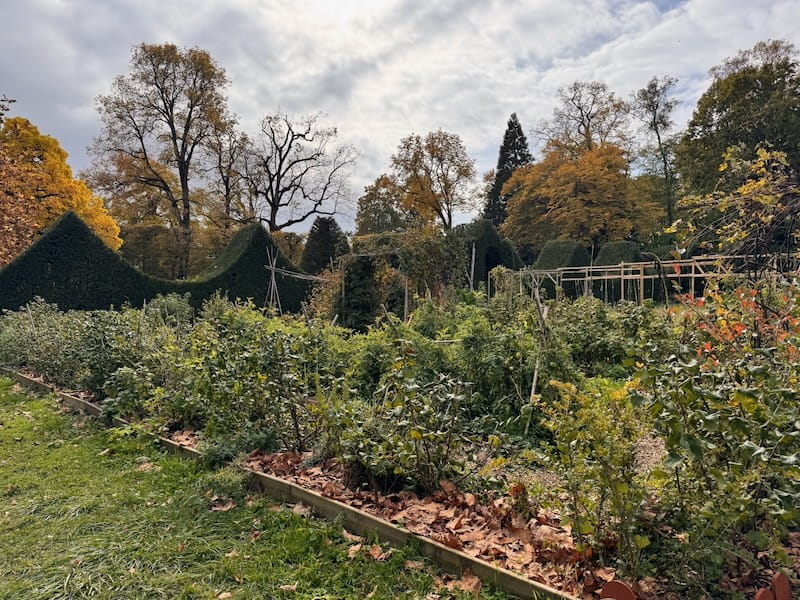 Voltaire's castle garden – it looks a bit messy with leaves on this blustery autumn day but will revert to its pristine order come spring and summer ©OffbeatFrance
His estate was relatively self-sufficient, and you won't miss the huge carp basin on your right as you walk along the circle drive towards the château. A vegetarian later in life, he would become almost completely autonomous, feeding himself and his staff from his garden.
The vegetable plots and fruit trees have survived the centuries, and are now in the hands of a local association.
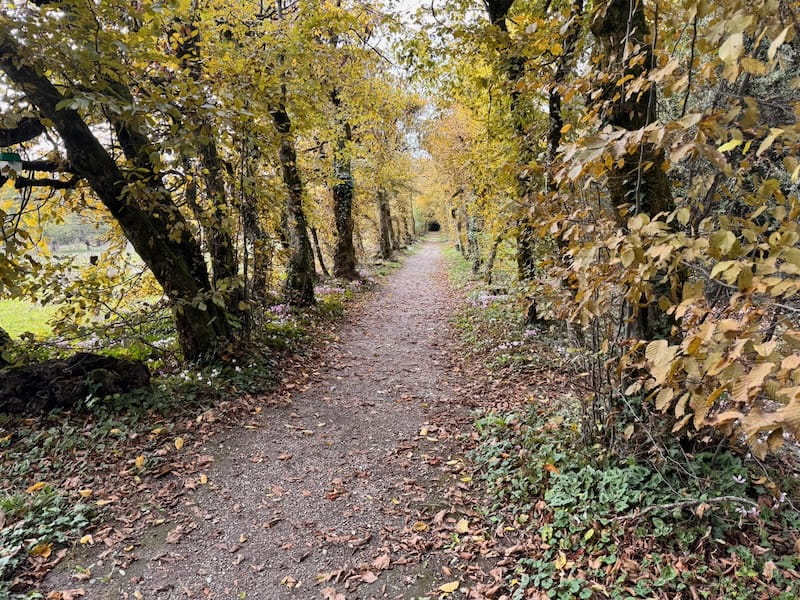 The alley known as La Charmille, one of several which provided pleasant shade from the sun on the property ©OffbeatFrance
The chapel
The chapel deserves a second look because beyond the inscription lauding Voltaire's importance, there's a story behind it.
At the time, Voltaire's land wasn't protected by walls, and people would walk right below his windows to reach the chapel (which also happened to be the parish church).
Not only was his privacy disturbed, but the chapel blocked the view from the château so he decided to pull it down. The dismantling of the chapel was already well underway when he was forced to stop – he couldn't find an appropriate site for the new building, and church authorities accused him of sacrilege for moving the church's crucifix. In the end, Voltaire lost this battle and had to rebuild the chapel. He got his own back, though – this was when the inscription with his name larger than God's appeared...
He had hoped to have his remains buried here because he feared being thrown into a common grave, as had happened to friends of his. The church considered actors and philosophers to be heretics and wouldn't allow them a Christian burial. To be buried here, Voltaire would have had to disavow his "heresies" which, of course, he wouldn't.
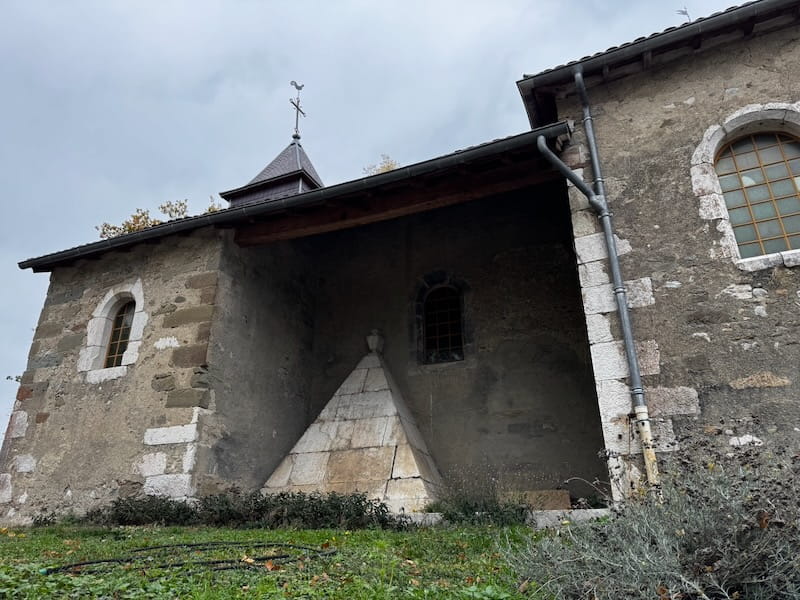 Voltaire's pyramid-shaped tomb, on the side of the château's chapel – he had hoped to be buried here ©OffbeatFrance
His scheme failed. If you've visited the Pantheon in Paris, you'll know that's where his body lies: he happened to be in Paris promoting his latest play when he died of cancer. He never made it back to Ferney, and his tomb there is empty.
A walk through Ferney-Voltaire
As someone who visited the town of Ferney-Voltaire (as it has been called since 1878) many times during my days of working in Geneva, I was surprised at just how much I'd missed. Mostly, I'd gone for lunch, never taking the time to explore the side streets or its history. My loss.
Voltaire did, after all, pluck this obscure backwater village of fewer than 200 souls out of its poverty and drop it smack into the middle of the Enlightenment, transforming it into a thriving commercial hub of 1200 people.
Here are just a few ways he contributed to the village:
- he drained the swamp on which it was built
- he built the town's watchmaking industry, attracting artisans from nearby Geneva and making sure their work found lucrative markets across Europe
- he financed buildings, many of which still stand
- he built a public fountain and paved the streets
At the time, it's estimated that he spent between 60-80% of his income on the building of Ferney.
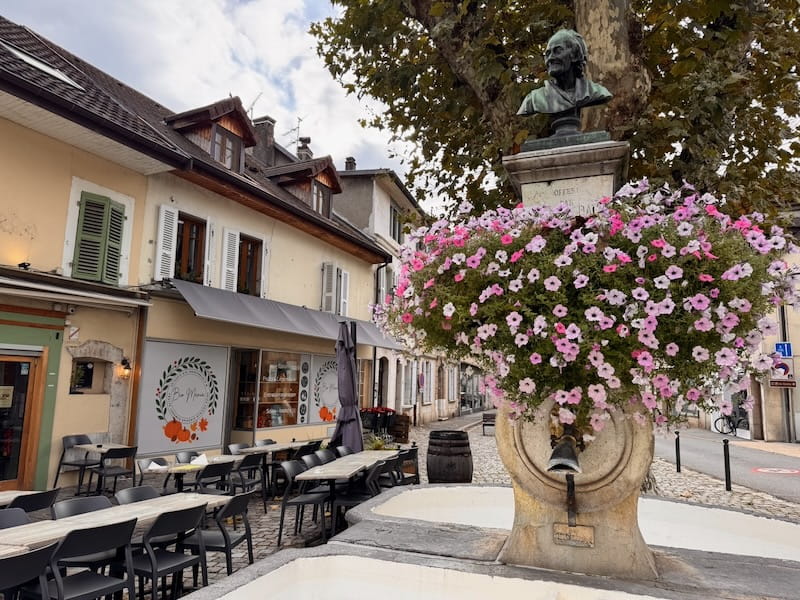
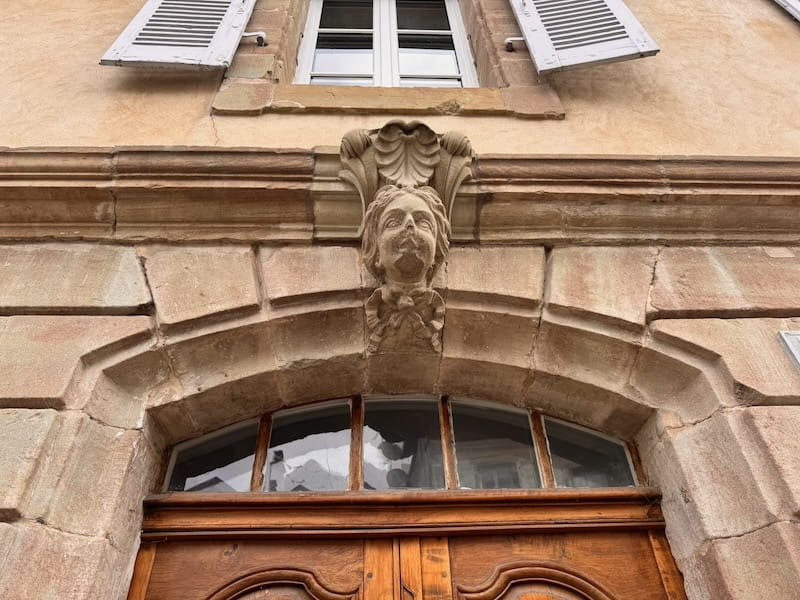
 These photos capture a few scenes of Ferney-Voltaire that bring back memories of Voltaire ©OffbeatFrance
The town, more than the castle, is his legacy.
After his death, his château was quickly emptied, its contents sold by Madame Denis, whose dislike of rurality was well known. People, many of them fans, took away bits and pieces of memorabilia, everything from swatches of curtain material to trinkets.
Later owners further degraded the property, breaking walls and changing the layout. It was only in 1999 that the then owners, the Lambert family, ceded the property to the Center for National Monuments.
PRACTICAL INFORMATION
- Getting there: Ferney-Voltaire is most easily reached by bus 60 from Geneva train station. From Paris, you can take the TGV to Bellegarde-sur-Valserine (now called Valserhône), where you can catch bus X33 to Ferney. From Bellegarde, beware, because the last bus leaves Ferney at 4:30pm. Ferney-centre is the station for lunch or downtown, and Château is the stop nearest the castle.
- How long to stay? You can see all the sights in half a day, but with lunch you'll run over that, especially if you decide to wander around the small older neighborhood, which you should.
- Where to stay: In my Geneva days I always put people up at the Hotel de France in the village center.
- Where I ate: Le Patriarche at the Hotel de France is always excellent, as is (if you've had enough of French food) the Karma, an Indian/Pakistani restaurant right around the corner.
- Best for: travelers interested in French history, the Enlightenment, or anyone looking for an easy cultural day trip from Geneva.
- Visiting Ferney-Voltaire: There's an excellent free app called Imagina which you can download for both iPhone and Android. It provides a full walking tour of Ferney-Voltaire, with plenty of useful explanations. The full circuit takes about two hours.
Before you go...
If you've come to Ferney-Voltaire, there's every chance you've arrived from Geneva or Annecy, both well worth visiting, but if you still have time, catch the boat from Geneva for a scenic ride to Yvoire, a medieval village on the shores of Lake Geneva on the list of most beautiful villages in France.
Even further afield, this five-day alpine itinerary from Geneva will take you into the mountains and surrounding region, all of it glorious in this part of the world.
I spent the day in Ferney-Voltaire with the Pays de Gex tourist office. They showed me the way but all opinions are mine.
Did you enjoy this article? I'd love if you shared it!

🇫🇷

Bonjour! I'm Leyla.
Born in Paris and now based in eastern France between Lyon and Annecy, I've spent years exploring the places and stories that explain why France is the way it is.
Offbeat France is for curious francophiles, whether you're planning a trip or simply fascinated by France. Here you'll discover the history behind the villages, castles, traditions, landscapes and everyday details that most visitors notice but few can explain.
Alongside practical travel advice, I share the context that helps you make sense out of France. The more you understand, the more rewarding every visit becomes.
If you finish an article thinking, "I never knew that... now I want to know more," then I've done my job.
Learn more about me!
Read my Substack historical essays
🇫🇷

🇫🇷
Booking.comWhat's New!


-
Belleau Wood: Where the US Marines Made History
Oct 21, 26 03:12 AM
A peaceful French forest hides the scars of a fierce World War I battle. Walk through Belleau Wood, where US Marines made history, and visit the American cemetery. -
Wellington Tunnels and the Boves: Exploring Underground Arras
Oct 13, 26 11:12 AM
What if an entire army could hide beneath a city? Explore the Wellington Tunnels and medieval Boves of Arras, where centuries of history lie underground. -
Figurines Compiegne Museum: More Than Toy Soldiers
Oct 12, 26 05:10 AM
Visit the Museum of Figurines, Compiegne, where thousands of toy soldiers share the stage with ancient objects comic-book heroes. -
The Strange Story of Compiegne’s Armistice Wagon
Oct 07, 26 04:08 AM
Discover the strange story of the Compiegne Armistice Wagon, where Germany signed an armistice in 1918 and France signed one in 1940. -
Arras, France: Where Things Are Not What They Seem
Sep 30, 26 04:34 AM
Discover things to do in Arras France, from grand Flemish-style squares to a hidden underground city, a curious citadel and a rebuilt historic center.