Fascinated by Gallo-Roman history? Click Here to download > > > Here are 6 ways Rome affected France





Follow me on
- Home ›
- Destinations ›
- Northern France ›
- Calais
An Unexpected Visit To Calais, France
Published on 26 October 2026 by Leyla Alyanak — Parisian by birth, Lyonnaise by adoption, historian by passion
For decades, Calais was somewhere you passed through on your way to somewhere else. But beyond the ferry port and Channel Tunnel lies a city with an extraordinary lace-making heritage, a famous Rodin sculpture, a history of conflict with England and a few unexpected surprises. Today, Calais is becoming a destination in its own right.
Mention visiting Calais and there's an instant elephant in the room.
For years, the city had an image problem. It was somewhere you passed through, not somewhere you planned to spend a holiday.
When the Channel Tunnel opened in 1994, it became even easier to bypass Calais altogether. Trains emerged at nearby Coquelles, and travelers could head straight onto the motorway without ever setting foot in the city.
The city was known as a transit point for travelers or, in 2016, as the Jungle of Calais migrant camp, which drew worldwide media attention.
The Jungle was dismantled in 2016, although migration remains a difficult issue around Calais. Meanwhile, the city has been investing in its attractions and waterfront, hoping to persuade travelers to give it a second look.
Does that mean you should suddenly decide to visit?
Maybe not suddenly. But I recently spent two days here and found far more to enjoy than I expected. Personally, I think Calais deserves a second look.
QUICK FACTS ABOUT CALAIS
- Population: Around 67,000
- Region: Hauts-de-France
- Département: Pas-de-Calais (62)
- Known for: Its ferry port, lace-making heritage, the Burghers of Calais sculptures and the Channel Tunnel
- Traditional industries: Lace manufacturing, textiles and maritime trade
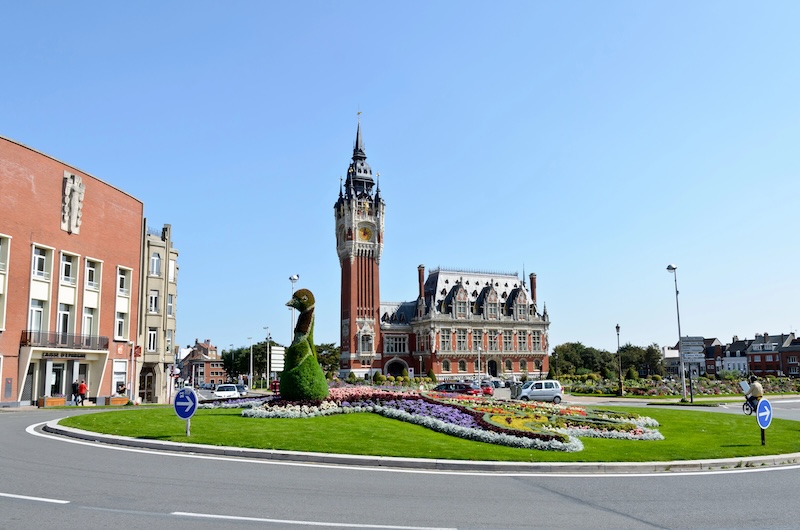
- Major landmark: Calais Town Hall and its UNESCO-listed belfry
- Major attractions: The Dragon of Calais, the Cité de la Dentelle et de la Mode (Lace and Fashion Museum), and the beach and waterfront.
- Historic event: The Siege of Calais (1346–1347), during the Hundred Years' War
- British connection: Calais was under English rule from 1347 to 1558
- Getting there: Trains from Paris, ferries from Dover and Channel Tunnel services via nearby Coquelles
One day in Calais, a sample itinerary
Even if you plan to spend just one day in Calais, you can see a surprising amount without rushing from one attraction to another. The following itinerary will provide you with the highlights.
Just make sure you check opening hours either online or through the tourist office because they can vary and some things close on certain days.
Also, the Dragon and the restaurants require reservations, so make sure you book as soon as possible. Everything else revolves around that.
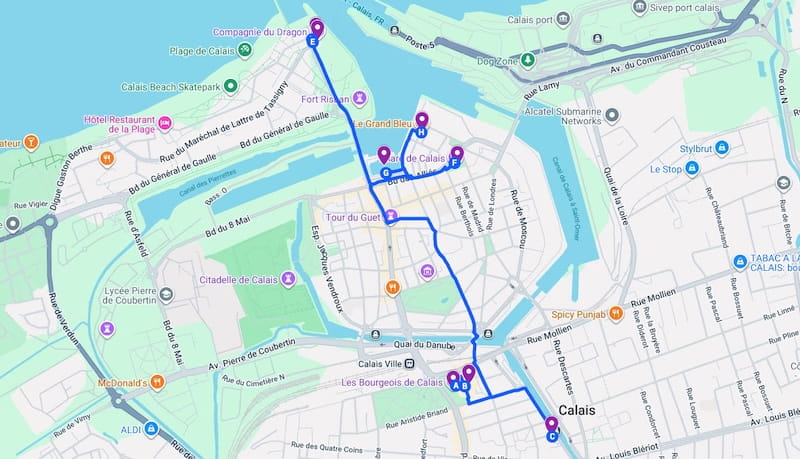
ONE DAY IN CALAIS - MAP KEY
A - The Burghers of Calais
B - Hôtel de Ville (city hall)
C - Museum of Lace and Fashion
D - Flamme Restaurant
E - Calais Dragon
F - Calais lighthouse
G - Bassin du Paradis and Courgains neighborhood
H - Le Grand Bleu Restaurant
GOING ELSEWHERE IN NORTHERN FRANCE?

But first, why do so many people give Calais a miss?
The obvious answer is geography.
Calais sits at the closest point between France and Britain, and while millions of people have passed through the port, most were headed somewhere else. I'm also guilty of this – like many, I've rushed past the edge of Calais, my eyes set on the ferry. The few who did stop were usually day trippers, searching for cheap drinks and foodstuffs to take home.
Calais's reputation as a transit point is even older: during World War I, it was a major Allied transit port with troops, supplies and wounded men passing through the city.
There was another problem: much of Calais does not look the way visitors expect a historic French city to look.
Calais suffered extensive damage during both world wars, particularly the second, and rebuilding was neither quick nor easy. The city initially hoped to reconstruct along more traditional lines, but money was scarce and practical considerations won out. Much of central Calais today is made up of broad streets and functional postwar buildings, with older landmarks standing out among them.
It isn't one of France's prettiest cities, and there's no point pretending otherwise. But judging Calais by its architecture alone means missing much of what makes it interesting.
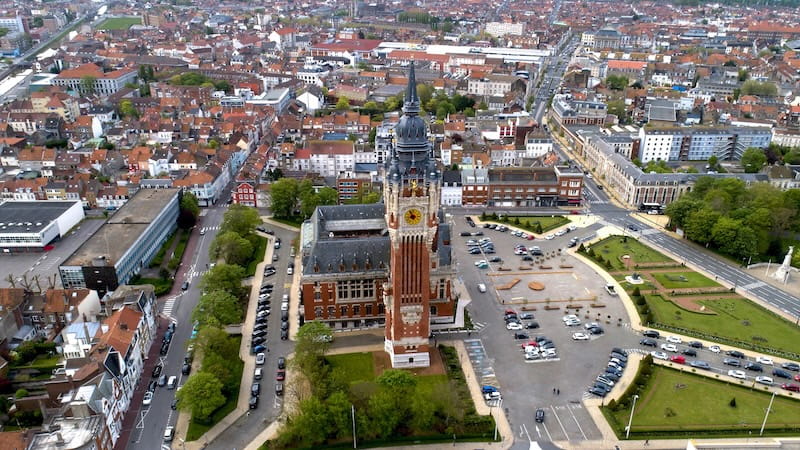 Calais may not be one of France's most beautiful cities, but it's full of unexpected discoveries that make you wonder what else you've missed by simply passing through
And that's where Calais surprised me.
The city has been reclaiming its waterfront and making more of its heritage. By creating attractions, it's helping give people a reason to stay. Some of the changes are striking, while others are easy to overlook. But taken together, they make Calais a much more interesting place to explore than its reputation suggests.
Fighting for control of Calais
For a city that many travelers barely notice, Calais has had a remarkably turbulent history. Its location, just across the Channel from England, made it enormously valuable. Whoever controlled Calais controlled one of the most convenient gateways between Britain and continental Europe.
The English certainly understood this.
In 1346, during the Hundred Years' War, King Edward III laid siege to Calais. The city held out for nearly a year before starvation forced it to surrender. According to the medieval chronicler Jean Froissart, six leading citizens offered themselves to the English king to save the rest of the population. They were spared, and their story would eventually inspire one of the world's most famous sculptures.
But the English didn't simply raid Calais and leave. They stayed for 211 years.
Calais was important to England, a heavily defended possession through which soldiers and merchants could pass, not to mention goods. Long after England had lost its other territories in France, Calais remained English.
THE ENGLISH OF CALAIS
After the surrender, Edward III expelled most of the French population and invited English settlers to take their place.
For more than two centuries Calais was an English town on French soil. In 1363 the crown made it the official center for England’s wool exports to the Continent, which brought in merchants and money. The surrounding territory, known as the Pale of Calais, was governed as a small English possession, and from 1536 it sent members to the English Parliament.
Henry VIII passed through in 1520 on his way to the Field of Cloth of Gold, the famous meeting with François I held nearby.
Then, in January 1558, the French struck back. Troops commanded by the Duke of Guise captured Calais in a matter of days, dealing a humiliating blow to England's Queen Mary I. She was reportedly so devastated that she declared Calais would be found engraved on her heart after her death.
Even that wasn't the end of the city's troubles. In 1596, Spanish forces captured Calais, holding it for two years before it was returned to France.
The centuries that followed were hardly uneventful. Calais grew into a busy passenger port and, in the 19th century, a major lace-making center. The two world wars brought more upheaval. In 1940, German troops captured the city after fierce fighting, and much of Calais was subsequently destroyed by bombing and combat. By the time it was liberated in 1944, large parts of the old city had disappeared.
It's worth remembering all this when you walk through Calais today. The modern buildings may not inspire much admiration, but they're also evidence of the city's spirit of survival. Here and there, you'll find reminders of the Calais that existed long before the ferries and the Channel Tunnel.
But Calais isn't just about its past. Much of what makes the city worth visiting today is relatively new, and nowhere is that more apparent than along its waterfront.
The beach
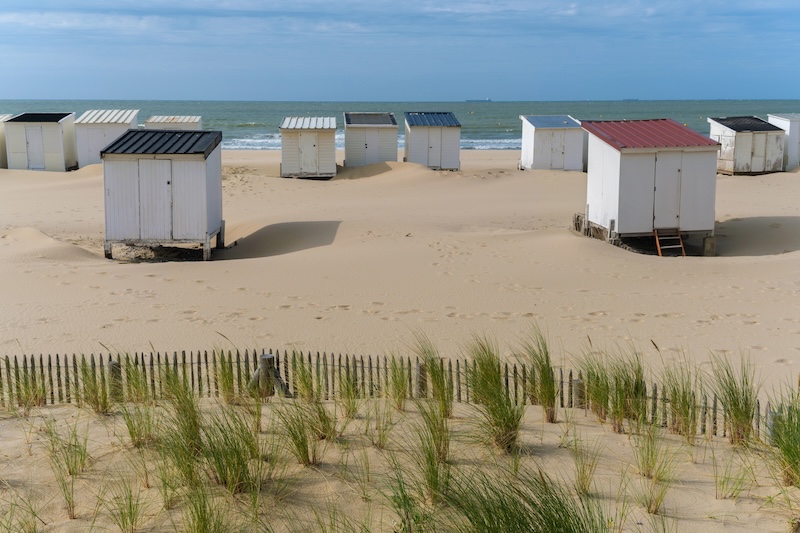
The beach is not only stunning, but it's extremely popular, having been voted France's favorite beach in a 2026 competition organized by Surfride Foundation. It stretches more than a kilometer, a length of sand with great views across the Channel and plenty of space for everyone to spread out.
It's also quite dog-friendly, the only restrictions being in July and August, when dogs are only allowed on the sand before 9am or after 7pm. The rest of the year, they're welcome all day.
Nearby, Fort Risban is the city's most important surviving fortification, now renovated and worth a visit.
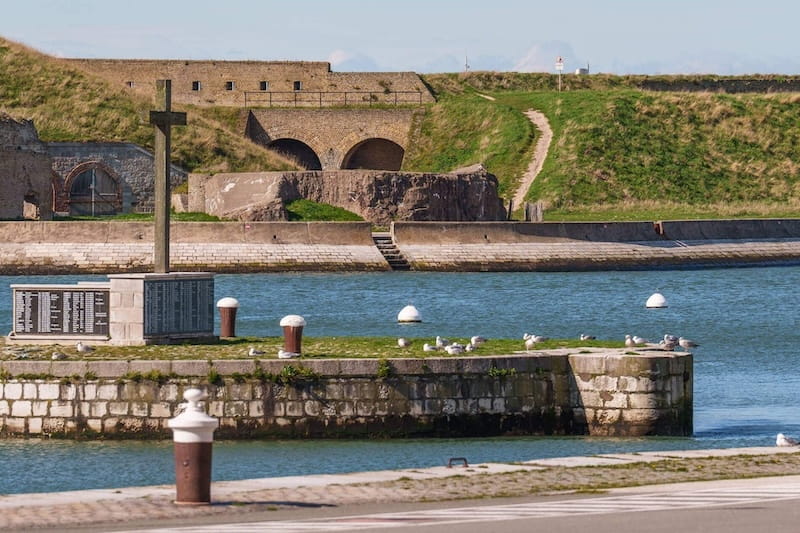 Fort Risban ©NOHCAB
There's also the lighthouse, for that high-up view of Calais if you can brave the 271 steps. But mostly, you'll come to the beach for...
The Calais Dragon
Have you heard of it?
I hadn't but the moment I did, I instantly wanted to meet this mythical creature, which is helping reconnect the city to its waterfront.
Le Dragon de Calais is a giant mechanical walking dragon, built by the same team who built the giant elephant in Nantes. The best part is that visitors can ride it along the seafront.
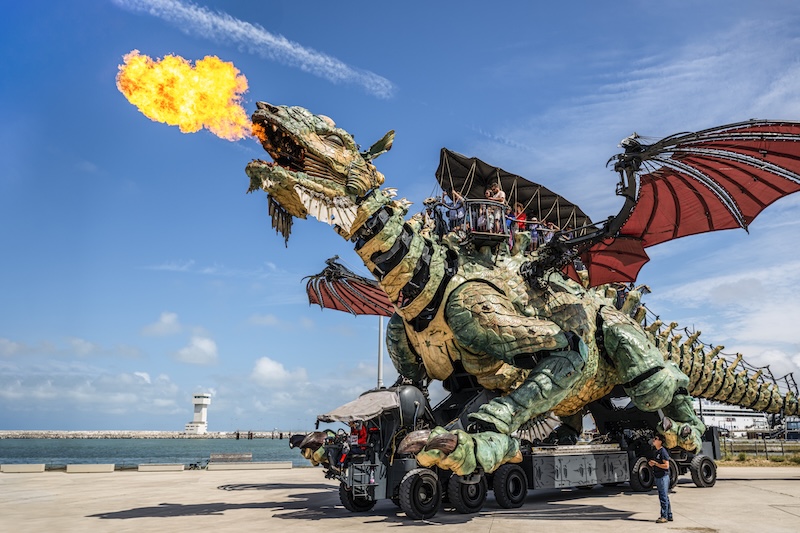 The Dragon of Calais in all its spectacular spread ©Hauts-de-France tourisme Stéphane Bouilland
The dragon arrived in Calais in 2019, in a spectacular three-day event that drew international media. The machine itself is 25 meters (82 ft) long and 10 meters (33 ft) high, which explains some of the extraordinary logistics involved in getting it through the city.
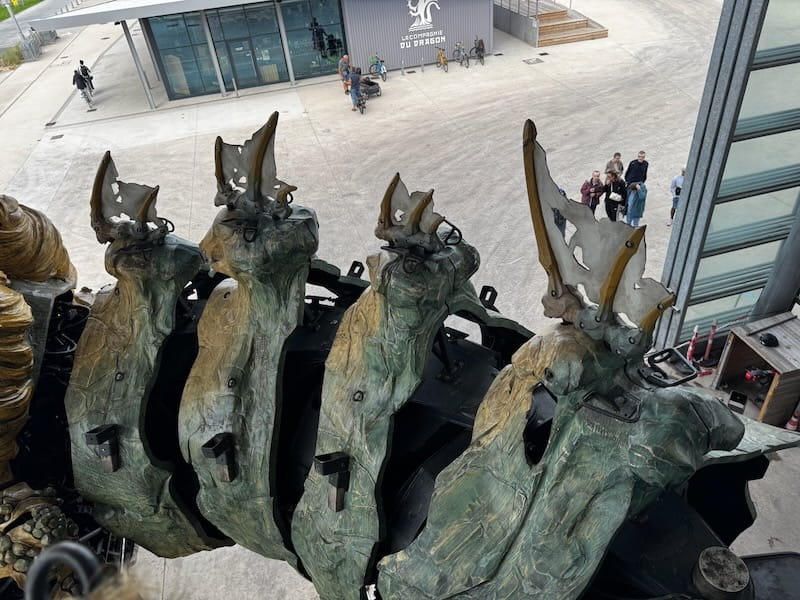 View of the tail from the top of the (very) high dragon ©OffbeatFrance
Sadly, I was unable to ride the dragon into town because it was undergoing maintenance the day I visited, but its engineers kindly let me walk up its tail into the cabin, just to get a feel for it. My inner child has decided I need to return when it's active.
The Courgain Maritime area
Not far away, the Courgain Maritime area is small, but worth exploring precisely because it feels different from the modern downtown area.
The traditional houses with their steep red-tiled roofs were rebuilt after the war to echo the old fishermen's quarter. The city had hoped to rebuild the entire neighborhood in this way but ran out of funds.
Still, this historic patch of Calais provides a glimpse of Old Calais and my favorite Calais restaurant, Le Grand Bleu, just happens to be in this neighborhood.
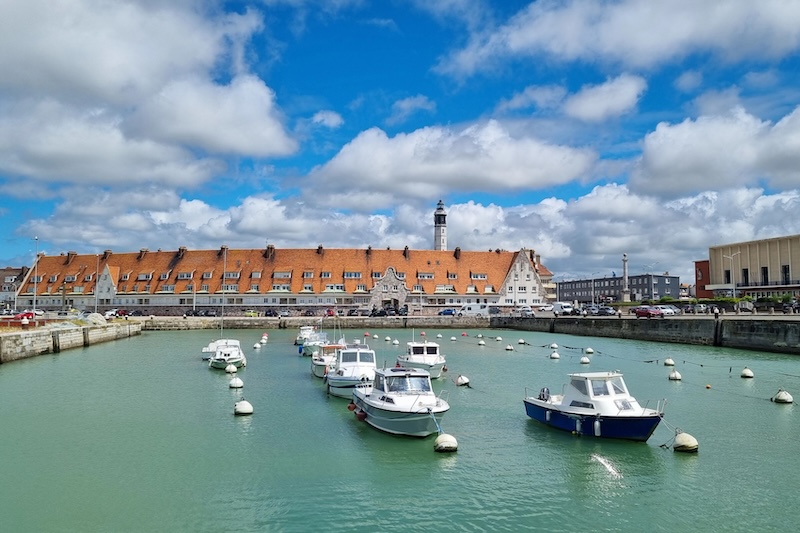 This is what the traditional houses in this neighborhood looked like before they were destroyed by war – and rebuilt
In front of the houses is the Bassin du Paradis, a small tidal harbor and the oldest surviving part of the medieval port. It still has a working fishing identity, and will give you a sense of what the port was like before the modern ferry terminals came along.
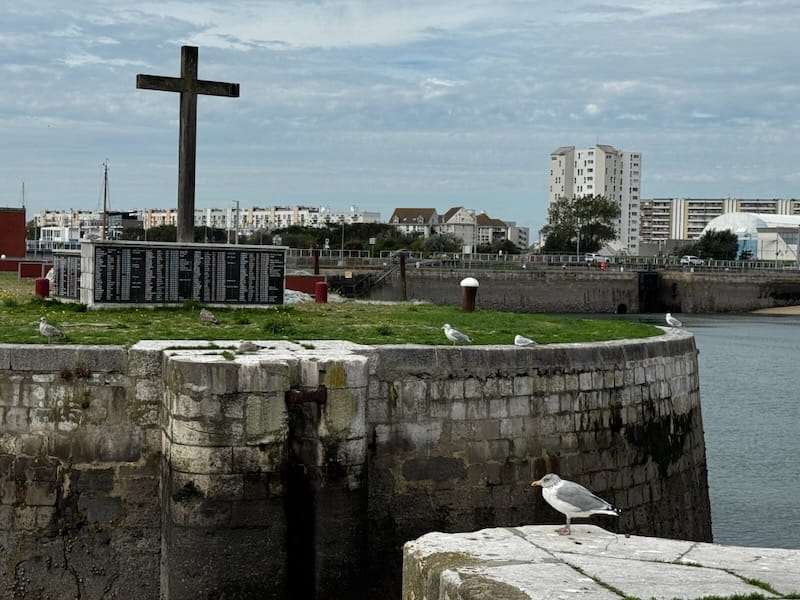 The Bassin du Paradis on the Calais waterfront ©OffbeatFrance
The Hôtel de Ville and the belfry
Heading away from the water, Calais's Hôtel de Ville (city hall) is one of the places where the city's different histories meet up.
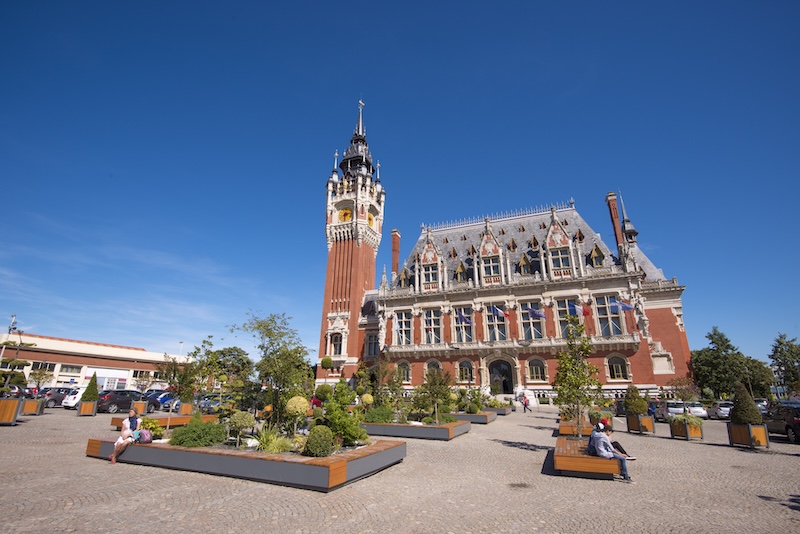 Calais City Hall - main building and belfry ©Hauts-de-France tourisme - Frédérik Astier
This is the building in which Charles de Gaulle married Yvonne Vendroux, a native of Calais...
Its grand staircase and stained-glass windows are worth seeing, and the building survived the destruction that devastated so much of Calais during World War II.
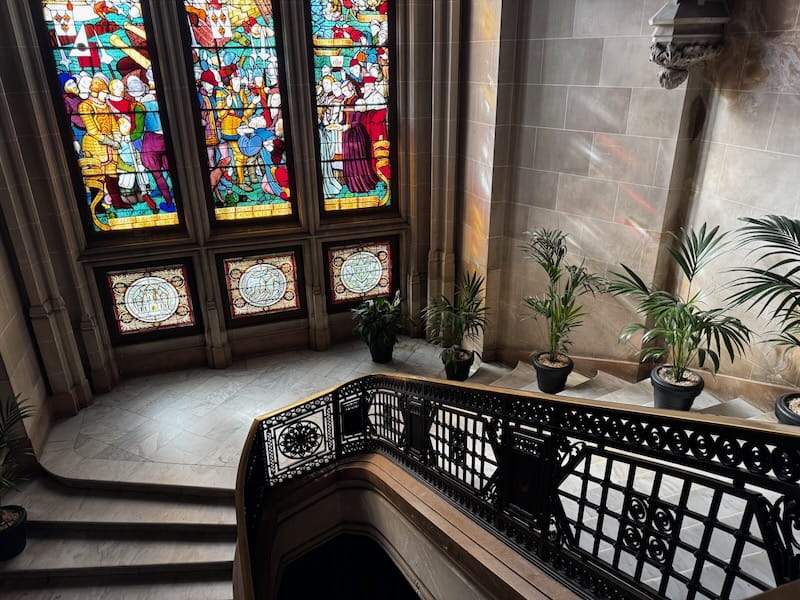 The majestic stairway of the City Hall of Calais, France ©OffbeatFrance
Next to the building is the belfry, the beffroi, also part of the historic center's skyline. The belfry has UNESCO World Heritage status, and was added in 2005 to the Belfries of Belgium and France listing, one of 23 sites in northern France.
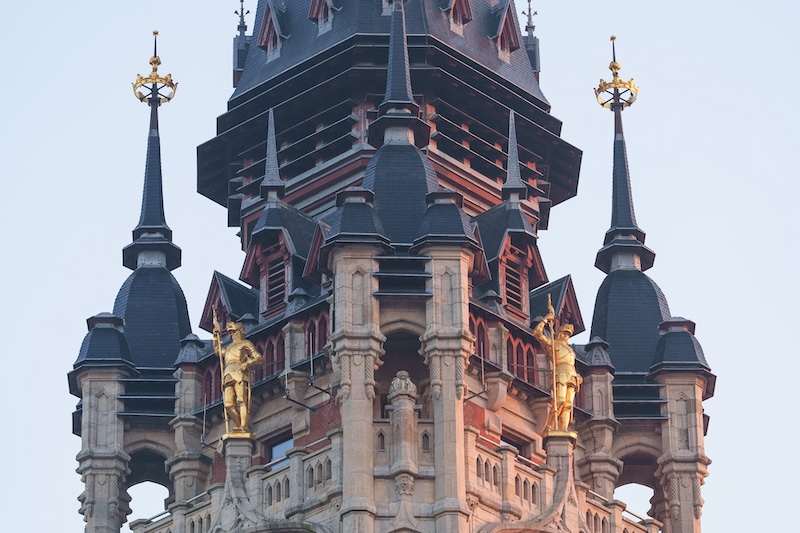 A closeup of the spectacular belfry attached to the City Hall ©NOHCAB
The belfry rises 75 meters (246 ft) above the city, and the view from the top helps explain Calais in a way that walking through the streets sometimes does not. You can see the port, the waterfront and the separation between the older parts of the city and the areas rebuilt after the war. The weather didn't play along when I visited but even under the clouds, you can see why it's worth going up (yes, there's an elevator).
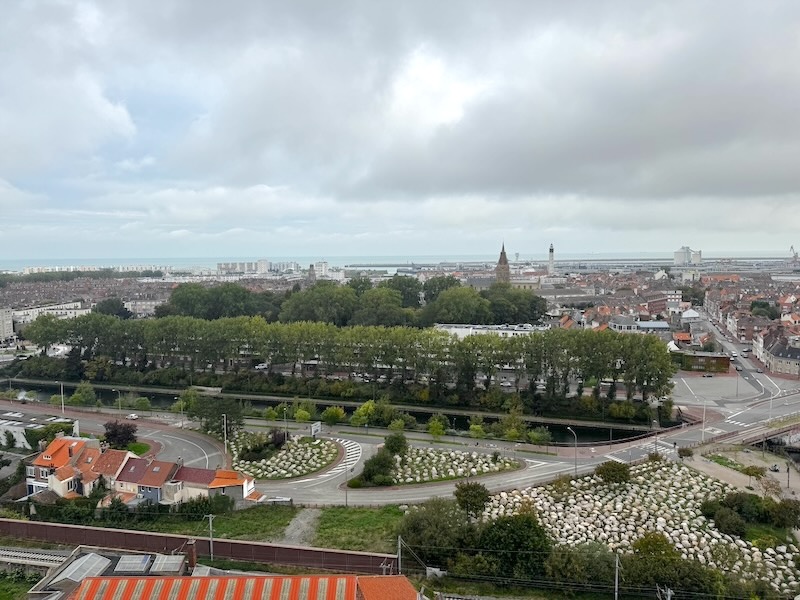 Vertigo or no vertigo, I can't resist climbing a belfry ©OffbeatFrance
The Rodin connection
In front of the Hôtel de Ville stands Auguste Rodin's Burghers of Calais. Rather than portraying triumphant heroes, Rodin showed six very human figures facing what they believed would be their execution. Walk around the sculpture and look at their expressions: each man seems to be confronting his fate differently. It's a remarkable monument, and one of the city's great attractions.
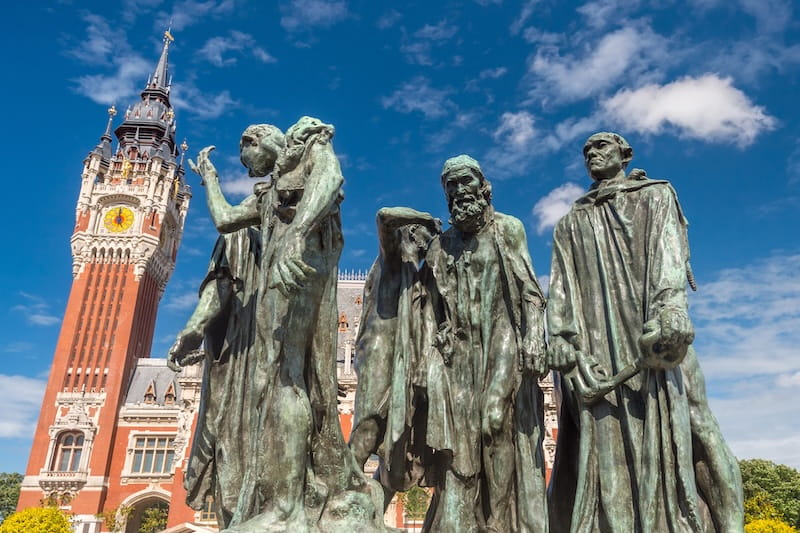
Speaking of Rodin, the city has another connection to him: the Musée des Beaux-Arts opened a dedicated Rodin gallery in 2025, and has a number of exhibits that shed more light on the Burghers of Calais and how they were designed.
A lace-making powerhouse
At the turn of the 20th century, lace was one of Calais's major industries, at its height employing some 40,000 workers. Production had skyrocketed after English lace manufacturers imported their mechanical processes in the early 19th century.
The city's spectacular Cité internationale de la dentelle et de la mode, the Lace and Fashion Museum, not only tells that story but explains the process of machine-made lace.
The museum occupies a former lace factory, and even the building is a reminder of its history. Make sure you look for the lace patterns outside the building, on the walls and on the ground. You'll also see that workshop stairs were on the outside of the building rather than inside, so workers could reach their workshops without passing through those of competitors, a sort of architectural solution to industrial espionage.
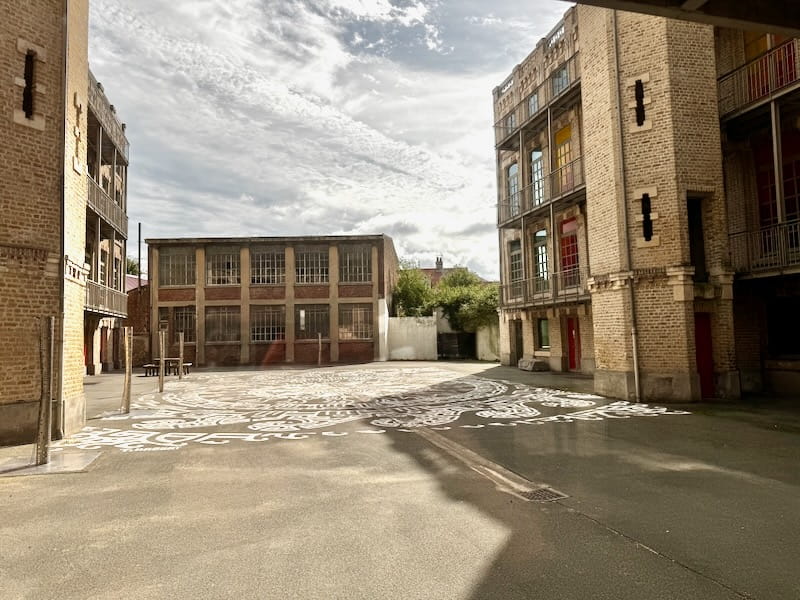 Outside the back of the lace museum – notice the lace pattern on the ground ©OffbeatFrance
Inside, the museum takes you from handmade lace to the enormous Leavers-type machines that transformed production. A Jacquard card effectively functioned as the machine's pattern instructions. One machine could produce roughly two meters of lace (6.5 feet) an hour across a four-meter width, replacing an enormous amount of manual labor.
The Jacquard system involved perforated cards that told the thousands of threads where to move and when. Those of you born in the mid-20th century may remember the old perforated computer cards – same type of system.
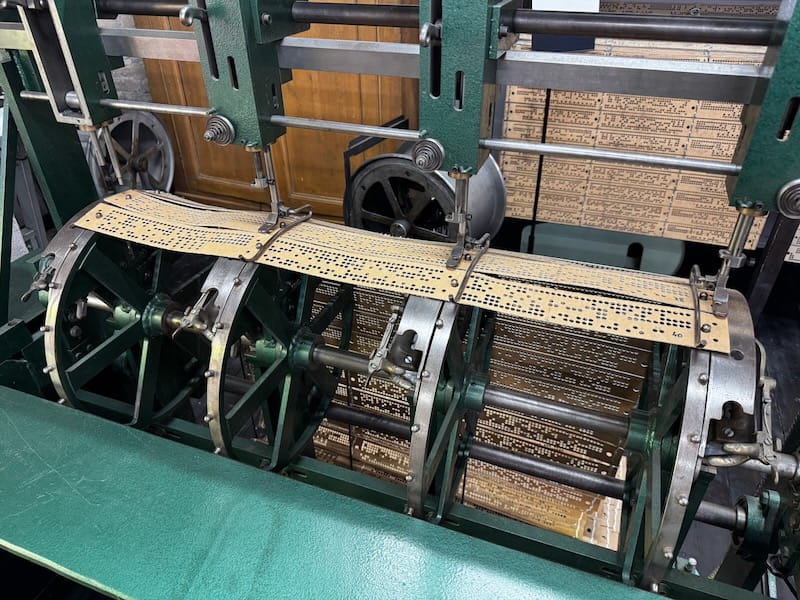 One of the many working lace-making machines at the Lace museum ©OffbeatFrance
That said, machines didn't take everything over – if a thread breaks during production, the machine has to stop, and workers check the finished lace and repair defects by hand.
The story of lace may have wound down for a time but it is experiencing a bit of a comeback thanks to contemporary fashion and textile design. Take lingerie – where would it be without lace?
And Calais has more
There's still more to see in Calais but time was working against me. If that's not the case for you, I'd try to add these to your itinerary.
Musée Mémoire 1939-1945
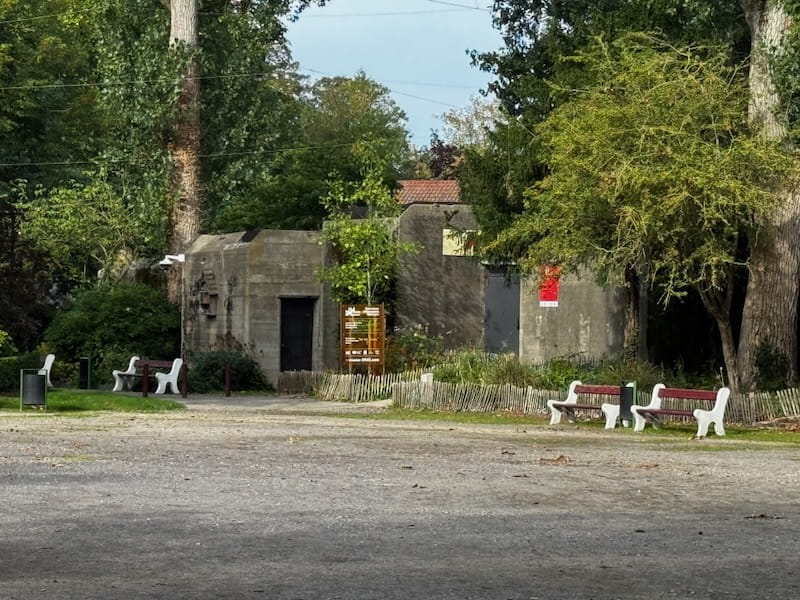 The bunker which has been turned into the Musée Mémoire 1939-1945 in Parc Saint-Pierre ©OffbeatFrance
For WWII visitors, one of the most interesting places is the Musée Mémoire 1939-1945 in Parc Saint-Pierre. It occupies a German bunker built in 1941 as a command post for the German navy, and survived the bombing that destroyed so much of Calais.
Notre-Dame Church
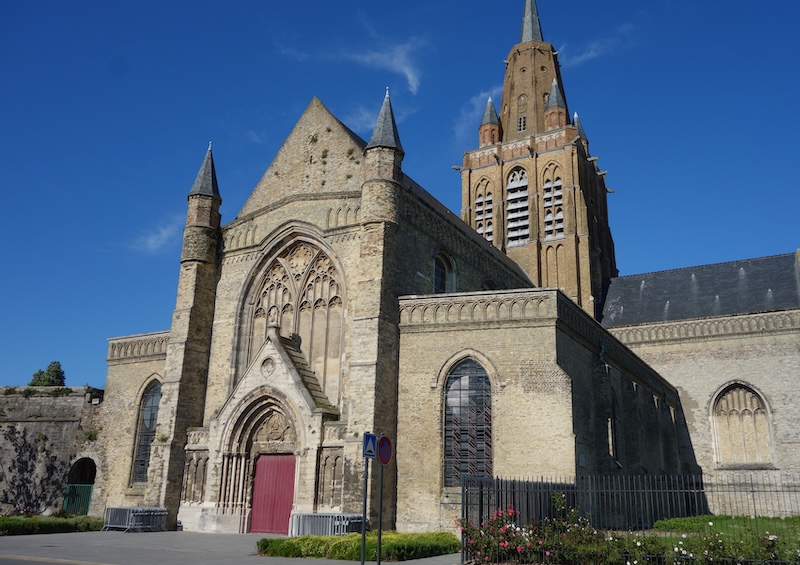 Calais's Church of Notre-Dame, with its Tudor influence
Notre-Dame is Calais's oldest church, and it reflects the city's 211-year English rule. The central tower and the English Gothic influence on the building are mixed with Flemish brickwork. The Tudor garden next door was inspired by the gardens of Hampton Court. These days it's mostly closed for visits but check with the Calais Tourist Office.
It's also where General de Gaulle held his religious wedding, the day after the civil ceremony at City Hall.
Street art in Calais
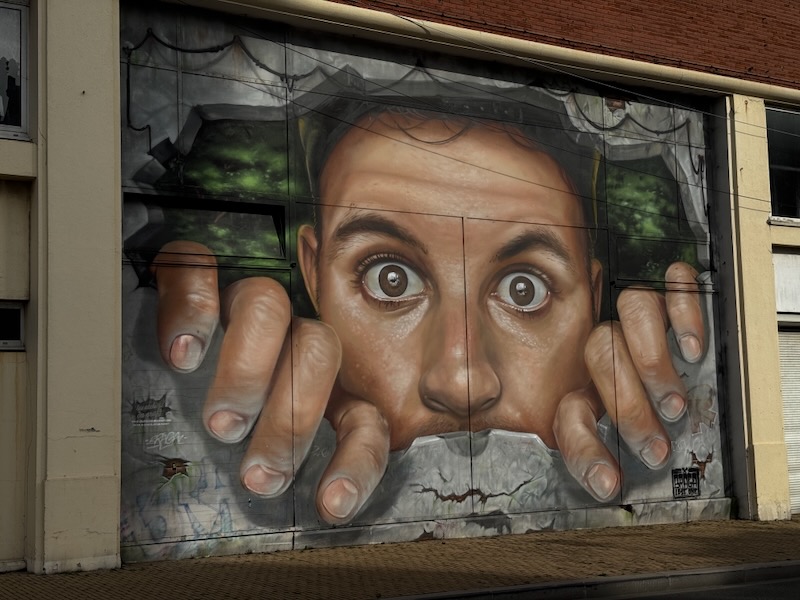 One of at least 115 examples of street art in Calais
Calais has embraced street art, and you'll find it in unexpected corners of the city. Some of the works are enormous, others easy to miss. Unlike the famous murals in Lyon, which often create the illusion of entire streets and buildings, Calais's walls are a colorful mix of portraits, graffiti and contemporary art. Keep your eyes open as you walk around – it's everywhere.
France rebuilt
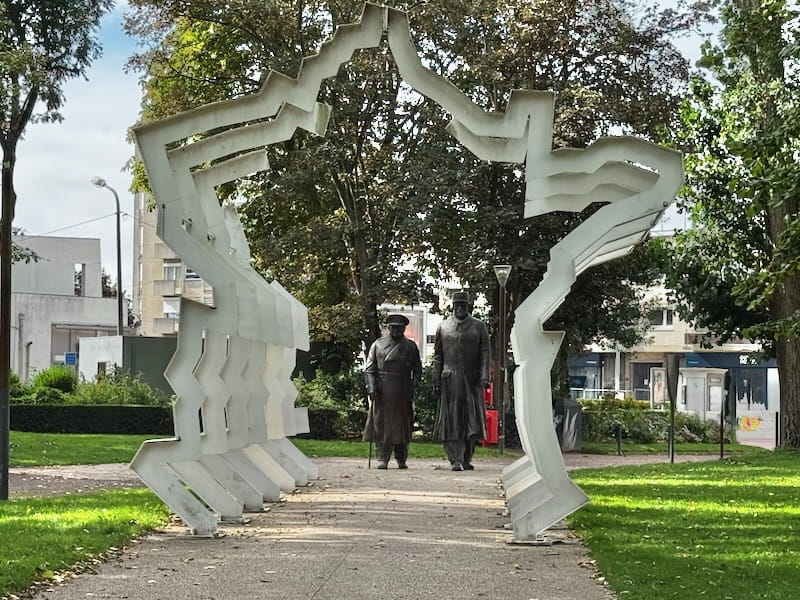 A vision of France reversed as Churchill and de Gaulle walk towards it ©OffbeatFrance
In Parc Richelieu, Churchill and de Gaulle are seen walking toward seven outlines of France, representing the country's gradual reconstruction after World War II. Curiously, the map appears reversed unless you stand behind the two leaders and look in their direction – though I haven't been able to confirm why.
Calais's Grand Théâtre
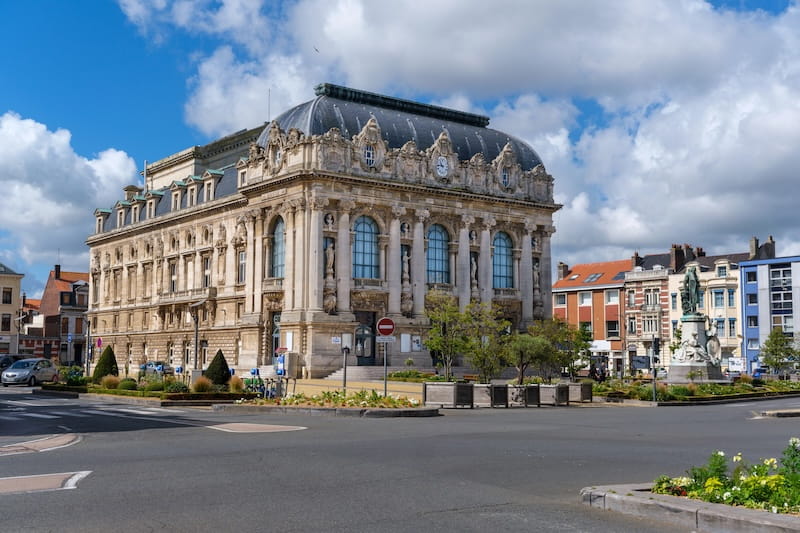
Calais's Grand Théâtre, inaugurated in 1905, is worth a quick stop for its ornate Belle Époque façade, decorated with statues representing Poetry, Comedy, Dance and Music. The interior is apparently equally impressive, but you can only visit during performances or special events.
PRACTICAL INFORMATION
- Getting there: Calais is easily reached from Britain by ferry or through the Channel Tunnel. From Paris, trains run directly to Calais. Try to catch a train to Calais Ville – Calais Fréthun is the TGV station a bit out of town, with a few (insufficient) trains between the two.
- How long to stay? If you're coming by ferry, a full day and night would be perfect, and you should get to see most of the city.
- Where to stay: Calais does not have an abundance of hotels but that is bound to change. For now, a cozy local hotel is the Meurice; the Metropol is next to the train station; the Ibis Centre is right downtown. You can also compare hotels and guesthouses in Calais.
- How to get around: Calais buses are free, as is most parking, so if you come by car you can just leave it and enjoy the free buses and electric canal ferries.
- Where I ate: I had what might be the best fish meal of my life at Le Grand Bleu (you'll have to reserve). If you're going to see the Dragon, have lunch at Flamme right next door for some local specialties – and just in time for the afternoon dragon ride. Typical of Calais are "friteries", small shops dedicated to French fries!
- Best for: travelers interested in history, lace and fashion, curious travelers willing to look beyond first impressions and discover a city that is changing.
FAQ
Is Calais, France worth visiting?
Is Calais, France worth visiting?
Yes! Calais has a spectacular mechanical Dragon, a sandy beach, fascinating history and an impressive lace museum. It's well worth a day or two.
Is Calais, France safe to visit?
Is Calais, France safe to visit?
Calais is generally safe for tourists, especially around its main attractions and waterfront. As in any city, take normal precautions.
Can you see Dover from Calais?
Can you see Dover from Calais?
On a clear day, you can see the English coastline, including the White Cliffs of Dover, across the Channel.
What food is Calais known for?
What food is Calais known for?
Calais is known for its seafood, particularly fresh fish and mussels. You'll also find northern French specialties such as welsh, a rich cheese dish, and traditional friteries.
Before you go...
You can see the highlights of Calais in a day, but I'd recommend two. That gives you time to explore the smaller museums, wander through the old fishing quarter or simply enjoy the beach without rushing off to your next destination.
I spent two days here, having arrived quite the skeptic, unsure I'd find much to enjoy, let alone write about. I was wrong. I found a city that may not always make the best first impression, but has a way of changing your mind if you're willing to look beyond it.
And if Calais has made you curious about northern France, Amiens is another city that deserves more attention than it gets, with its magnificent Gothic cathedral and canalside neighborhoods.
So if you're crossing the Channel, consider staying a night or two. Calais might just surprise you as much as it surprised me.
Parts of my visit were hosted by Pas-de-Calais Tourism, but the observations and opinions here are entirely my own.
Did you enjoy this article? I'd love if you shared it!

🇫🇷

Bonjour! I'm Leyla.
Born in Paris and now based in eastern France between Lyon and Annecy, I've spent years exploring the places and stories that explain why France is the way it is.
Offbeat France is for curious francophiles, whether you're planning a trip or simply fascinated by France. Here you'll discover the history behind the villages, castles, traditions, landscapes and everyday details that most visitors notice but few can explain.
Alongside practical travel advice, I share the context that helps you make sense out of France. The more you understand, the more rewarding every visit becomes.
If you finish an article thinking, "I never knew that... now I want to know more," then I've done my job.
Learn more about me!
Read my Substack historical essays
🇫🇷

🇫🇷
Booking.comWhat's New!


-
Belleau Wood: Where the US Marines Made History
Oct 21, 26 03:12 AM
A peaceful French forest hides the scars of a fierce World War I battle. Walk through Belleau Wood, where US Marines made history, and visit the American cemetery. -
Wellington Tunnels and the Boves: Exploring Underground Arras
Oct 13, 26 11:12 AM
What if an entire army could hide beneath a city? Explore the Wellington Tunnels and medieval Boves of Arras, where centuries of history lie underground. -
Figurines Compiegne Museum: More Than Toy Soldiers
Oct 12, 26 05:10 AM
Visit the Museum of Figurines, Compiegne, where thousands of toy soldiers share the stage with ancient objects comic-book heroes. -
The Strange Story of Compiegne’s Armistice Wagon
Oct 07, 26 04:08 AM
Discover the strange story of the Compiegne Armistice Wagon, where Germany signed an armistice in 1918 and France signed one in 1940. -
Arras, France: Where Things Are Not What They Seem
Sep 30, 26 04:34 AM
Discover things to do in Arras France, from grand Flemish-style squares to a hidden underground city, a curious citadel and a rebuilt historic center.